Accuracy Formula - How to Find Accuracy Formula
 Nikita Aggarwal15 Apr, 2026
What is Accuracy Formula?
It is a mathematical representation used to determine the correctness of a measurement. Accuracy indicates the degree of conformity of a measured value to its standard or true value.
In most places, we express accuracy as a percentage. This makes it easier to compare different sets of data. A high percentage means your experimental results are very close to the target, while a low percentage suggests significant errors in your measurement process or equipment.
Basic Components of Accuracy Formula
To find accuracy formula, you need two primary pieces of data:
-
Accepted Value (Actual Value): This is the "real" number, which you can usually find in textbooks or get from your teacher.
-
Experimental Value (Measured Value): This is what you got when you did the math or the experiment.
How to Find Accuracy Formula and Calculations?
Calculating accuracy usually involves two steps. First, you find the error, and then you convert that error into a percentage to see the overall accuracy level.
1. Finding the Absolute Error
Before you can use the main formula, you must find the absolute error. This is the The numerical difference between the true value and your measured value is calculated.
Formula: Absolute Error = |True Value - Measured Value|
(Note: We use absolute bars because error is always a positive magnitude.)
2. The Percentage Accuracy Formula
To find the percentage, you first calculate the "Relative Error" and then subtract it from 100%, or use the direct calculation method below:
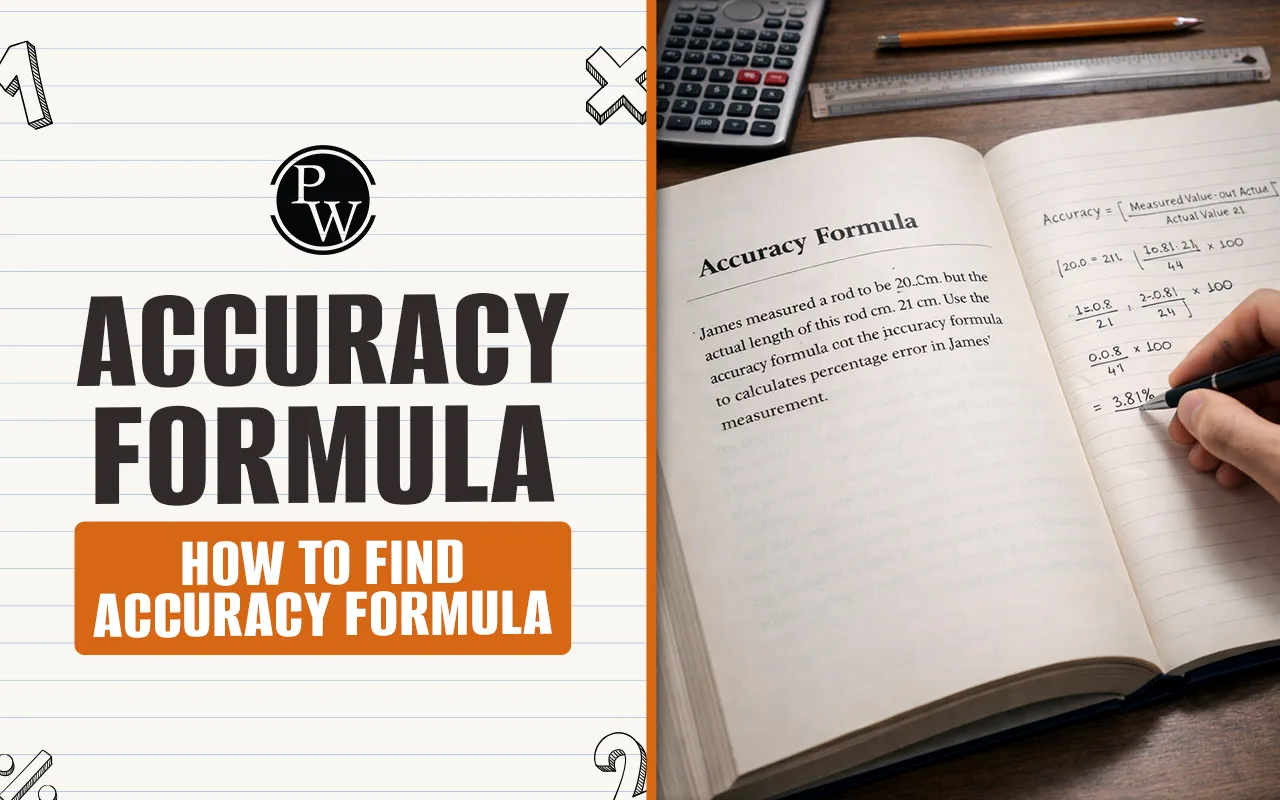
Accuracy Percentage = [ 1 - (|True Value - Measured Value| / True Value) ] x 100
Alternatively, a common way to look at this in accuracy formula examples is to find the percentage error first:
Percentage Error = (|Actual Value - Experimental Value| / Actual Value) x 100
Once you have the Percentage Error, your Accuracy is simply 100% - Percentage Error.
Step-by-Step Guide: How to Calculate Accuracy
-
Find the Standard: Find out what the accepted value is for your experiment.
-
Write down your result: Be careful when you take your measurement.
-
Subtract: Find out how much smaller one number is than the other.
-
Split: Split that difference by the standard value.
-
To find the error percentage, multiply by 100.
-
Last step: To find your accuracy, take 100 and subtract the error from it.
Read More - Perimeter of a Circle – Definition, Formula, πd & 2πr with Examples
Accuracy Formula Examples
Let us see the examples below to understand the concept better.
1. Measuring the Length of a Table
Imagine a carpenter knows a table is exactly 150 cm long. A student measures it and records a length of 147 cm.
-
True Value: 150 cm
-
Observed Value: 147 cm
-
Calculation: 1. Find the error: 150 - 147 = 3 cm. 2. Divide by true value: 3 / 150 = 0.02. 3. Convert to percentage: 0.02 x 100 = 2% (This is the error). 4. Accuracy: 100% - 2% = 98%.
2. Calculating Gravity in Physics
In a school experiment, the acceleration due to gravity is accepted as 9.8 m/s². A group of students calculates it to be 9.5 m/s² using a pendulum.
-
True Value: 9.8
-
Observed Value: 9.5
-
Calculation:
-
Error: 9.8 - 9.5 = 0.3.
-
Percentage Error: (0.3 / 9.8) x 100 = 3.06%.
-
Accuracy: 100% - 3.06% = 96.94%.
3. Estimating the Number of Jellybeans
A jar contains exactly 500 jellybeans. You estimate there are 480 beans inside.
-
True Value: 500
-
Observed Value: 480
-
Calculation:
-
Error: 500 - 480 = 20.
-
Divide by True Value: 20 / 500 = 0.04.
-
Accuracy: (1 - 0.04) x 100 = 96%.
4. Chemistry Mass Measurement
A chemical reaction is supposed to produce 25 grams of a precipitate. After the experiment, the dried powder weighs 24.2 grams.
-
True Value: 25g
-
Observed Value: 24.2g
-
Calculation:
-
Error: 25 - 24.2 = 0.8.
-
Percentage Error: (0.8 / 25) x 100 = 3.2%.
-
Accuracy: 100% - 3.2% = 96.8%.
Read More - Segment of a Circle, Types, Formula, Properties, Examples
5. Geometry Area Calculation
A circle has a theoretical area of 78.5 square units. Based on a rounded measurement of the radius, a student calculates the area as 77.9 square units.
-
True Value: 78.5
-
Observed Value: 77.9
-
Calculation:
-
Error: 78.5 - 77.9 = 0.6.
-
Percentage Error: (0.6 / 78.5) x 100 = 0.76%.
-
Accuracy: 100% - 0.76% = 99.24%.
Factors That Affect Accuracy Formula
If your results show a low percentage, several factors might be at play:
-
Instrument Calibration: Your tools might not be set to zero properly.
-
Environmental Factors: Temperature or humidity can change the physical properties of what you are measuring.
-
Human Error: Mistakes in reading a scale or recording data.
-
Methodology: The process used to take the measurement might be flawed.
By identifying these issues, you can improve your results and achieve a higher percentage when you next apply the formula.
Summary Table of Accuracy Formula
Using these steps, you can confidently answer any question regarding how to find the formula and apply it to your school projects or competitive exams.
|
Term |
Definition |
Formula |
|
Absolute Error |
The raw difference between values |
|
|
Relative Error |
Error relative to the size of the true value |
Absolute Error / True Value |
|
Percentage Error |
Error expressed as a percentage |
Relative Error x 100 |
|
Accuracy |
The degree of correctness |
100% - Percentage Error |
Make Maths Simple and Enjoyable with CuriousJr
CuriousJr helps children build a strong maths foundation by removing fear and boosting confidence. Our Mental Maths online classes for students from Classes 1 to 8 are designed to improve speed, accuracy, and logical thinking through easy techniques and interactive learning methods.
With our dual-mentor approach, students join engaging live classes and receive dedicated support for doubt-solving after every session. Animated lessons, fun activities, and exciting challenges make maths learning fun and easy to understand.
Parents also get regular progress reports along with review sessions, ensuring complete transparency in their child’s learning journey.
Book a demo class today and discover how CuriousJr makes maths simple, engaging, and confidence-building for your child.