How to Make My Child a Faster Learner in School Using Mental Maths?
 Jasdeep Singh25 Apr, 2025
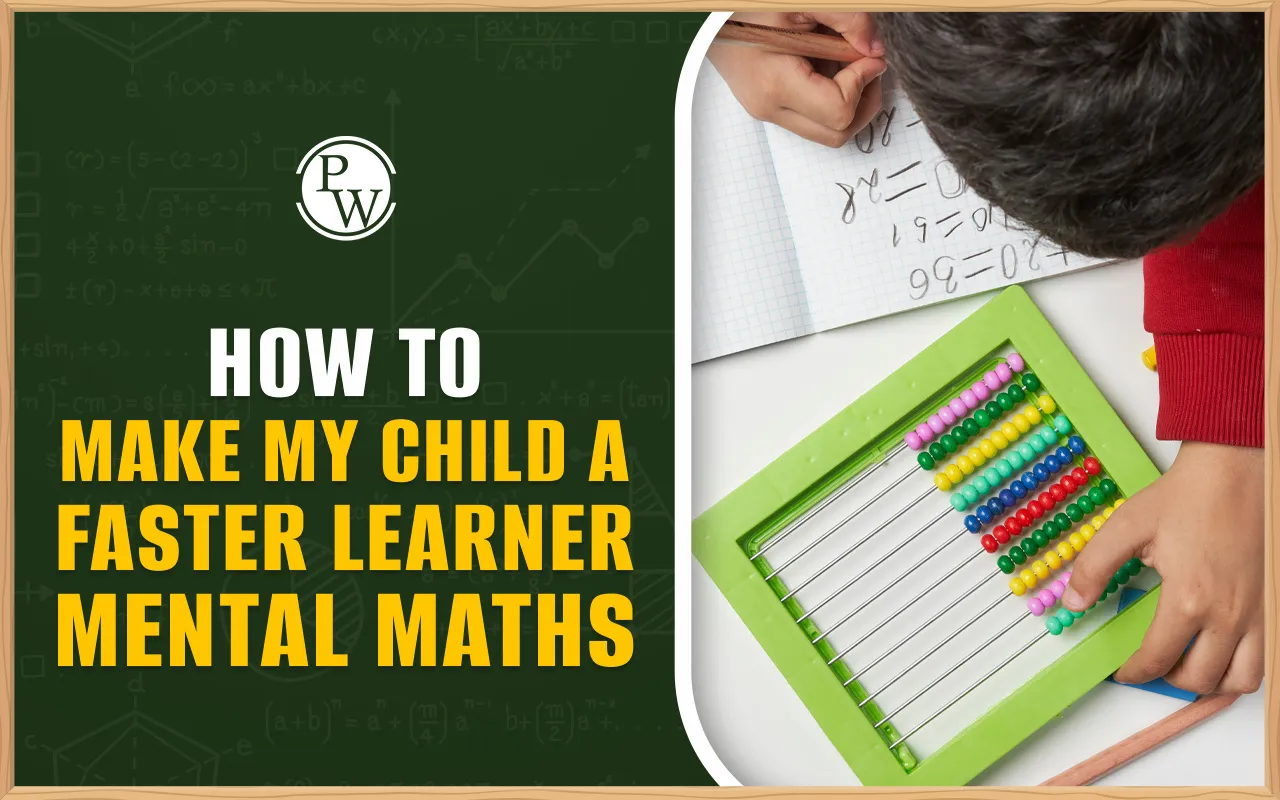
Every parent wants their child to understand lessons quickly and do well in school. However, with the increasing amount of information students need to process, some children struggle to keep up. One way to improve learning speed is by using mental maths.
Mental maths is not just about solving equations in the head. It improves focus, strengthens memory, and helps children develop reasoning skills.
When children practice mental maths regularly, they become more efficient at learning, not just in mathematics but in all subjects.
This blog will explain what mental maths is, how it helps a child learn faster, and simple ways parents can include it in daily routine.
What is Mental Maths?
Mental maths is solving mathematical problems without using a calculator, paper, or pen. It requires the brain to work with numbers through estimation, visualization, and number patterns.
Instead of using traditional step-by-step methods, mental maths encourages children to think in groups, break numbers into smaller parts, and find shortcuts to get to the answer. This technique improves thinking speed and allows children to complete tasks with more confidence.
For example, a child solving 48 × 5 on paper may take multiple steps. A child trained in mental maths will think of 48 as 50 minus 2, multiply 50 × 5 = 250, then subtract 2 × 5 = 10, giving the correct answer of 240 in seconds.
By practicing mental maths regularly, children develop the ability to recognize number patterns, improving their understanding of mathematics. This method is not limited to calculations.
It also strengthens problem-solving skills, helping students in science, reasoning, and real-life decision-making.
How Mental Maths Helps My Child Learn Faster in School?
Learning is not just about reading and memorizing information. It also requires quick thinking, problem-solving, and strong memory skills.
Mental maths helps with all of these, making it easier for children to understand and process information faster.
Here’s how mental maths helps your child learn faster in school:
1. Enhances Brain Development and Cognitive Skills
Mental maths is like an exercise for the brain. When children perform calculations in their heads, they strengthen their ability to think critically, focus better, and process information faster.
It improves neural connections, which leads to better memory retention and sharper attention spans.
When children engage in mental maths, they become quicker at recalling facts, recognizing number patterns, and estimating values without hesitation.
These skills help them not only in mathematics but also in other subjects like science and reasoning-based activities.
2. Helps Solve Problems Faster and More Efficiently
A child who practices mental maths regularly will be able to approach problem-solving with confidence and speed.
By training their brain to work with numbers mentally, they become more efficient at breaking down complex problems into simpler steps. This reduces hesitation and allows them to complete schoolwork faster.
This skill is beneficial in exams and classwork where time is limited. Instead of spending too much time on calculations, children can focus more on understanding concepts and applying them correctly.
Whether it’s quickly estimating a sum in maths, solving an equation in physics, or analyzing data in a science experiment, mental maths helps children think and respond quickly.
3. Improves Numerical Fluency and Mathematical Understanding
Children who develop mental maths skills gain a deeper understanding of numbers.
Instead of memorizing formulas without comprehension, they learn how numbers interact and develop an instinct for solving problems logically.
Numerical fluency allows children to grasp more advanced concepts with ease. When they can mentally manipulate numbers, they are better prepared for higher-level mathematics like algebra and geometry.
This makes maths a less intimidating subject and gives them the confidence to approach new challenges without fear.
4. Enhances Logical Thinking and Decision-Making
Mental maths encourages children to think in a structured way. They learn how to analyze problems, consider multiple approaches, and choose the most efficient solution.
This kind of logical reasoning extends beyond maths and helps them make better decisions in everyday situations.
For example, if a child needs to plan how much time to spend on different subjects while studying, their ability to estimate and divide time efficiently will be stronger.
Similarly, when faced with real-world challenges like budgeting their pocket money or calculating time intervals, they can apply mental maths techniques to make quick and smart choices.
5. Strengthens Focus and Attention Span
Mental maths requires concentration, and the more children practice, the better they become at staying focused for longer periods.
This improved focus helps them in all subjects, from reading comprehension to solving science equations.
Children who struggle with distractions often find it hard to stay engaged in lessons. However, mental maths trains the brain to hold information and work through problems without losing track.
A child who can concentrate well will complete tasks faster, retain more information, and participate more actively in class discussions.
6. Boosts Confidence and Reduces Fear of Mathematics
Many children develop anxiety around maths, which affects their ability to learn. When they struggle with calculations, they may feel discouraged and avoid participating in maths-related activities.
Mental maths helps overcome this fear by making calculations faster, easier, and more natural.
When children see that they can solve problems quickly without external help, they become more confident in their abilities.
This confidence extends to other subjects as well, making them more willing to take on challenges, answer questions in class, and perform well in exams.
7. Encourages a Positive Attitude Toward Learning
When children realize that they can work with numbers easily, they start enjoying the learning process. Mental maths introduces an element of play and challenge that keeps them engaged.
Instead of seeing learning as a difficult task, children begin to associate problem-solving with fun.
This positive attitude makes them more curious, more motivated to explore new topics, and more open to challenges in school.
Over time, this mindset helps them develop a love for learning that benefits them beyond the classroom.
Tips to Help Your Child Learn Mental Maths
Teaching mental maths does not require expensive materials. Parents can help their children develop this skill through simple, fun activities at home. Here are some useful mental maths tricks and techniques to help your child get started on their learning journey!
1. Encourage Daily Practice Without a Calculator
Children improve at mental maths when they practice regularly. Instead of relying on a calculator, encourage your child to solve simple calculations mentally before checking the answer.
Start with basic addition, subtraction, multiplication, and division and gradually increase the difficulty level.
For example, ask them to quickly double numbers, calculate percentages, or estimate totals while shopping.
By making mental calculations a daily habit, children develop confidence, accuracy, and speed, which helps them solve more complex problems over time.
2. Use Mental Maths Tricks and Shortcuts
Teaching children mental maths strategies can help them solve problems faster. Some useful tricks include:
-
Breaking Numbers Apart: To add 37 + 48, think of it as 30 + 40 = 70 and 7 + 8 = 15, then combine both to get 85.
-
Multiplication by 5: To multiply a number by 5, first multiply it by 10 and then divide by 2. For example, 36 × 5 becomes (36 × 10) ÷ 2 = 180.
-
Multiplication by 9: To multiply by 9, multiply by 10 and subtract the original number. For example, 25 × 9 becomes (25 × 10) - 25 = 225.
-
Doubles and Near Doubles: If a child knows 8 + 8 = 16, they can quickly calculate 8 + 9 = 17 by adding 1.
Practicing these tricks allows children to solve problems faster without relying on traditional step-by-step methods.
3. Play Math Games to Make Learning Fun
Children learn better when they enjoy the process. Games help reinforce mental maths skills in an interactive way. Some fun games include:
-
Multiplication War: A card game where two players pick cards and multiply the numbers. The player with the highest product wins the round.
-
Number Jeopardy: Pick a number and give your child one minute to find as many ways as possible to reach that number using addition, subtraction, multiplication, or division.
-
Math Bingo: Instead of calling out numbers, call out sums or products, and children have to find the answer on their bingo cards.
-
Online Math Apps: Platforms like Curious Junior provide engaging activities to improve mental maths fluency.
4. Apply Mental Maths in Real-Life Situations
Children understand maths better when they see how it applies to everyday life. Simple daily activities can reinforce mental maths skills:
-
Grocery Shopping: Ask your child to estimate the total cost of items in the cart before reaching the checkout.
-
Time Management: Have them calculate how long it will take to reach a destination based on speed and distance.
-
Cooking Measurements: Let them convert fractions of ingredients while following a recipe.
-
Money Calculations: Encourage them to count change or calculate discounts and percentages when shopping.
5. Introduce Flashcards for Quick Recall
Flashcards are a great way to improve math fact fluency. Use them to help children quickly recall:
-
Multiplication and division tables
-
Addition and subtraction facts
-
Square roots and powers
-
Fractions and percentages
Set a timer and challenge them to answer as many flashcards as possible in one minute. This builds speed, accuracy, and confidence in recalling essential maths facts.
6. Encourage Estimation Before Solving Problems
Estimation helps children make quick and reasonable guesses before finding the exact answer. This skill is useful in everyday situations like:
-
Approximating a total bill at a restaurant
-
Guessing the weight of objects before measuring
-
Predicting how much time a task will take
Encouraging children to estimate first and then check their answers strengthens their number sense and allows them to make educated guesses with confidence.
7. Try the Taped-Problem Approach for Speed
The Taped-Problem Approach helps children solve maths problems quickly by improving mental recall. Record a series of maths problems, leaving a short pause before stating the answer.
The child listens, writes down the problem, and solves it mentally before hearing the correct answer.
For example, the recording says "12 × 4", pauses for a few seconds, then gives the answer "48." The child must write 48 before the answer is revealed.
Start with longer pauses and reduce them as the child improves. This method boosts speed, accuracy, and confidence, helping children solve problems faster in exams and everyday situations.
Help your child overcome math anxiety and build confidence with Curious Junior's one-week Mental Maths Booster Course.
Starting March 3, 2025, this course covers 50 + mental math strategies that help children calculate faster, think logically, and easily solve complex math word problems.
Through live interactive audio-video sessions, engaging exercises, and one-on-one mentorship, math becomes easier and more enjoyable for your child.
Limited spots are available! Secure your child's seat today!