Coding-Decoding Mental Maths Tricks for Class 6
 Nikita Aggarwal28 May, 2026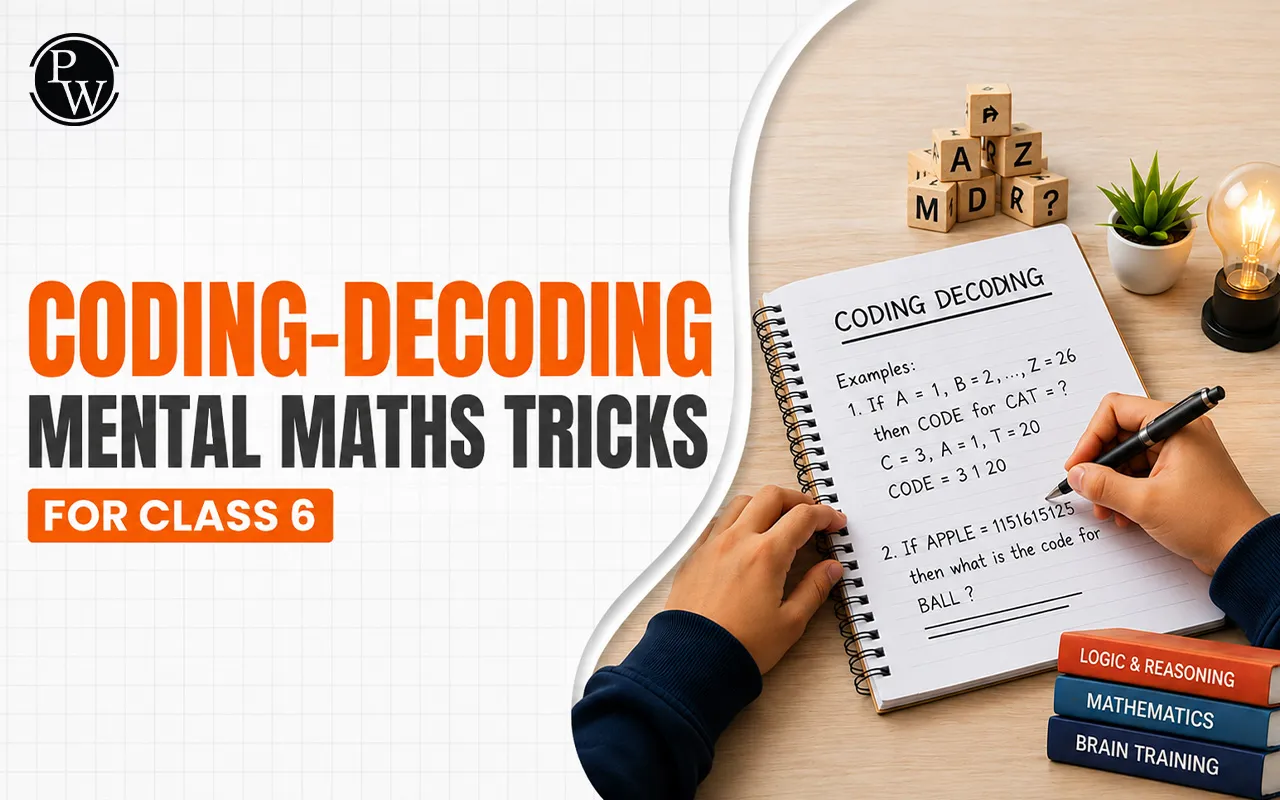
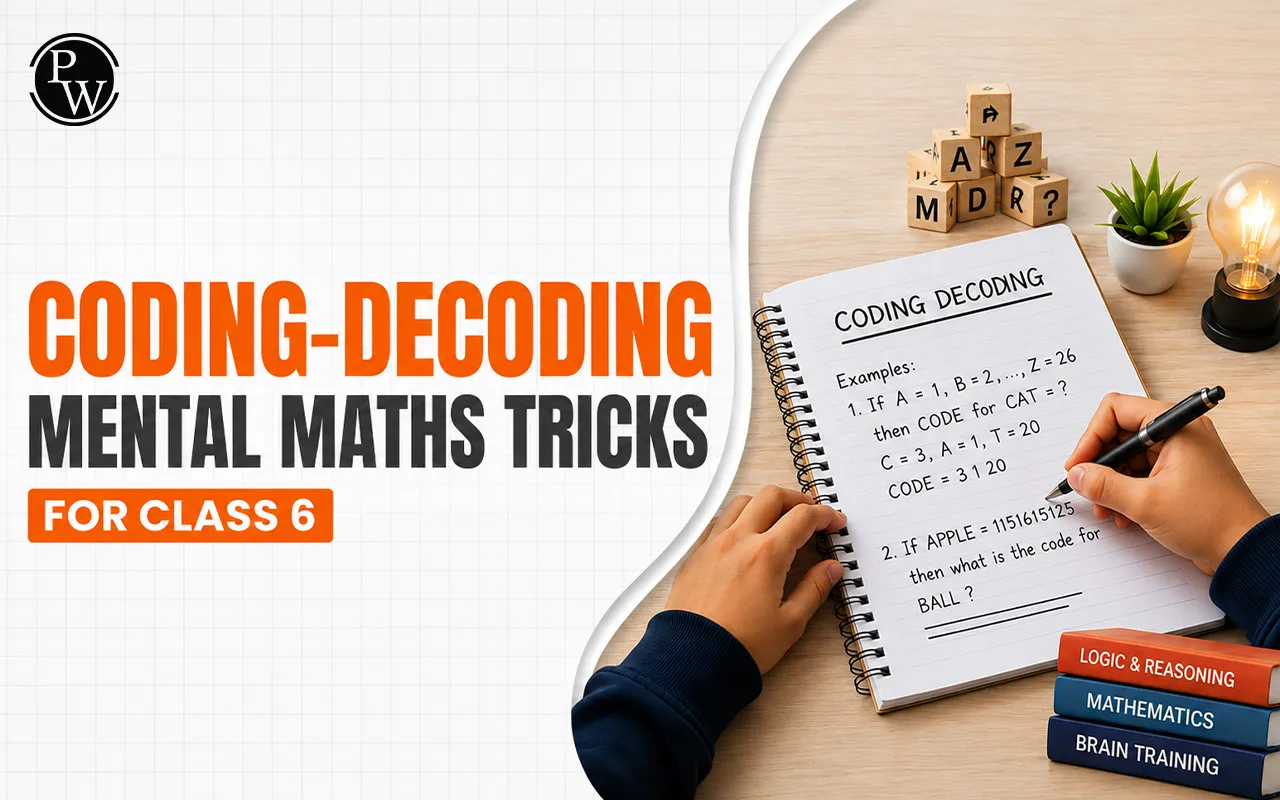
What is Coding-Decoding?
Coding-decoding is an important portal of logical reasoning whereby any word, letter or even a sentence gets encrypted in the desired format as defined by specific rules. The act of converting clear information into a secret sequence is coding. On the other hand, decoding is figuring out that pattern to discover the root meaning.
This topic is basically an introduction to higher-order mental processing for Class 6 students. This subject measures the ability to identify trends, validate hypotheses and implement a set of standard rules uniformly across operations. By moving an entire alphabet or word from point A to point B, these logic puzzles train the brain to recognise structure instead of random content.
Simple Coding Decoding Mental Maths Tricks
To really succeed at Class 6 coding-decoding, you need a systematic toolbox of clever shortcuts. These are the examples of the best coding decoding tricks that help you identify patterns instantly and solve problems in your mind.
1. The Forward Alphabetical Tracking Trick
Rather than counting fingers each time you see a letter shift, use concrete numbers. A = 1, B = 2 through Z = 26, the base standard of position from A to Z, but write it down so it's easier or just memorise it.
-
The Logic: Find the constant gap between letters of the original word and the coded word to see whether addition or subtraction is performed on them.
-
Mental Example: If the word CAT becomes FDW, your brain tracks the positional jump. C (+3) becomes F, A (+3) becomes D, and T (+3) becomes W. The pattern rule is a constant shift of +3.
Read More - Doubling & Halving Vedic Maths Tricks for Class 6
2. The Reverse Alphabet Pair Trick
In many complex patterns, letters will be swapped to the opposite of each other according to an alphabet series counting backward (Z=1; Y=2; A=26).
-
The Logic: Pair the beginning of the alphabet with its mirror end. A pairs with Z, B pairs with Y, C pairs with X, and so on. A brilliant mental shortcut to verify a reverse pair is that the sum of their forward positions always equals 27 (e.g., G is 7, T is 20; 7 + 20 = 27).
-
Mental Example: If BOY is coded as YLA, you can instantly identify that B flips to Y, O flips to L, and Y flips to A.
3. Even and Odd Position Splitting
Never apply a rule across the word. And occasionally the operation is determined by the position of the letter.
-
The Logic: Letters in odd positions (1st, 3rd, and 5th) follow one specific shifting rule, while letters at even positions (2nd, 4th, and 6th) are entailed under an entirely different set of rules.
-
Mental Example: In a six-letter word, the odd positions might add 1 (+1) while the even positions subtract 1 (-1). Always look out for this alternating behaviour.
4. Segment Breakdown (The Word-Splitting Trick)
Dealing with really long words can make us fatigued from calculating as if we are processing all the letters at once.
-
The Logic: Open the word into two near halves or quarters, allowing you to understand how each side functions separately.
-
Mental Example: For an eight-letter word, split it into two four-letter blocks. You will often notice that the letters within each block are simply written in reverse order or cross-swapped.
5. Consonant and Vowel Differentiation
In this trick, the emphasis at play is strictly on the linguistic properties of letters rather than where they are placed.
-
The Logic: Vowels (A, E, I, O, U) are based on a simple subtraction or addition rule, and consonants have an entirely different shift.
-
Mental Example: All consonants in a word move to the next alphabet (+1), while all vowels change to the previous alphabet (-1).
6. The Multiplier Sum Trick
This method connects the use of letters (those you find in a name) and purely numeric values.
-
The Logic: Transform each letter of the word into its default position number, sum those digits together and multiply or divide that total by a fixed digit.
-
Mental Example: If the word FUR is coded as 90, find the individual values: F=6, U=21, R=18. Adding them up gives 45. Multiplying the sum by 2 gives the final code: 45 x 2 = 90.
Read More - Finding Remainders Using Vedic Method for Class 6
Benefits of Coding Decoding Mental Maths Tricks
Using these types of mental reasoning exercises provides immense cognitive benefits, which go much deeper than simply performing well on a weekly class quiz. This is why implementing those strategies can be very beneficial for a Class 6 student.
-
Eliminates Calculation Fatigue: Manually writing multiple horizontal columns or drawing lines on paper is hard work. Keeping these calculations in your brain saves energy for complex problems later on.
-
Sharpened Pattern Recognition: Students are trained to identify mathematical structures and connections that exist in words, numbers, and geometric figures.
-
Reduces Exam Anxiety: Instant feedback on the first few multiple-choice questions of a paper provides immediate assurance, paving the way for feeling in charge of what is learned/examined.
-
Improves Concentration and Focus: Retaining multiple letter steps at numerical positions, as a process to write the letters down, makes students develop deep concentration naturally due to an increased attention span.
-
Strategic Exam Preparation: Getting a firm grip on shifting logic works as great practice for future talent hunt tests and Olympiads.
How Does CuriousJr Help with Class 6 Mental Maths Tricks?
CuriousJr takes these abstract academic topics and breaks them down into structured, step-by-step learning adventures designed for younger brains. CuriousJr online mental maths class targets the real-world performance problems that Class 6 students face every day by focusing on interactive engagement.
-
Bypasses Passive Learning: Rather than relying on rote memorisation, this framework uses constructive logic-building tasks to instil deep structural understanding.
-
Instant Interactive Feedback: Students get live corrections about their calculation paths, which assist them in identifying mathematical trends & correcting the gap in computation right away.
-
Curated Sequencing Modules: The focused mental exercises on the platform revolve around ordering rules, numeric replacement and word swapping.
-
Reduces Cognitive Strain: It provides simulations that break difficult puzzles down into simple, step-by-step cognitive processes for the brain to handle heavy tracking without burnout.
-
Builds Academic Self-Assurance: Gradual level progressions allow students to master basic changes first before advancing to complex, multi-tier logical reasoning puzzles.