What is a Polyhedron—Definition, Types, and Examples
 Nikita Aggarwal19 Jan, 2026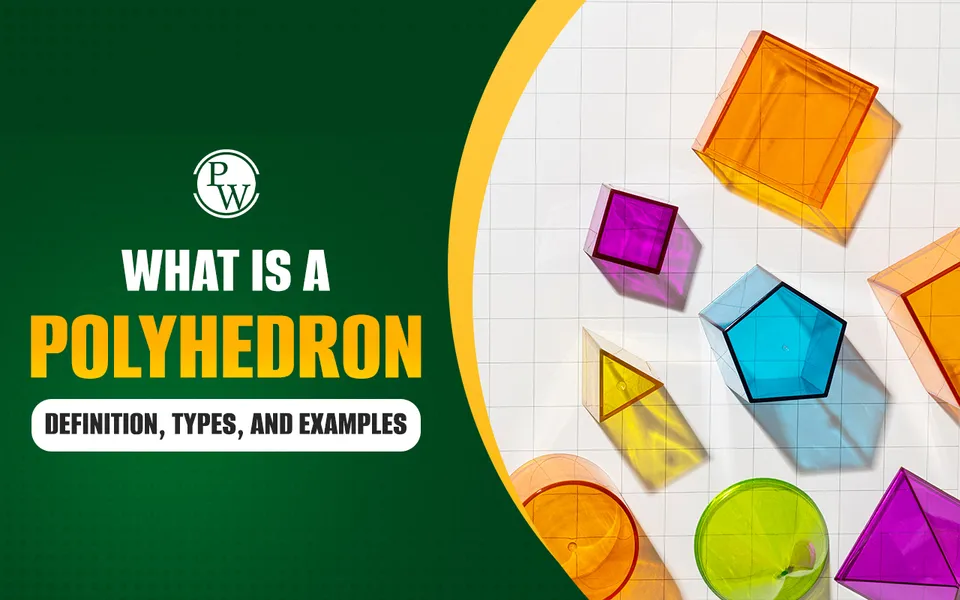
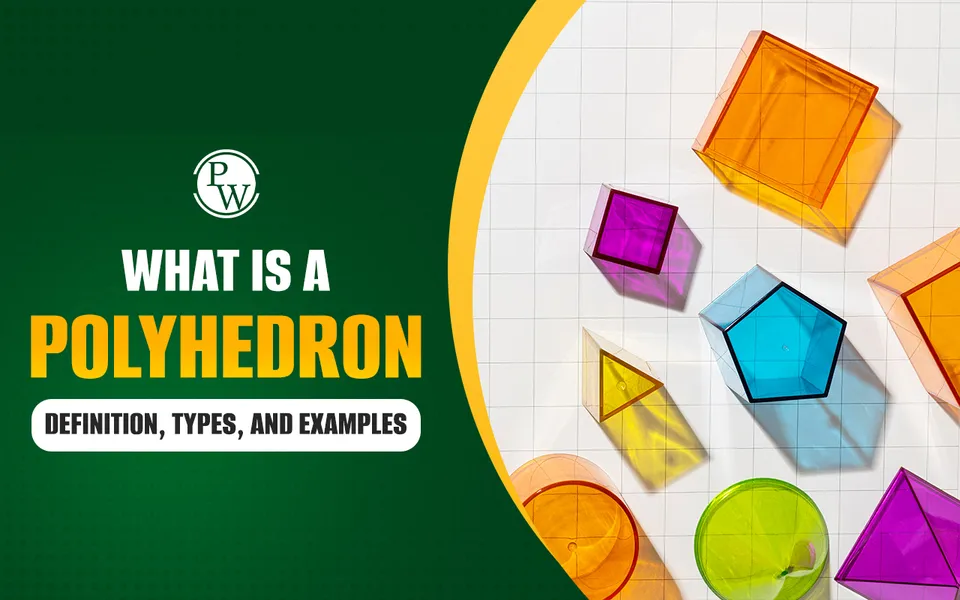
Polyhedron is one of the most fascinating three-dimensional shapes that students explore in mathematics. From the tiny dice used in board games to the grand pyramids of Egypt, polyhedrons can be found all around us in daily life.
These solids are made up of flat faces, straight edges, and sharp corners, which make them unique and interesting to study. Here, we will discuss the different types of polyhedrons with clear examples to help students understand the concept thoroughly.
What is Polyhedron?
A polyhedron is a three-dimensional solid figure made up of flat polygonal faces that connect at straight edges and meet at vertices. The different terms associated with polygons are as follows:
-
Faces: The flat surfaces that determine the shape of a polyhedron are called faces.
-
Edges: The line segments formed where two faces meet are called edges.
-
Vertices: The points where edges meet the surfaces are called vertices.
For example, a cube is a polyhedron because it has six square faces, twelve edges, and eight vertices.
Also read: Volume - Formula, Definition, Calculate, Examples
Key Characteristics of Polyhedron
Polyhedrons are identified by some common characteristics as mentioned below:
-
It must be a three-dimensional shape.
-
All the faces must be in the shape of polygons.
-
The faces meet along straight edges.
Thus, as per polyhedron definition and properties, spheres, cones, and cylinders are not considered polyhedrons because they have curved surfaces, not polygonal surfaces.
Also read: Exponent and Power
Euler’s Formula for Polyhedron
The relationship between the number of faces (F), vertices (V), and edges (E) of a polyhedron is expressed by Euler’s formula, as mentioned below:
F + V - E = 2.
This formula is valid for all convex polyhedra.
For example, for a cube:
-
Vertices (V) = 8
-
Edges (E) = 12
-
Faces (F) = 6
So, F + V - E = 6 + 8 - 12 = 14 - 12 = 2, which satisfies Euler’s formula.
Types of Polyhedrons Based on Structure
Polyhedrons can be classified in various ways depending on their structures and the nature of surfaces. Let us explore the different types of polyhedrons.
Convex and Concave Polyhedrons
Polyhedrons are classified based on the properties of their surface diagonals, as explained below:
Convex Polyhedron: In this type of shape, the line segment connecting any two points of the solid shape lies inside or on the surface of the polyhedron. For example, Cube, Tetrahedron.
Concave Polyhedron: It is a type of polyhedron where at least one line segment joining two points goes outside the solid shape. For example, star-shaped polyhedrons.
Regular and Irregular Polyhedron
Polyhedrons can be classified based on the nature of their surfaces and other properties, as explained below
Regular Polyhedron: It is a type of polyhedron whose all faces are regular polygons and where the same number of faces meet at each vertex.
Example: A cube is a regular polygon with all square faces.
Irregular Polyhedron: It is a type of polyhedron with polygonal faces of different shapes and sizes.
For example, a cuboid is an irregular polygon because it has rectangular faces which are not regular polygon faces.
Also read: Periodic Table: Elements, Groups and Facts
Different Types of Regular Polyhedrons
Regular polyhedrons can be classified based on the shapes of faces by which they are formed. They are convex polyhedrons and conventionally called Platonic solids. The main five types of platonic solids are as follows:
|
Different Types of Regular Polyhedrons |
||||
|
Polyhedron Name |
Nature of faces |
No. of Faces |
No. of Edges |
No. of Vertices |
|
Cube |
Square faces |
6 |
12 |
8 |
|
Tetrahedron |
Equilateral Triangle |
4 |
6 |
4 |
|
Octahedron |
Equilateral Triangle |
8 |
12 |
6 |
|
Dodecahedron |
Regular pentagon |
12 |
30 |
20 |
|
Icosahedron |
Equilateral Triangle |
20 |
30 |
12 |
Different Types of Irregular Polyhedrons
Irregular polyhedrons are classified into two main groups, as explained below
Prisms
A prism is a solid shape which has two parallel polygon faces of the same size and shape which are connected by rectangular faces. Prisms are named based on their base shape, as mentioned in the table below:
|
Different Types of Irregular Polyhedrons |
||||
|
Prism Name |
Nature of base |
No. of Faces |
No. of Edges |
No. of Vertices |
|
Triangular Prism |
Triangle |
5 |
9 |
6 |
|
Square Prism |
Square |
6 |
12 |
8 |
|
Rectangular Prism |
Rectangle |
6 |
12 |
8 |
|
Pentagonal Prism |
Pentagon |
8 |
18 |
12 |
|
Hexagonal Prism |
Hexagon |
10 |
24 |
16 |
Pyramid
It is a type of polyhedron which has a regular polygonal base and triangular faces meeting at a single vertex. It can be of different types based on the shape of their bases, as listed in the table below:
|
Pyramid Name |
Nature of base |
No. of Faces |
No. of Edges |
No. of Vertices |
|
Triangular Pyramid |
Triangle |
4 |
6 |
4 |
|
Square Pyramid |
Square |
5 |
8 |
5 |
|
Pentagonal Pyramid |
Pentagon |
6 |
10 |
6 |
|
Hexagonal Pyramid |
Hexagon |
7 |
12 |
7 |
Also read: Sequences and Series - Definitions, Types, Concepts
Polyhedrons Solved Examples
1. Find the number of faces, edges, and vertices of a heptagonal prism.
Solution:
A heptagonal prism has 2 faces that are regular heptagons and 7 rectangular faces.
So, the total number of faces is 2 + 7 = 9, and the number of vertices is 7 + 7 = 14.
According to Euler’s formula,
F + V – E = 2
Where,
F = No. of faces
V = No. of vertices
E = No. of edges
Therefore,
9 + 14 – E = 2
Or, E = 9 + 14 - 2 = 21
So, a heptagonal polyhedron has 9 faces, 14 vertices, and 21 edges.
2. A polyhedron has 12 vertices and 20 edges. How many faces does it have?
Solution:
Using Euler’s formula,
F + V – E = 2
Or, F = E – V + 2
Or, F = 20 - 12 + 2 = 10
So, the polyhedron has 10 faces.
3. Check if a polyhedron exists with these dimensions: Edges (E) = 16, Faces (F) = 8, and Vertices (V) = 12.
Solution:
We can check this using Euler’s formula.
F + V – E = 2
Substituting the values of F, V, and E, we get:
8 + 12 – 16 = 4
The value 4 doesn’t satisfy Euler’s formula, so a polyhedron with these dimensions doesn’t exist.
Also read: Simple Equations: Definition, Transposition and Uses
Applications of Polyhedrons
Polyhedrons are not just theoretical concepts; they have practical applications across various fields, as explained below:
-
Architecture: Many buildings and domes use polyhedral structures for strength and aesthetics.
-
Science: Prisms are used to understand the refraction of light and spectrum formation from white light.
-
Gaming and Entertainment: Dice used in games are often found in the shape of a polyhedron.
-
Computer Graphics: Polyhedron shapes are used in 3D modelling, animation, and virtual reality.
-
Jewellery: Precious stones and gems are cut into polyhedral shapes to enhance their shine and beauty.
The study of polyhedrons is a fascinating branch of geometry that connects mathematics with the real world. These solid figures with flat polygonal faces, straight edges, and vertices have some specific characteristics that can help your child identify, categorize, and apply these shapes in mathematical and practical application
Build Confidence in Maths with CuriousJr Online Maths Classes
Is your child struggling to understand maths concepts and falling behind in class? Many students experience this when they don’t fully grasp the basics, which can lead to lower marks and a lack of confidence.
At CuriousJr, our online maths tuition classes are here to support better understanding through step-by-step teaching, consistent practice, and personal attention. We aim to make maths learning more approachable, enjoyable, and effective.
Why Choose Our Online Maths Classes:
-
Live and interactive sessions led by dedicated and friendly teachers
-
Two-teacher model to ensure every student receives individual attention and support
-
Visual explanations and real-life examples that make concepts easier to understand and remember
-
Daily practice, homework support, and regular doubt-solving sessions to strengthen learning
-
Progress updates for parents, so you can stay informed and involved in your child’s growth
Book a demo class today and see how CuriousJr can help your child feel more confident and motivated in maths.