What Grammar Topics Should a Class 5–6 Student Know in English?
 Nikita Aggarwal20 Jun, 2026
Why Are English Grammar Topics Class 5 and 6 Important?
In primary classes, students mainly learn basic words, simple sentences, and reading skills. However, in middle school, they need to learn how to use grammar correctly to speak and write more effectively. A well-planned English grammar checklist Class 5 students follow helps build a strong foundation for better communication.
Good grammar helps students express their ideas clearly and confidently. It also improves their reading, writing, speaking, and understanding skills. As students move to higher classes, grammar becomes even more important for school assignments, exams, and daily communication.
Without a strong understanding of grammar rules, students may find it difficult to write clear sentences, understand passages, or organize their thoughts properly. They may also make common mistakes in punctuation, sentence structure, and word usage.
Learning important grammar topics step by step helps students improve their language skills and prepares them for more advanced English lessons in the future.
English Grammar Topics Class 5 and 6 Parts of Speech
A functional understanding of the fundamental parts of speech forms the core of all Class 5 6 English topics. Learners need to go beyond identifying standard nouns or basic verbs; they must master how these categories behave under different syntactic conditions.
Advanced Noun Mechanics and Pronoun Agreement
Students must differentiate between common, proper, abstract, and collective nouns. They must also learn to navigate irregular singular and plural formations alongside distinct noun genders.
Pronouns require careful study to prevent ambiguity in long paragraphs. Key concepts include:
-
Reflexive Pronouns: Correct deployment of words like myself, himself, and themselves to reflect actions back to the subject.
-
Interrogative Pronouns: Using structural question words like who, whom, and whose accurately.
-
Pronoun-Antecedent Agreement: Ensuring every pronoun perfectly matches its corresponding noun in both number and gender throughout a passage.
Adjectives and Adverbs for Richer Compositions
Descriptive writing relies heavily on modifiers. Students learn to use adjectives for comparison across positive, comparative, and superlative degrees (e.g., fast, faster, fastest). They also explore the difference between interrogative pronouns and interrogative adjectives based entirely on context.
Similarly, adverbs must be utilised to modify verbs, adjectives, or other adverbs. Pupils study adverbs of manner, time, place, and frequency to show exactly how, when, and where an action takes place, turning flat statements into engaging narratives.
English Grammar Topics Class 5 and 6 Word Formation Skills
An essential aspect of the English grammar topics The Class 5 and 6 framework involves understanding word forms. Words do not remain static; they alter their structural shapes to serve different grammatical functions within a sentence.
|
Root Word |
Noun Form |
Verb Form |
Adjective Form |
Adverb Form |
|
Beauty |
Beauty |
Beautify |
Beautiful |
Beautifully |
|
Strength |
Strength |
Strengthen |
Strong |
Strongly |
|
Happy |
Happiness |
— |
Happy |
Happily |
|
Quick |
Quickness |
Quicken |
Quick |
Quickly |
Read More - How to Improve English Speaking Skills at Home
Prefixes, Suffixes, and Compound Variations
Middle schoolers learn to expand their vocabulary independently by manipulating root words using internal morphological extensions:
-
Prefixes: Attaching structural fragments to the beginning of a word to alter its core definition (e.g., happy becomes unhappy).
-
Suffixes: Placing structural elements at the end of a word to transform its core grammatical part of speech (e.g., happy becomes happiness).
-
Conversion Without Change: Recognizing words that function as completely different parts of speech without altering their written layout (e.g., "I went for a run" vs "I run daily").
-
Compound Word Forms: Combining separate independent words to formulate entirely fresh concepts, categorised into closed, open, or hyphenated formats (e.g., rainbow, bus stop, part-time).
English Grammar Topics Class 5 and 6 Tenses and Time Expressions
Navigating timelines accurately is a key element of the A2 English grammar benchmark. Middle school students must graduate from basic time frames to complex, multi-layered tenses to describe interconnected events clearly.
Present and Past Continuous Systems
Learners must master the interplay between simple structures and continuous structural frameworks. They must identify when to employ the simple present or present continuous tense for ongoing tasks. Similarly, they need to combine the past simple and past continuous tenses to show a background action interrupted by a sudden event (e.g., “She was reading when the phone rang”).
Perfect Tense Matrices and Future Planning
The introduction of perfect tenses represents a significant step up in complexity. Students explore:
-
Present Perfect Simple: Connecting past actions directly to the present moment.
-
Present Perfect Continuous: Explaining long, ongoing actions that started in the past and persist now.
-
Past Perfect Simple: Clarifying which of two distinct historical events occurred first.
-
Future Time Presentations: Choosing between will, be going to, or using the present continuous with a future meaning based on intent.
Read More - 100+ Daily English Sentences for Kids and Beginners
English Grammar Topics Class 5 and 6 Sentence Structure Rules
Understanding individual words is only half the battle; arranging them into coherent syntax patterns is where true fluency develops. The Cambridge Key grammar Class 5 6 syllabus prioritises sentence structure to ensure clear written communication.
[Subject] + [Auxiliary/Modal Verb] + [Main Verb] + [Direct Object] + [Adverbial Phrase]
Riya should finish her homework quickly tonight.
Subject and Predicate Parts
Every complete thought requires a distinct subject and a functional predicate. Students learn to isolate the complete subject from its accompanying modifiers and analyze the predicate to identify direct objects, indirect objects, and subject complements.
Connectives and Prepositions
Prepositions of time, place, and direction (e.g., in, on, at, under, behind) establish clear contextual relationships between nouns. Conjunctions act as the structural glue that joins clauses together, allowing students to combine short sentences into sophisticated compound or complex sentences.
Direct and Indirect Speech
Shifting spoken words into reported prose is a key skill at this stage. Learners practice converting direct quotes into indirect speech, which requires adjusting tenses, changing pronouns, and modifying time expressions accurately (e.g., “I am tired,” he said becomes He said that he was tired).
English Grammar Topics Class 5 and 6 Punctuation and Grammar Basics
Proper punctuation ensures that a writer's message is easy to understand. Without strict adherence to mechanical guidelines, even the most descriptive prose can become confusing.
-
Capitalisation Rules: Always apply capital letters to the first word of every sentence, proper nouns, and the standalone pronoun I.
-
Terminal Punctuation: Ensuring sentences end with a full stop, question mark, or exclamation mark based on their communicative purpose.
-
Commas and Quotation Marks: Setting apart introductory phrases, separating items in a list, and isolating direct quotes to ensure clear meaning.
-
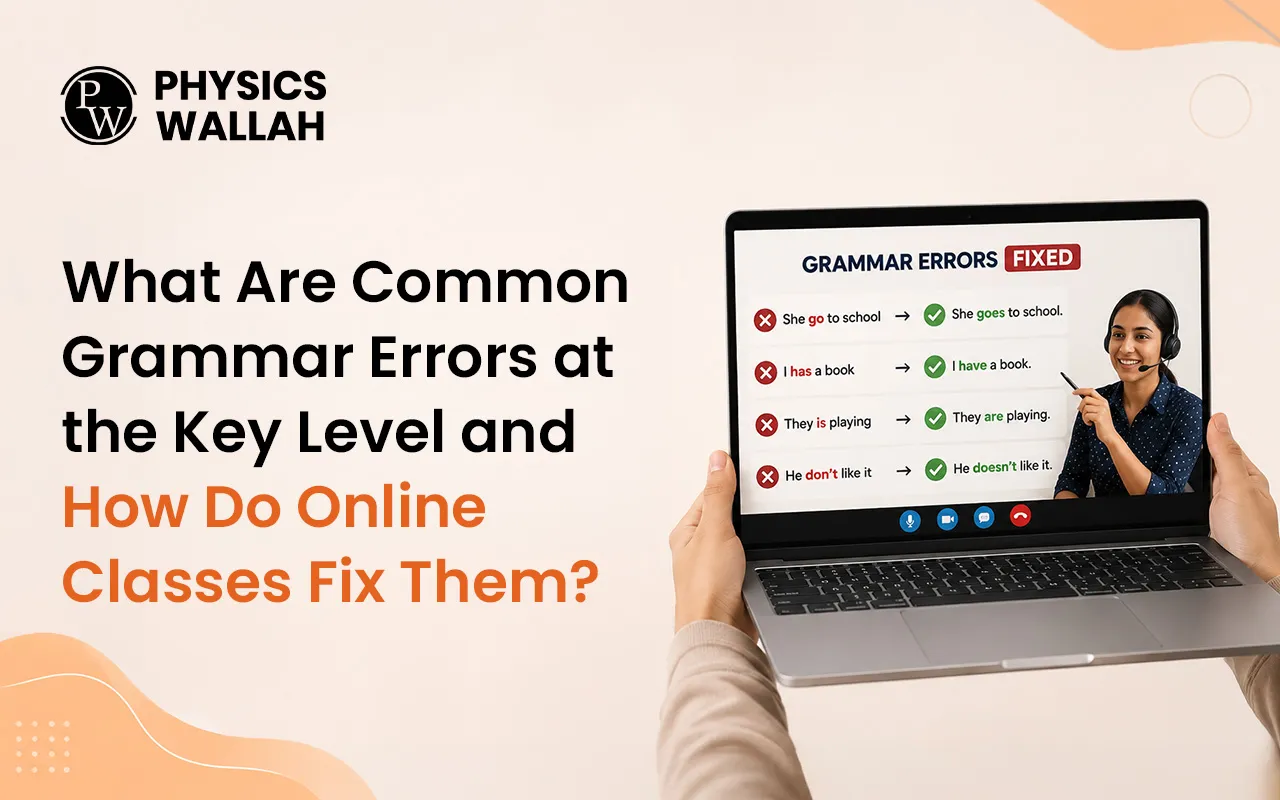
Subject-Verb Agreement: Ensuring singular subjects take singular verbs and plural subjects take plural verbs, especially when dealing with tricky collective nouns.
How CuriousJr Helps with English grammar topics Class 5 and 6
Mastering these concepts requires consistent, high-quality practice beyond the traditional classroom. Parents seeking structured academic support often enroll their children in an online English class Class 5 6 format to reinforce these foundational ideas.
CuriousJr offers a comprehensive, step-by-step approach tailored to the middle school language syllabus. Through interactive exercises, real-time feedback, and engaging modules, the platform helps students master word formations, tense transitions, and complex sentence structures. By breaking down intricate rules into accessible lessons, CuriousJr ensures that pupils build the confidence needed to excel in school exams and international English proficiency assessments.




What Grammar Topics Should a Class 5 to 6 Student Know in English? FAQs
What are the main English grammar topics for Class 5 and 6 students?
How do word forms help students improve their writing?
What is the difference between an adjective and an adverb?
Why is subject-verb agreement important for Class 5 and 6 students?

Get Free Counselling Today
and Clear up all your Doubts
 Live & recorded classes available at easeDashboard for progress trackingLakhs of practice questions