
Volume of Right Circular Cylinder - Formula with Examples
 Nikita Aggarwal30 Mar, 2026
What is Volume of Right Circular Cylinder?
It tells you how much room the cylinder takes up or how much it can hold. You could tell exactly how much water is in a cylinder by looking at the volume. There are many kinds of solids, but a right circular cylinder is one where the axis (the line that connects the centers of the two bases) is perpendicular to the base. This means that it stands straight up, unlike an oblique cylinder, which could lean to one side.
Concept of Volume in a Cylinder
To visualise the volume of a right circular cylinder, think about a flat round disc. Now, picture putting hundreds of the same discs on top of each other. The space that this stack takes up is the volume. In maths, this is essentially multiplying the base area (the circle) by the height of the stack.
Examples of Circular Cylindrical Objects
We see the volume applied all around us every day:
-
Kitchen Items: Cans of soup, jars of jam, and drinking glasses.
-
Infrastructure: Giant water towers, oil pipelines, and concrete pillars.
-
Stationery: Glue sticks, markers, and pencil holders.
-
Industrial: Gas tanks and barrels for storing chemicals.
Volume of Right Circular Cylinder Formula
The key to solving any difficulty with this shape is to use its mathematical rule. One of the best tools a student may have in their geometry toolbox is the volume formula.
Mathematical Formula for Right Circular Cylinder Volume
To find the volume (V), use this formula:
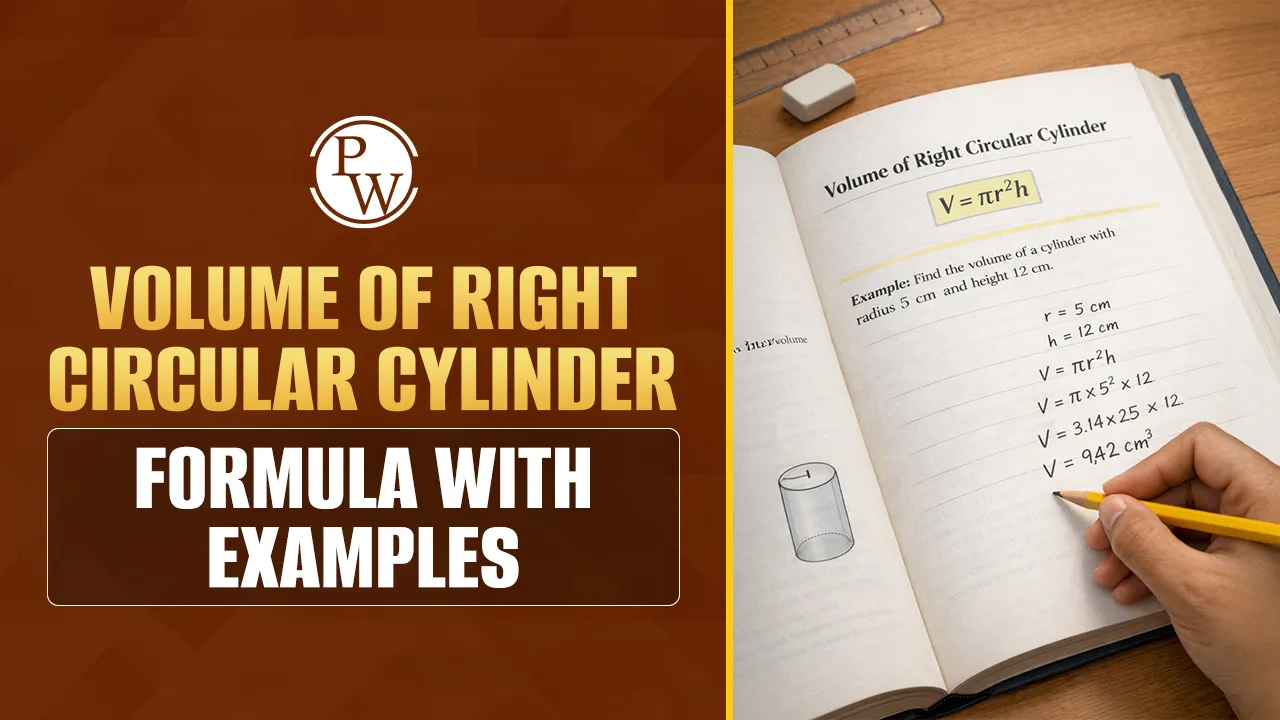
V = πr²h
|
Component |
Symbol |
Description |
|
Volume |
V |
The total 3D space inside the cylinder. |
|
Pi |
π |
A constant value (approx. 3.14 or 22/7). |
|
Radius |
r |
Distance from the centre to the edge of the base. |
|
Height |
h |
The vertical distance between the two bases. |
Meaning of Radius and Height in Right Circular Cylinder
Understanding the variables is crucial for accuracy:
-
The Radius (r): This is the distance from the centre of the circular base to its outer edge. If a problem gives you the diameter, you must divide it by 2 to get the radius.
-
The Height (h): This is the vertical distance between the top and bottom circular bases.
Derivation of the Volume of Right Circular Cylinder Formula
You don't just have to memorise the formula; you can understand where it comes from!
-
The base of the cylinder is a circle. The area of a circle is Area = πr².
-
We multiply the base area by the height (h) to find out how much space the whole solid takes up.
-
So, Volume = Base Area × Height, which means V = πr²h.
Read More - Volume of Cone – Formula, Derivation, Steps & Examples
How to Calculate Volume of Right Circular Cylinder?
If you follow a logical series of steps, figuring out the volume is easy.
For every problem, do this in this order:
-
Write down the height (h) and radius (r) that are given in the question.
-
Make sure that "r" and "h" are both in the same units, such cm or m.
-
To find the square of the radius, multiply it by itself (r × r).
-
To find the height (h), multiply the answer from the last step by the height.
-
To find the final volume, multiply by 3.14 or 22/7.
Units Used for the Right Circular Cylinder Volume
-
You always use cubic units to measure volume. This is because you are multiplying three lengths: height, radius, and height. Common amounts include cubic centimetres (cm³), cubic meters (m³), and cubic millimetres (mm³).
-
One litre is equal to 1,000 cm³, which is a common measurement for liquids.
Common Mistakes While Calculating Circular Cylinder Volume
Be wary of these typical errors:
-
Using Diameter instead of Radius: If you use the whole width of the circle instead of half, you'll receive the wrong answer.
-
Forgetting to Square: Sometimes students double the radius (2r) instead of squaring it (r²).
-
Unit Mismatch: The solution will be inaccurate if you use one measurement in inches and another in centimetres.
Volume of Right Circular Cylinder Examples
Let's look at some examples to show how maths works in the real world.
Example 1: Finding Volume Using Radius and Height
Question: The height of a cylinder is 10 cm, while the radius is 7 cm. Find out how much space it takes up. (Use 22/7 for pi)
-
r = 7 cm, h = 10 cm
-
Formula: V = πr²h
-
V = (22/7) × 7 × 7 × 10
-
V = 22 × 7 × 10 = 1540 cm³
Example 2: Word Problem on Volume of the Right Circular Cylinder
Question: A soft drink can is 6 cm wide and 12 cm tall. How much liquid can it hold? (Use 3.14 for π)
-
Diameter = 6 cm, so Radius (r) = 3 cm
-
h = 12 cm
-
V = 3.14 × (3)² × 12
-
V = 3.14 × 9 × 12 = 339.12 cm³
Example 3: Real-Life Cylinder Volume Calculation
Question: The radius of a cylindrical water tank is 2 meters and the depth is 5 meters. Find out how much it can hold.
-
r = 2 m, h = 5 m
-
V = 3.14 × (2)² × 5
-
V = 3.14 × 4 × 5 = 62.8 m³
Example 4: Working with Large Dimensions
Question: The height of a big industrial pillar is 200 cm, and its radius is 21 cm. Determine the amount of concrete needed to fill it. (Use 22/7 for π)
-
r = 21 cm, h = 200 cm
-
V = (22/7) × 21 × 21 × 200
-
V = 22 × 3 × 21 × 200 (since 21/7 = 3)
-
V = 277,200 cm³
Example 5: Finding Volume from Base Area
Question: The base of a right circular cylinder has an area of 154 cm². Find its volume if it is 5 cm tall.
-
Base Area (πr²) = 154 cm²
-
h = 5 cm
-
Volume = Base Area × Height
-
V = 154 × 5 = 770 cm³
Read More - Volume of Sphere: Formula, Derivation, Examples
Applications of Volume of Right Circular Cylinder
Why do we learn this? Beyond the classroom, this calculation is a vital part of many professional fields.
Uses of Right Circular Cylinder in Daily Life
-
Cooking: When cooking, you can use cylindrical measuring cups to measure out the components.
-
Fuelling: Figuring out how much diesel or petrol a tanker can carry.
-
Gardening: Figuring out how much dirt you need for cylindrical planters.
Cylinder Volume in Engineering and Science
-
Cooking: You can use cylindrical measuring cups to measure out the parts as you cook.
-
Fuelling: Finding out how much diesel or petrol a tanker can hold.
-
Gardening: How to figure out how much dirt you need for round planters.
Practice Questions on Volume of Right Circular Cylinder
Test your knowledge with these practice problems.
Easy Questions on Right Circular Cylinder
-
The inside radius of the pipe is 3 cm, while the outside radius is 20 cm. How much water can it hold?
-
What is the volume of a cylinder that is 3 m tall and 10 m wide?
Advanced Questions on Right Circular Cylinder
-
The pipe's internal radius is 3 cm, while its outside radius is 20 cm. How much water can it hold?
-
Find the radius of a cylinder that is 8 cm tall and has a volume of 308 cm³. (Hint: Change the order of the formula.)
Key Points to Remember About Right Circular Cylinder
-
Formula: Always begin with V = πr²h.
-
The "Right" Part: This only works when the height is straight up from the base.
-
Radius vs. diameter: Always check to see if you need to divide the diameter by 2 when comparing radius and diameter.
Units: Volume is always measured in cubic units (units³).