Tetrahedron Shape - Meaning, Properties & Formulas
 Swati Kumar20 Jan, 2026
Tetrahedron Shape
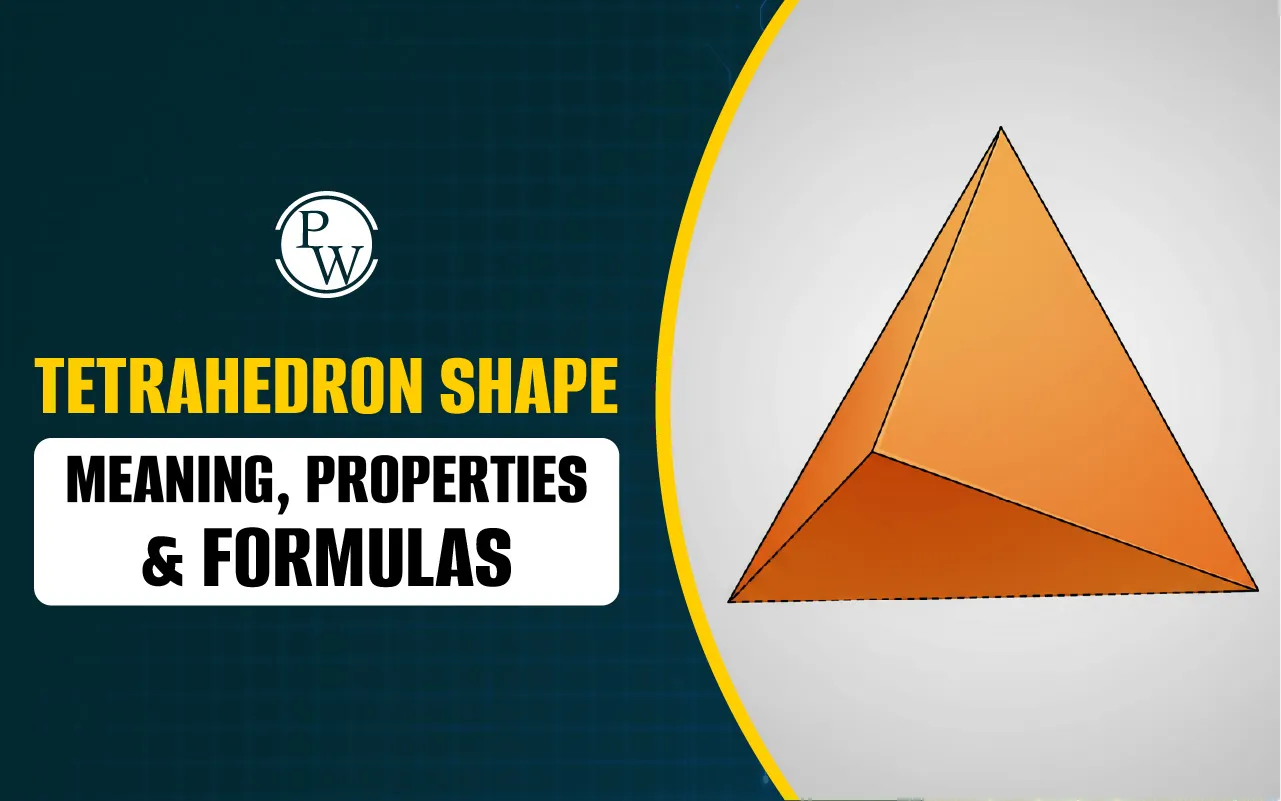
Tetrahedron is a 3D geometrical shape made up of four triangular faces, six edges, and four vertices. It is also referred to as a triangular pyramid since it has a triangular base and three triangular sides converging at a vertex. In a regular tetrahedron, the four faces are all equilateral triangles with equal edges and angles, and all the vertices are equidistant from one another. The tetrahedron possesses special characteristics like no parallel faces and six planes of symmetry.
Tetrahedron Definition
A tetrahedron is a fundamental three-dimensional shape, a polyhedron defined by four triangular faces, six straight edges, and four vertices. It's the simplest possible convex polyhedron. All four faces of a regular tetrahedron are congruent equilateral triangles, so all six edges have the same length
This also implies all of the face angles are 60 degrees (being equilateral triangles) and the angle between any two faces (the dihedral angle) is about 109.47∘. This particular dihedral angle is important in chemistry for molecular geometry.
Read More: What is Hexagon
Tetrahedron Net
A tetrahedron net is a flat two-dimensional shape that, when folded along its internal lines after cutting out, makes a three-dimensional tetrahedron. Unfold a cardboard box and imagine the flattened shape as its net. For a four-sided triangular tetrahedron, its net will always be four triangles joined in such a manner that they can fold into the 3D shape.
The most natural and well-known net for a standard tetrahedron (one with all faces as equilateral triangles) is illustrated below. It's four equilateral triangles put together to create an even larger equilateral triangle.
Here's how it works:
- The Base: The middle triangle (usually referred to as the base in these figures) will be the bottom face of the tetrahedron.
- The Sides: The three triangles along its edges will fold up.
- The Apex: The apex (top vertex) of the tetrahedron will be created at a single point where the vertices of these three upward-folding triangles converge.
Read More: Platonic Solids
Properties of Tetrahedron
A tetrahedron is a polyhedron with four faces, six edges, and four vertices. The properties of tetrahedron can be understood better by making a distinction between a general tetrahedron and a regular tetrahedron. The properties of tetrahedron are described below:
1. Faces, Edges, and Vertices: It possesses four equal faces, six equal edges, and four vertices, with three faces meeting at each vertex.
2. Angles:
- Face Angles: All face angles of the triangular faces are 60∘ since they are equilateral triangles.
- Dihedral Angle: The dihedral angle between any two faces is fixed at about 109.47∘. This particular angle is a characteristic and is the foundation for the geometry of most molecules, such as methane.
3. Symmetry: A regular tetrahedron possesses very high symmetry, with 24 rotational and reflectional symmetries.
4. Platonic Solid: It is a member of the five Platonic Solids, which are convex polyhedra having identical regular faces.
Read More: What is a Polyhedron
Surface Area of Tetrahedron
The surface area of tetrahedron is the sum of the areas of all the faces of the tetrahedron and is expressed in units of area such as m², cm², or in². There are two primary surface areas for a tetrahedron:
- Lateral surface area: It is the sum of the area of the three slant faces minus the base.
- Total surface area: It consists of the area of all four triangular faces.
The total surface area provides the complete coverage of the outer surface of the tetrahedron, whereas the lateral surface area is concerned with only the side faces and not with the base.
Lateral Surface Area of Tetrahedron
The lateral surface area of a tetrahedron is the total area of its sides, not including the base.
Think of a pyramid you might see in a book, its lateral area is just the area of the sloping faces that go up to the top point. A tetrahedron has four faces in total, so its lateral surface area is the sum of the areas of the three faces that are not the base.
LSA of Regular Tetrahedron = Sum of 3 congruent equilateral triangles, i.e.,
Lateral faces = 3 × (√3)/4 a2
where 'a' is the side length of a regular tetrahedron.
Total Surface Area of Tetrahedron
The total surface area of a tetrahedron is the total area of all its faces. A tetrahedron has four faces, so you just need to find the area of each face and add them up.
TSA of Regular Tetrahedron = Sum of 4 congruent equilateral triangles, i.e., all its faces
= 4 × (√3)/4 a2 = √3 a2
where 'a' is the side length of the regular tetrahedron.
Read More: Mean, Median, Mode
Volume of Tetrahedron
The volume of a tetrahedron is the amount of space it takes up. Just like you can find the volume of a pyramid, a tetrahedron's volume is calculated using its base area and height.
For any tetrahedron, you can find its volume using a simple formula. You just need to know the area of its base and its vertical height.
Formula:
Volume = 1/3× Base Area × Height
A regular tetrahedron is special because all its faces are identical equilateral triangles. This means its volume can be calculated just by knowing the length of one of its edges, which we'll call 'a'.
Formula:
Volume =a^3/ 6√2
Tetrahedron Examples
Here are some tetrahedron examples.
Also read: Construction in Maths
Boost Your Child’s Speed and Accuracy in Math with CuriousJr
Are you worried about your child's slow speed when doing mathematical calculations?
While it seems common among children to take time when solving math problems, this can affect their speed and confidence at school during exams.
That’s why CuriousJr’s Mental Math Online Classes are designed to help your child build faster and sharper calculation skills through fun and engaging learning.