Platonic Solids - Definition, Properties, Types, Examples
 Swati Kumar20 Jan, 2026
Platonic Solids
Platonic Solids are special 3D shapes that have been challenging mathematicians for thousands of years. Consider them to be the most "perfect" shapes you can create in three dimensions. What's so special about them is that every face is the same regular polygon (such as a square or an equilateral triangle), and the same number of faces share each corner.
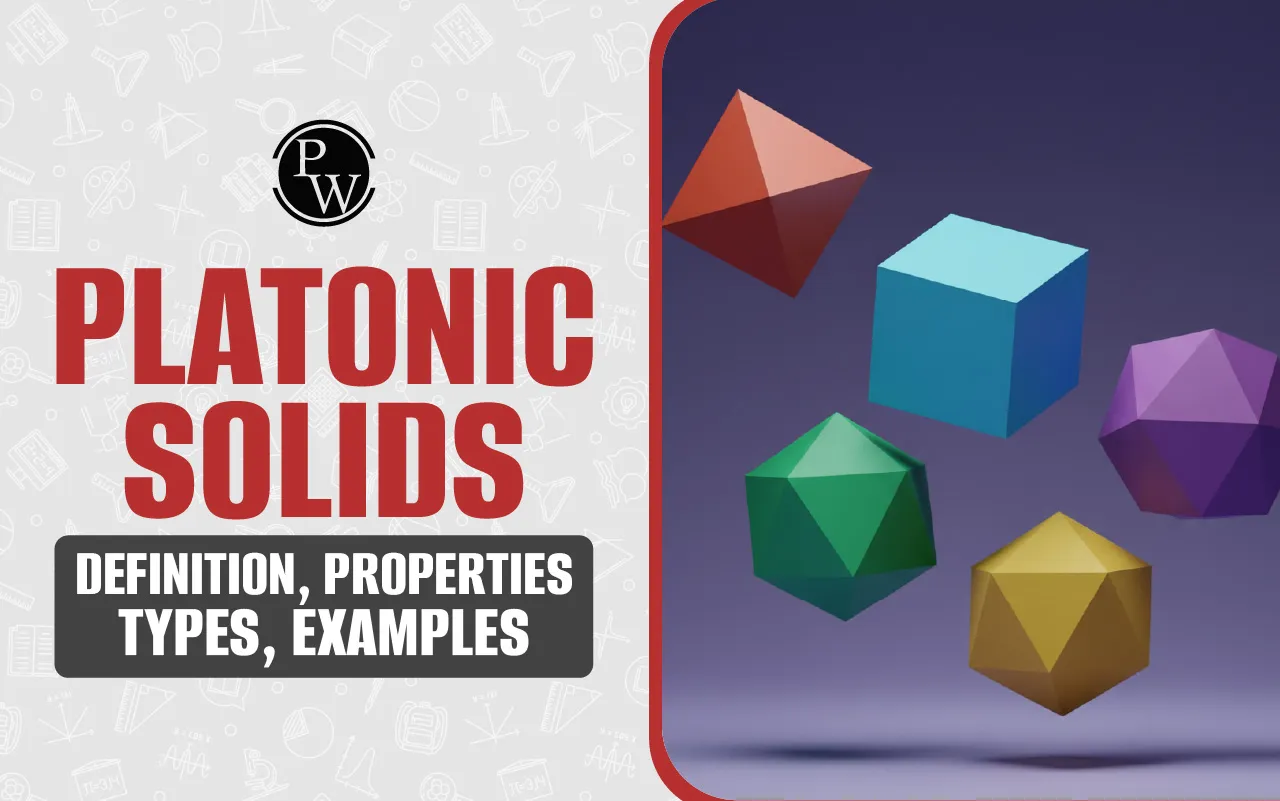
There are only five of these figures possible in the entire universe, namely Cube, Tetrahedron, Octahedron, Dodecahedron, and Icosahedron. They are so-called because the ancient Greek philosopher Plato believed they embodied the elements of the world. These mathematical marvels demonstrate how symmetry and a few rules can produce complicated, stunning forms.
Definition of Platonic Solids
Platonic solids are five unique forms of 3D shapes that are the "most perfect" shapes in geometry. They are also referred to as regular polyhedra. A 3D shape has to fulfill two extremely rigorous rules to be a Platonic Solid.
- All Faces Are Identical: Every face of the shape has to be the same regular polygon. A regular polygon is a two-dimensional shape in which each of the sides and each of the angles is equal (such as an equilateral triangle or a square).
- Same Number of Faces Meet: The same number of faces have to meet up at every corner (vertex) of the solid.
There are 5 platonic shapes existing today. They are named after the Greek philosopher Plato, who wrote about them thousands of years ago, believing they were the building blocks of the universe.
Here are the 5 platonic shapes:
- Tetrahedron: Has 4 triangular faces.
- Cube (Hexahedron): Has 6 square faces.
- Octahedron: Has 8 triangular faces.
- Dodecahedron: Has 12 pentagonal faces.
- Icosahedron: Has 20 triangular faces.
Read More: What is a Polyhedron
Properties of Platonic Solids
Platonic solids possess certain notable properties that distinguish them from other shapes. Below are the properties of Platonic solids.
- All the faces of a Platonic solid are the same regular polygons, i.e., each face is composed of equal sides and angles.
- The solids are convex in nature, i.e., they bend outward and contain no indentations.
- An equal number of faces converge at each corner (vertex) of the figure.
- The edges of the faces touch each other but don't overlap or cross.
- Every Platonic solid has a different number of faces, edges, and vertices.
- There are only five Platonic solids due to these strict conditions.
- These figures are extremely symmetrical and also symbolize natural things such as earth, air, fire, water, and the universe.
Read More: What is Hexagon
Types of Platonic Solids
There are 5 types of platonic solids with identical, regular polygon faces meeting equally at each corner. Each one is described below.
1. Tetrahedron
A Tetrahedron is a 3D shape that looks like a basic pyramid with a triangular base. It is the simplest and first of the five special shapes called the Platonic Solids. The properties of a tetrahedron are given below.
- Has 4 triangular faces.
- Has 6 edges and 4 vertices (corners).
- Each face is an equilateral triangle.
- Also called a triangular pyramid.
- Plato connected it with the element fire.
- Examples of a Tetrahedron are dice, pyramids, and molecules.
2. Cube (Hexahedron)
A Cube, or a Hexahedron, is probably the most well-known 3D shape and is the second of the five Platonic Solids. The name Cube is just the common name for the regular hexahedron.
It should have the following properties:
- Has 6 square faces.
- Has 12 edges and 8 vertices.
- All the edges are the same length.
- Faces are at right angles (90 degrees).
- Plato associated it with the element earth.
- Examples are building blocks, sugar cubes, Rubik's Cube, and dice.
3. Octahedron
The Octahedron is the third of the five perfect Platonic Solids. It's a special three-dimensional shape that appears to be two pyramids with square bases joined together at the bases. The Greek name for it comes from the fact that "octa" means eight and "hedra" means face. Therefore, it really is a shape with eight faces.
- It must have the following properties:
- Has 8 triangular faces.
- Has 12 edges and 6 vertices.
- Every face is an equilateral triangle.
- Appearance of two pyramids base to base.
- Was associated with the element air by Plato.
- Examples include kite, dice, and crystals.
4. Dodecahedron
The Dodecahedron is the fourth of the five perfect Platonic Solids. It is a rare 3D shape with 12 faces, and it resembles a giant, symmetrical gemstone. The following are the key properties of a dodecahedron.
- Has 12 pentagonal faces (5 sides on each face).
- Has 30 edges and 20 vertices.
- Faces are regular pentagons.
- It's a more complicated shape with lots of edges.
- Plato associated it with the universe or heavens.
5. Icosahedron
The Icosahedron is the fifth and last of the five perfect Platonic Solids. It is an extremely complicated and almost spherical 3D shape, and it has the most faces. These are its properties.
- Has 20 triangular faces.
- Has 30 edges and 12 vertices.
- All of its faces are equilateral triangles.
- Has the highest number of faces among the Platonic solids.
- Plato correlated it with the element water.
- Examples are dice, viruses, and geodesic domes.
Also read: Sequences and Series
Build Confidence in Maths with CuriousJr Online Maths Classes
Is your child struggling to understand maths concepts and falling behind in class? Many students experience this when they don’t fully grasp the basics, which can lead to lower marks and a lack of confidence.
At CuriousJr, our online maths tuition classes are here to support better understanding through step-by-step teaching, consistent practice, and personal attention. We aim to make maths learning more approachable, enjoyable, and effective.