
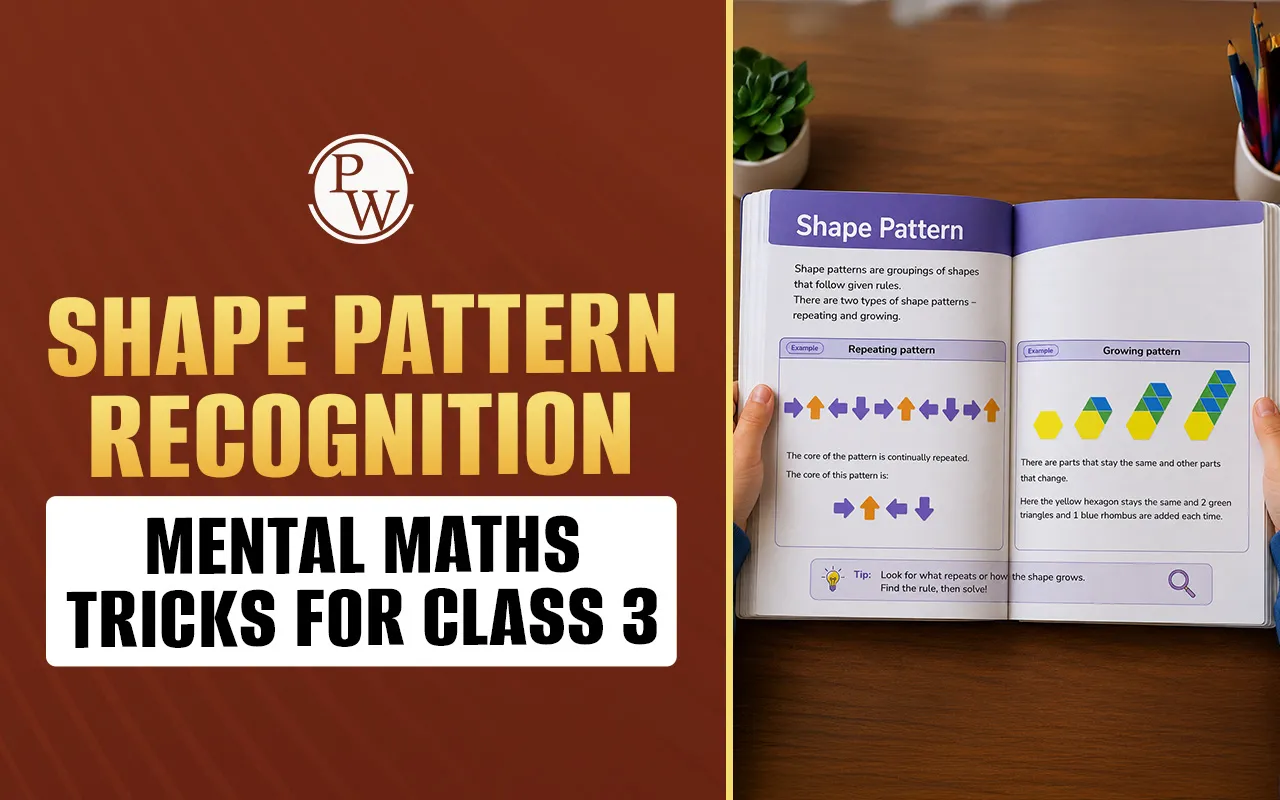
Shape Pattern Recognition Mental Maths Tricks for Class 3
 Nikita Aggarwal29 May, 2026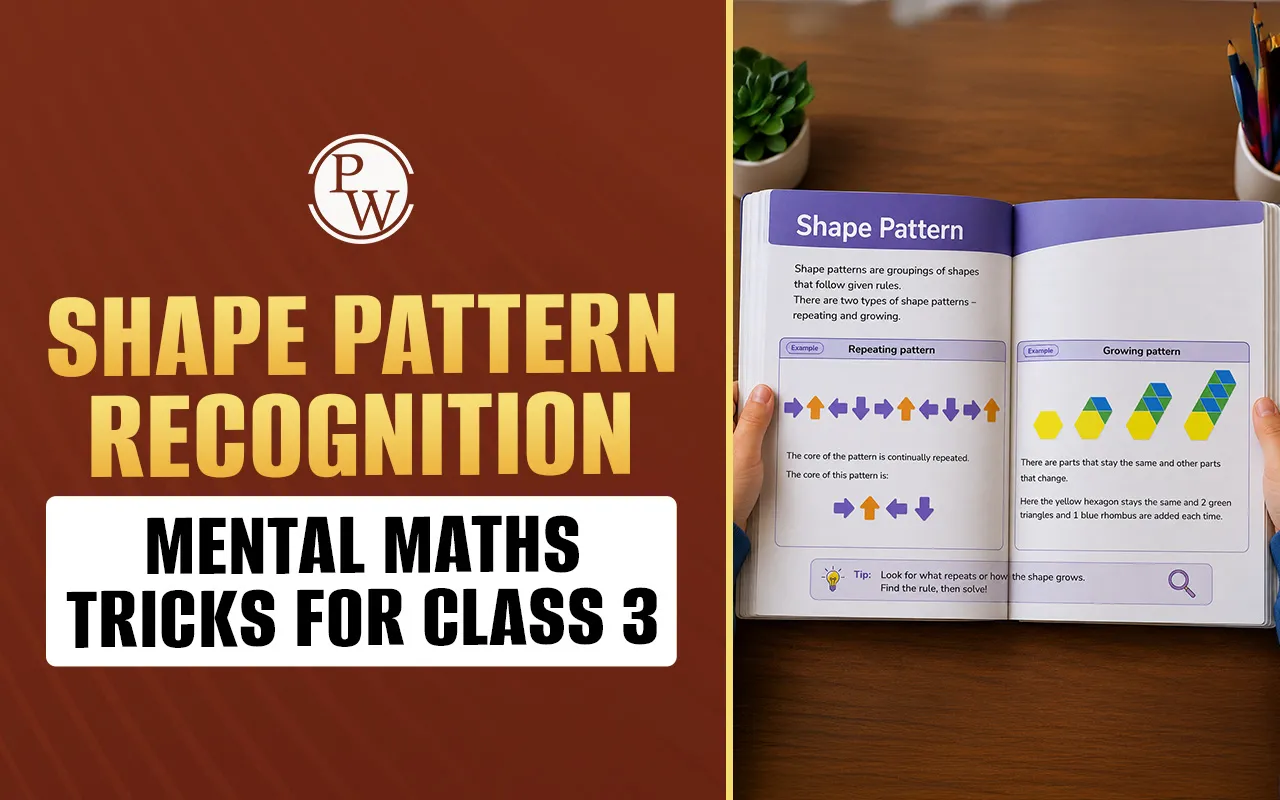
Importance of Shape Pattern Recognition Mental Maths Tricks
Children who understand visual patterns often become stronger problem solvers. These methods help young learners notice how shapes repeat, grow, or change.
-
Faster Problem Solving: Children learn to quickly scan a row of shapes and find the next answer without counting everything one by one.
-
Better Logical Thinking: Pattern activities teach children how to break big problems into smaller, easier parts.
-
Less Exam Stress: When children know easy pattern tricks, they solve questions faster and feel calmer during tests.
-
Stronger Observation Skills: Children become better at noticing colours, shapes, directions, and small differences.
-
More Confidence in Maths: As children start solving pattern puzzles correctly, they feel more confident while learning maths.
Easy Shape Pattern Recognition Mental Maths Tricks
In class 3 shape pattern recognition, children learn how to find the hidden rule inside a shape sequence.
Some patterns repeat the same group again and again. Other patterns slowly grow bigger step by step.
Children should always:
-
Look carefully at all shapes
-
Find what stays the same
-
Find what changes
-
Predict the next shape
This simple process makes pattern solving much easier.
Shape Pattern Recognition Mental Maths Tricks for Repeating Patterns
A repeating pattern uses the same group of shapes again and again.
The repeating group is called the core pattern.
Example
Blue Triangle → Red Heart → Yellow Circle → Blue Triangle → Red Heart → Yellow Circle
The core pattern is:
-
Blue Triangle
-
Red Heart
-
Yellow Circle
Once children find the core, they can easily guess the next shape.
Reading the pattern out loud often helps children notice the repeating order faster.
Shape Pattern Recognition Mental Maths Tricks with Letter Patterns
Patterns can also use letters instead of shapes.
Example
A, B, B, H, A, B, B, H
The repeating block is:
A, B, B, H
Children should always check the full row before answering because some letters or shapes may repeat inside the pattern.
This method helps children avoid mistakes.
Read More - Spatial Puzzle Solving Mental Maths Tricks for Class 3
Shape Pattern Recognition Mental Maths Tricks Using Shape Sequences
Many kids mental maths tricks use visual sequences because they improve thinking speed and observation.
Example
Circle → Square → Circle → Square → Circle →?
The missing shape is:
Square
Children slowly learn how to predict patterns without writing anything down.
This builds strong mental thinking skills.
Shape Pattern Recognition Mental Maths Tricks for Growing Patterns
Growing patterns do not repeat the same group again and again. Instead, the shapes slowly increase or change.
Example
Step 1:
1 Triangle
Step 2:
2 Triangles
Step 3:
3 Triangles
The next step will have:
4 Triangles
Children learn to look at how many shapes are added each time.
This makes geometric patterns, grade 3 questions, much easier to solve.
Shape Pattern Recognition Mental Maths Tricks for Constant Parts
In many growing patterns, one part stays the same while another part changes.
Example
Step 1:
1 Purple Triangle + 1 Red Heart
Step 2:
2 Purple Triangles + 1 Red Heart
Step 3:
3 Purple Triangles + 1 Red Heart
The red heart stays the same every time.
The purple triangles grow by one each step.
So the next step will have:
4 Purple Triangles + 1 Red Heart
Children should always be separated:
-
The constant part
-
The changing part
This simple trick improves accuracy.
Read More - Speed Maths Test for Class 3 (Try Now)
Shape Pattern Recognition Mental Maths Tricks with 3D Shape Sequences
Many shape sequences and patterns worksheets also include 3D shapes, like:
-
Cubes
-
Cylinders
-
Cones
-
Spheres
At first, these patterns may look difficult, but the rule is still simple.
Example
Purple Cube → Purple Cube → Orange Cube → Purple Cube → Purple Cube → Orange Cube
The colour pattern repeats.
Children should focus on:
-
Colour changes
-
Size changes
-
Direction changes
This helps them solve 3D shape patterns faster.
Shape Pattern Recognition Mental Maths Tricks with Grid Patterns
Some worksheets use growing square blocks or grid patterns.
Example
Step 1:
2 squares wide and 2 squares tall
Step 2:
3 squares wide and 3 squares tall
Step 3:
4 squares wide and 4 squares tall
Children notice that:
-
Width grows by 1
-
Height grows by 1
The next shape will become:
5 squares wide and 5 squares tall
This simple method helps children solve bigger grid patterns easily.
Shape Pattern Recognition Mental Maths Tricks with Visual Learning
Many children learn faster when they can see shapes and colours.
Teachers and parents can use:
-
Shape cards
-
Flashcards
-
Colour blocks
-
Drawing activities
-
Puzzle games
Visual learning helps children clearly understand how patterns work.
Children also enjoy maths more when they use pictures and games.
Shape Pattern Recognition Mental Maths Tricks with Daily Practice
Children improve quickly when they practise a little every day.
Parents can spend 10 to 15 minutes daily doing:
-
Shape matching games
-
Pattern drawing
-
Missing shape puzzles
-
Colour sequence games
-
Shape sorting activities
Small daily practice slowly builds faster thinking skills.
Children also become more confident during classroom maths activities.
Shape Pattern Recognition Mental Maths Tricks Worksheets for Home Practice
Parents can make simple pattern worksheets at home using paper and colours.
Easy Pattern Activity
Draw:
-
Circle
-
Square
-
Circle
-
Square
-
Circle
Ask the child:
“What comes next?”
Growing Pattern Activity
Draw:
-
1 star
-
2 stars
-
3 stars
Ask:
“How many stars come next?”
These simple games make learning fun and stress-free.
Shape Pattern Recognition Mental Maths Tricks with Real Objects
Children can also learn patterns using real objects at home.
Parents can use:
-
Spoons
-
Blocks
-
Fruits
-
Toys
-
Buttons
Example
Apple → Banana → Apple → Banana
Children can guess the next fruit easily.
Hands-on activities help children remember patterns better because they can touch and move the objects.
How to Learn Shape Pattern Recognition Mental Maths Tricks with CuriousJr?
CuriousJr helps children learn shape pattern recognition and mental maths tricks through simple and fun learning activities.
-
Interactive Pattern Games – Children solve visual puzzles and shape-matching games.
-
Step-by-Step Learning – Lessons slowly move from simple patterns to harder shape sequences.
-
Fun Visual Activities – Children learn through colours, shapes, and easy visual models.
-
Friendly Teacher Support – Teachers guide children patiently during practice sessions.
-
Better Maths Confidence – Children improve their thinking speed and feel more confident in school maths.