Section Formula: Definition, Formulas, Derivation, Examples
 Shivam Singh20 Jan, 2026
What is Section Formula?
What is section formula? is a commonly asked question among students when learning coordinate geometry. Section formula is a simple method used in maths to find the coordinates of a point that divides a line segment in a given ratio. It helps you locate a point either inside the line segment (internally) or outside it (externally). So, when a point divides a line joining two given points in a particular ratio, we use the section formula to find its exact position.
Section formula is useful in both mathematics and physics. In maths, it helps in finding the centroid, incenter, or midpoint of a triangle. In physics, it helps in locating the centre of mass or point of equilibrium. Hence, the section formula makes it easy for you to calculate the coordinates of any point that divides a line segment in a known ratio.
Read more:Perfect Cube
Section Formula in Coordinate Geometry Definition
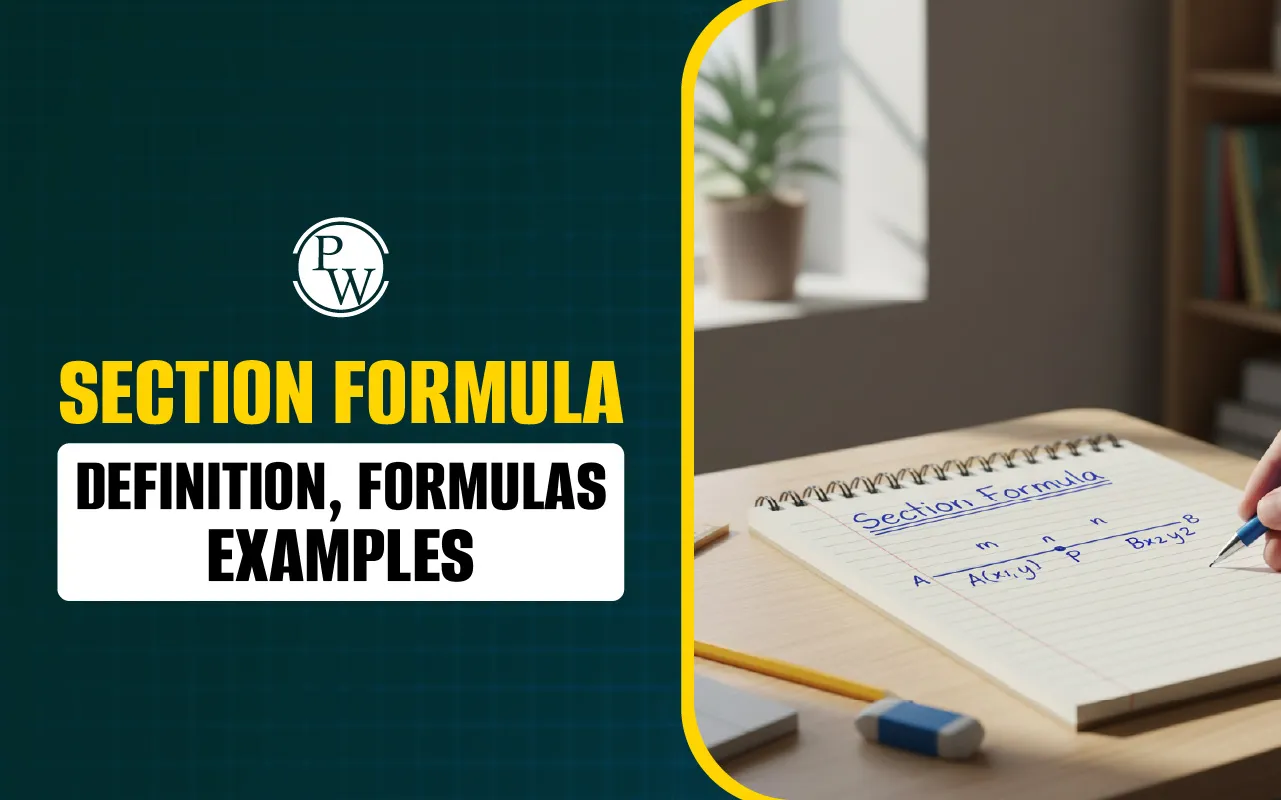
Section formula in coordinate geometry is used to find the coordinates of a point that divides a line segment joining two points in a given ratio. Suppose a point P (x, y) divides the line joining two points A (x₁, y₁) and B (x₂, y₂) in the ratio m : n; then, according to the Section Formula Coordinate Geometry,
Here, m and n show how the line is divided. The section formula helps you find the exact position of a point on the line segment. Moreover, section formula in coordinate geometry is divided into two types: the internal section formula and the external section formula. Let's understand them one by one.
What is Internal Section Formula?
Internal Section Formula is used when a point divides a line segment between the two given points in a certain ratio. To explain it simply, if a point lies between two points A (x₁, y₁) and B (x₂, y₂) on the same line and divides the line in the ratio m : n, we use the internal section formula to find its coordinates.
Internal Section Formula: P (x, y) = ((mx₂ + nx₁) / (m + n), (my₂ + ny₁) / (m + n))
In this internal section formula,
-
x and y show the coordinates of the point P that divides the line.
-
(x₁, y₁) are the coordinates of the first point, A.
-
(x₂, y₂) are the coordinates of the second point B.
-
m and n tell us how the point P divides the line segment AB in a certain ratio.
Read more: Surface Area of A Cube
What is External Section Formula?
External Section Formula is used when a point divides a line segment outside the two given points in a particular ratio. In other words, when a point lies beyond the two endpoints of a line segment and divides it externally, we use the section formula externally to find its coordinates.
External Section Formula: P(x, y) = ((m x₂ − n x₁) / (m − n), (m y₂ − n y₁) / (m − n))
Here,
-
x and y are the coordinates of the point P that divides the line externally.
-
(x₁, y₁) are the coordinates of the first point, A.
-
(x₂, y₂) are the coordinates of the second point B.
-
m and n are the ratio values in which P divides the line segment externally.
Read more: Collinear Points
Section Formula Derivation
Understanding the section formula derivation becomes easy by using two similar right-angled triangles. Let’s learn how the section formula is derived step-by-step:
-
Let a point P (x, y) divide the line segment AB internally in the ratio m : n.
-
The coordinates of A are (x₁, y₁) and of B are (x₂, y₂).
-
Draw parallel lines to get two right-angled triangles, AQP and PRB, which are the same triangles.
-
So, AP / PB = AQ / PR = PQ / BR = m / n …(1)
-
Now, using coordinates,
AQ = x − x₁ …(2)
PR = x₂ − x …(3) -
From equations (1), (2), and (3): (x − x₁) / (x₂ − x) = m / n
-
Solving for x, we get: x = (m x₂ + n x₁) / (m + n) … (A)
-
Similarly,
PQ = y − y₁ …(4)
BR = y₂ − y …(5) -
From equations (1), (4), and (5): (y − y₁) / (y₂ − y) = m / n
-
Solving for y, we get: y = (m y₂ + n y₁) / (m + n) … (B)
Hence, combining (A) and (B),
P(x, y) = ((m x₂ + n x₁) / (m + n), (m y₂ + n y₁) / (m + n))
For a point dividing the line externally, the section formula becomes:
P(x, y) = ((m x₂ − n x₁) / (m − n), (m y₂ − n y₁) / (m − n))
Read More: Substitution Method
What is Section Formula for Midpoint?
Section Formula for midpoint is used to find the point that lies exactly in the middle of a line segment. This midpoint divides the line into two equal parts. The ratio between the two parts is 1 : 1. To put it simply, if you have two points, A (x₁, y₁) and B (x₂, y₂), the midpoint is the point M (x, y) that lies halfway between them.
Section Formula is: M (x, y) = ((m×x₂ + n×x₁) / (m + n), (m×y₂ + n×y₁) / (m + n))
For a midpoint, the ratio m : n = 1 : 1, so the formula becomes: M(x, y) = ((x₁ + x₂) / 2, (y₁ + y₂) / 2).
Here,
-
(x₁, y₁) are the coordinates of point A.
-
(x₂, y₂) are the coordinates of point B
-
(x,y) are the coordinates of the midpoint (M).
So, the section formula for midpoint helps you find the centre point of any line segment by simply averaging the x- and y-coordinates of its two ends
Section Formula Examples With Solutions
Here are some solved section formula examples to help you understand how to apply it when you solve real questions in maths:
Example 1: Find the coordinates of the point that divides the line joining (6, 2) and (14, 10) in the internal ratio 2 : 1.
Solution: Given:
A(6, 2), B(14, 10) and ratio m : n = 2 : 1
Using the internal section formula,
P(x, y) = ((m×x₂ + n×x₁) / (m + n), (m×y₂ + n×y₁) / (m + n))
Substitute the values:
P(x, y) = ((2×14 + 1×6) / (2 + 1), (2×10 + 1×2) / (2 + 1))
P(x, y) = ((28 + 6)/3, (20 + 2)/3)
P(x, y) = (34/3, 22/3)
So, the required point is P (34/3, 22/3) or approximately (11.3, 7.3).
Example 2: Find the coordinates of the point that divides the line joining A(2, 1) and B(8, 4) in the ratio 3 : 2 externally.
Solution: Given: A(2, 1), B(8, 4), m : n = 3 : 2
Using the external section formula,
P(x, y) = ((m×x₂ − n×x₁) / (m − n), (m×y₂ − n×y₁) / (m − n))
Substitute the values:
P(x, y) = ((3×8 − 2×2) / (3 − 2), (3×4 − 2×1) / (3 − 2))
P(x, y) = ((24 − 4)/1, (12 − 2)/1)
P(x, y) = (20, 10)
So, the coordinates of the required point are P(20, 10).
Example 3: Find the midpoint of the line joining (5, -3) and (13, 9).
Solution: For the midpoint, the ratio is 1 : 1.
Using the section formula for the midpoint,
M(x, y) = ((x₁ + x₂)/2, (y₁ + y₂)/2)
M(x, y) = ((5 + 13)/2, (-3 + 9)/2)
M(x, y) = (18/2, 6/2)
M(x, y) = (9, 3)
So, the midpoint is M(9, 3).
These section formula examples show how it helps find points dividing a line segment internally, externally, or at the midpoint.
Also Read: Euler's Formula
Help Your Child Clear Math Concepts With CuriousJr Online Tuition
Does your child also fall behind when it comes to keeping up with maths lessons taught in school? It can happen when concepts are taught too fast in class, and before they can understand one topic, the next one starts. This leaves them confused during homework and nervous before tests.
CuriousJr’s Maths Online Tuition Classes are specially designed to help your child learn maths clearly, step by step. These classes start after school, with a flexible schedule that fits into your child’s daily routine.
-
Our dual-teacher model ensures personal attention, where one teacher explains the topic in class, while another mentor provides 24×7 doubt-solving and homework support.
-
The personalised curriculum covers your child’s school board and syllabus, making sure that they stay on track with school learning.
-
With regular online PTMs, progress tracking, and concept-based learning, CuriousJr helps your child understand maths in a simple, enjoyable, and stress-free way.
Book a maths demo class today and see how CuriousJr can make maths easier, clearer, and more enjoyable for your child.