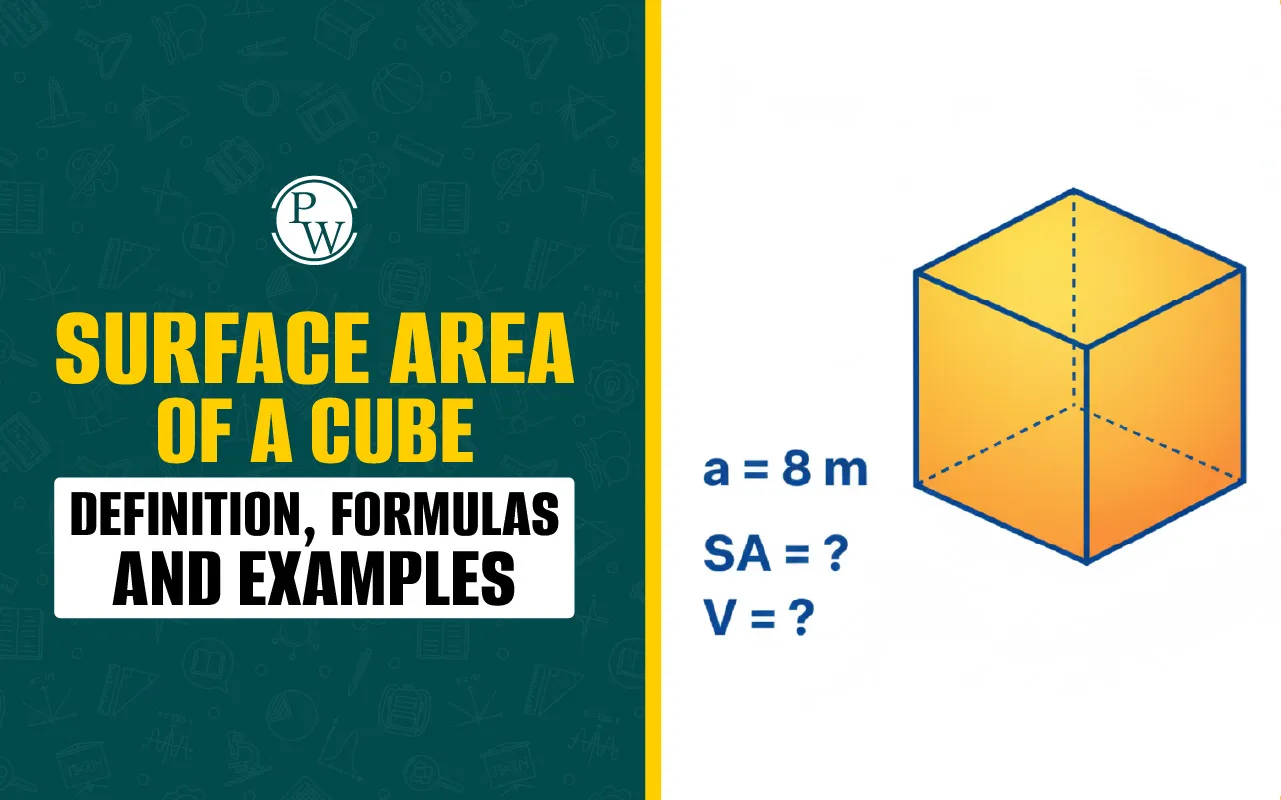
Surface Area of A Cube - Definition, Formulas and Examples
 Shivam Singh19 Jan, 2026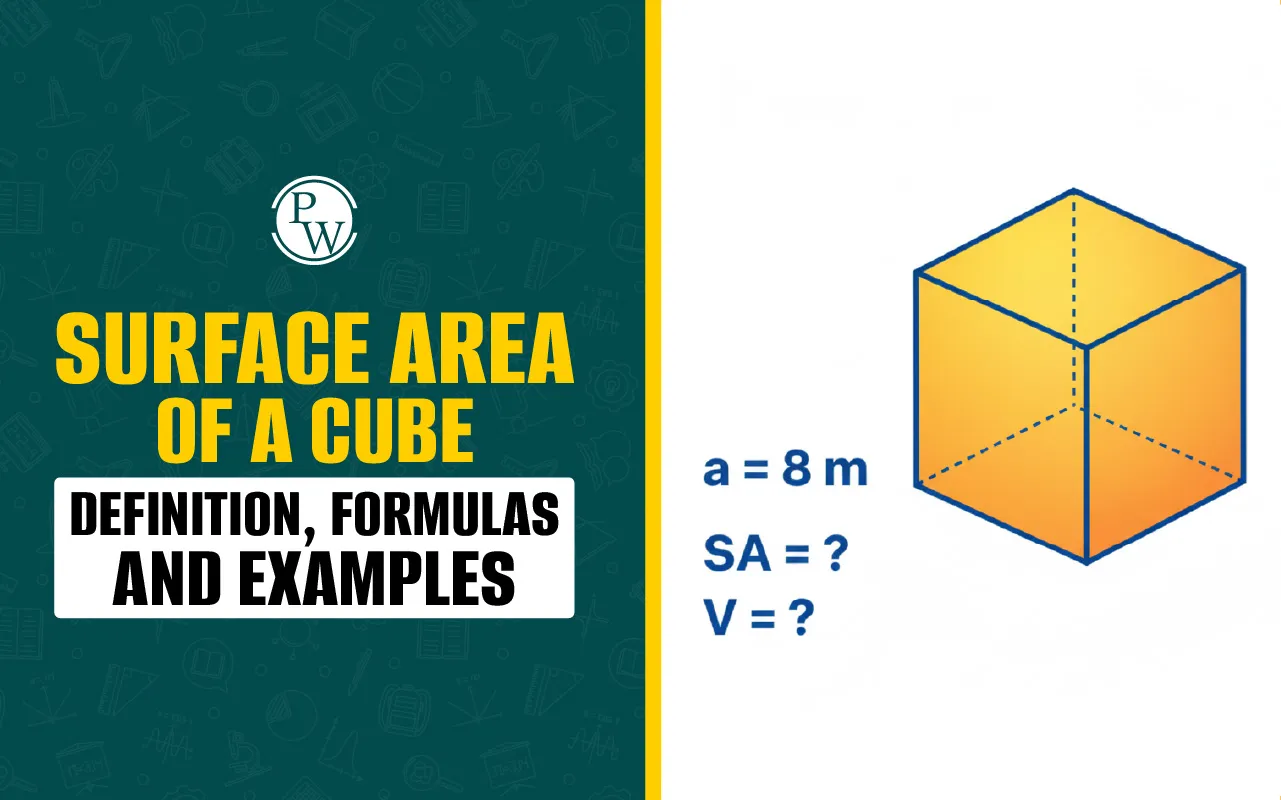
Surface Area of Cube
Surface Area of a Cube means finding out how much space is covered by the outside faces of a cube. A cube has six square faces, and all its sides are of equal length. To find the surface area, we calculate the area of one square face and then multiply it by 6, because a cube has six equal faces.
This topic helps students understand geometry, use formulas, and practice working with square units. It also builds the basics for learning about the volume and surface area of other 3D shapes.
Knowing how to find surface area is useful in real life, like when wrapping boxes or designing objects. Students can learn more about the surface area of cube formula, how to find surface area of a cube, example, and more below.
Read More: Area of Semicircle
What is the Surface Area of Cube?
The surface area of a cube is the total area of all six faces that cover the outside of the cube. Since each face of a cube is a square and all sides are equal in length, we use a simple formula to calculate it.
The surface area of cube formula is:
Surface Area = 6 × a²
Here, a is the length of one side (edge) of the cube. We find the area of one square face (a²) and multiply it by 6 because a cube has six equal faces.
The surface area is always written in square units like cm², m², or in², depending on the unit of the side length.
Total Surface Area of Cube
The Total Surface Area (TSA) of a cube is the total area of all the outer surfaces (faces) of the cube.Since a cube has 6 square faces of equal size, we can calculate the TSA by finding the area of one face and multiplying it by 6.
Formula for TSA of a Cube:
TSA = 6 × a²
Where:
-
a = length of one edge of the cube
-
a² = area of one square face
-
6a² = total area of all 6 square faces
Read More: Cone: Formula, Properties, Types, Examples
How to Find Surface Area of a Cube?
To find the surface area of a cube, you need to calculate the total area covered by all six square faces of the cube. Since each face is a square and all sides of a cube are equal, the formula becomes easy to use.
The surface area is found using this formula:
Surface Area of Cube = 6a²
Here, a is the length of one side (edge) of the cube. This formula works because a cube has six equal faces, and each face has an area of a × a = a².
Steps to Find TotalSurface Area of a Cube:
-
Measure the length of one edge of the cube (a).
-
Square the length: a × a = a²
-
Multiply the result by 6: Surface Area = 6a²
This method helps students understand how to apply formulas in geometry. It also connects to real-life uses like calculating the surface area of boxes or objects.
Read More: (a + b)³ Formula
Surface Area of Cube With Example
The surface area of a cube is the total area of all six square faces that cover the cube. Since each face of a cube is a square and all sides are equal, we use the formula:
Surface Area = 6 × a²
Example:
Question: What is the surface area of a cube if each side is 7 cm long?
Solution: Given, side length a = 7 cm
Surface Area = 6 × a²
= 6 × 7²
= 6 × 49
= 294 cm²
So, the surface area of the cube is 294 square centimeters.This example shows how to apply the formula using a given side length.
Also read: Median - Formula, Meaning, Example
Help Students Improve Math Confidence and Speed with CuriousJr
CuriousJr offers a Mental Maths Classes that helps students practice math calculations quickly and easily. The course uses a math-based curriculum to support learning and improve skills step by step.
Students can work on solving problems in their mind and become more comfortable with numbers. The lessons are designed to make math practice simple and clear, helping students build confidence and speed naturally.
PW CuriousJr provides tools for steady learning and better understanding of math concepts over time. Enroll today!