Collinear Points: Definition, Formula, Examples and Types
 Shivam Singh28 Sept, 2026
What Are Collinear Points?
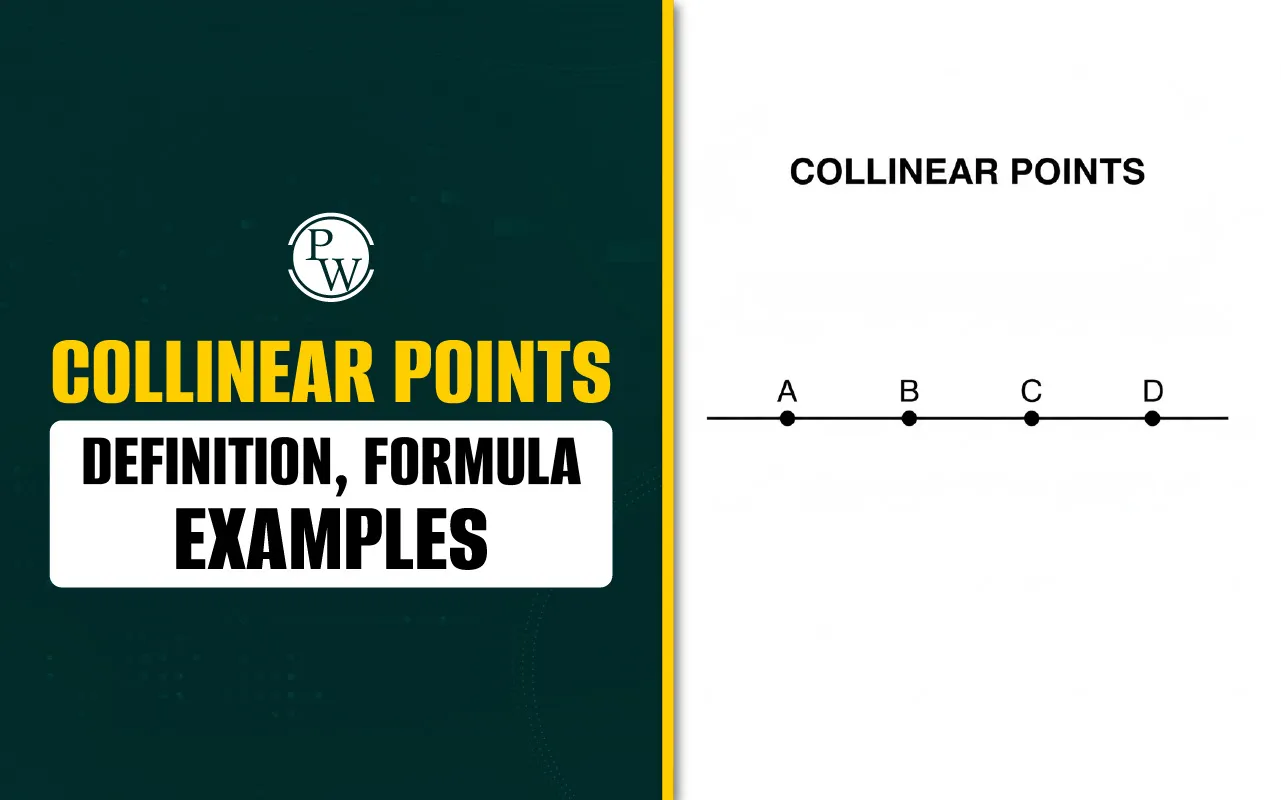
Collinear points are two or more points that lie on the same straight line.
For example, if points A, B and C all lie on one straight line, they are called collinear points.
The word collinear comes from:
- Co = together
- Linear = related to a line
So, collinear points are points that lie together on the same straight line. Students can explore more simple geometry concepts, maths activities, and educational resources on Curious Jr.
Simple Example of Collinear Points
Suppose three points are placed on a straight line:
A • —— • B —— • C
Since A, B and C lie on the same straight line, they are collinear.
Are Two Points Always Collinear?
Yes. Any two distinct points are always collinear because exactly one straight line can be drawn through any two distinct points.
The question of collinearity becomes important when there are three or more points.
For three points, we need to check whether all three lie on the same straight line.
Also Explore : Class 8 Mental Maths Classes for Strong Maths Basics
Collinear Points Meaning
In mathematics, collinear means lying on the same straight line.
Therefore:
Collinear points are points that lie on the same straight line.
For example:
-
A(1, 2)
-
B(2, 4)
-
C(3, 6)
These points are collinear because they all lie on the line:
y = 2x
Read More: Coincident Lines
What Are Non-Collinear Points?
Non-collinear points are points that do not lie on the same straight line.
For example, consider:
-
A(1, 1)
-
B(2, 3)
-
C(3, 2)
These three points do not lie on one straight line, so they are non-collinear.
Collinear vs Non-Collinear Points
|
Collinear Points |
Non-Collinear Points |
|
Lie on the same straight line |
Do not lie on the same straight line |
|
Can be connected by one straight line |
Cannot all be connected by one straight line |
|
Three points can form a degenerate triangle |
Three non-collinear points form a triangle |
|
Area of the triangle formed by three points is zero |
Area of the triangle formed by three points is greater than zero |
Collinear Points in Geometry
In geometry, collinearity describes the relationship between points and a straight line.
If points A, B and C all lie on one line, we can say:
A, B and C are collinear.
A straight line is uniquely determined by any two distinct points. Once two points are given, a third point is collinear with them only if it lies on that same line.
Collinearity is useful in:
-
geometry problems
-
coordinate geometry
-
proving geometric relationships
-
checking whether points are aligned
-
studying triangles and polygons
-
solving problems involving slopes and equations of lines
Read More: Cartesian Plane
Collinear Points in Coordinate Geometry
In coordinate geometry, points are represented using ordered pairs such as:
A(x₁, y₁), B(x₂, y₂), C(x₃, y₃)
We can determine whether the points are collinear by using different methods.
The most common methods are:
-
Slope method
-
Distance method
-
Area or determinant method
The area method is particularly useful when the slope method involves a vertical line.
Collinear Points Formula
There is not just one formula for checking collinearity. The method you use depends on the information given.
1. Slope Method
For three points:
A(x₁, y₁), B(x₂, y₂), C(x₃, y₃)
the slope of AB is:
m₁ = (y₂ - y₁) / (x₂ - x₁)
The slope of BC is:
m₂ = (y₃ - y₂) / (x₃ - x₂)
If:
m₁ = m₂
then the three points are collinear, provided the slopes are defined.
Important Point About Vertical Lines
If two points have the same x-coordinate, the line is vertical and its slope is undefined.
For example:
-
A(2, 1)
-
B(2, 4)
-
C(2, 7)
All three points lie on:
x = 2
Therefore, they are collinear even though the usual slope formula involves division by zero.
For such cases, the area method is a useful alternative.
2. Distance Method
If B lies between A and C and the three points are collinear, then:
AB + BC = AC
Use the distance formula:
AB = √[(x₂ - x₁)² + (y₂ - y₁)²]
BC = √[(x₃ - x₂)² + (y₃ - y₂)²]
AC = √[(x₃ - x₁)² + (y₃ - y₁)²]
If:
AB + BC = AC
then A, B and C are collinear with B between A and C.
Important Note
The condition AB + BC = AC specifically checks the case where B lies between A and C.
For a general collinearity test, the area or determinant method is often more direct.
3. Area or Determinant Method
Three points are collinear if the triangle formed by them has zero area.
For:
A(x₁, y₁), B(x₂, y₂), C(x₃, y₃)
the area is:
Area = 1/2 |x₁(y₂ - y₃) + x₂(y₃ - y₁) + x₃(y₁ - y₂)|
If:
Area = 0
then the points are collinear.
If:
Area ≠ 0
then the points are non-collinear.
This method works for vertical and non-vertical lines.
Read More: Before Number Concept
How to Find Collinear Points
To check whether three points are collinear:
Method 1: Compare Slopes
-
Write the coordinates of the three points.
-
Find the slope of the first pair.
-
Find the slope of the second pair.
-
Compare the slopes.
-
If they are equal, the points are collinear.
Method 2: Use the Area Formula
-
Write the three coordinates.
-
Substitute them into the area formula.
-
Simplify.
-
If the area is zero, the points are collinear.
-
If the area is not zero, the points are non-collinear.
Read More: Mean, Median, Mode
Method 3: Use Distances
If one point lies between the other two:
-
Calculate AB.
-
Calculate BC.
-
Calculate AC.
-
Check whether AB + BC = AC.
Collinear Points Examples
Example 1: Using the Slope Method
Check whether:
A(2, 3), B(4, 5), C(6, 7)
are collinear.
Step 1: Find the slope of AB
m₁ = (5 - 3) / (4 - 2)
m₁ = 2/2 = 1
Step 2: Find the slope of BC
m₂ = (7 - 5) / (6 - 4)
m₂ = 2/2 = 1
Since:
m₁ = m₂ = 1
the points A, B and C are collinear.
Example 2: Using the Distance Method
Check whether:
A(2, 3), B(4, 5), C(6, 7)
are collinear.
Step 1: Find AB
AB = √[(4 - 2)² + (5 - 3)²]
= √(4 + 4)
= √8 = 2√2
Step 2: Find BC
BC = √[(6 - 4)² + (7 - 5)²]
= √(4 + 4)
= 2√2
Step 3: Find AC
AC = √[(6 - 2)² + (7 - 3)²]
= √(16 + 16)
= √32 = 4√2
Step 4: Compare
AB + BC = 2√2 + 2√2 = 4√2
Since:
AB + BC = AC
the points are collinear, with B lying between A and C.
Example 3: Using the Area Method
Check whether:
X(1, 1), Y(2, 3), Z(3, 5)
are collinear.
Use:
Area = 1/2 |x₁(y₂ - y₃) + x₂(y₃ - y₁) + x₃(y₁ - y₂)|
Substitute the values:
Area = 1/2 |1(3 - 5) + 2(5 - 1) + 3(1 - 3)|
= 1/2 |-2 + 8 - 6|
= 1/2 |0|
= 0
Since the area is zero, the points X, Y and Z are collinear.
Example 4: Three Points with the Same x-Coordinate
Check whether:
P(4, 1), Q(4, 5), R(4, 9)
are collinear.
All three points have the same x-coordinate:
x = 4
Therefore, all three points lie on the vertical line:
x = 4
Hence, P, Q and R are collinear.
How to Check Collinearity Quickly
For many questions, you can use these quick checks:
|
Situation |
Result |
|
Any two distinct points |
Always collinear |
|
Three points have the same x-coordinate |
Collinear |
|
Three points have the same y-coordinate |
Collinear |
|
Slopes of two pairs are equal |
Collinear |
|
Area formed by three points is 0 |
Collinear |
|
Area formed by three points is not 0 |
Non-collinear |
|
One distance equals the sum of the other two |
Collinear, when the middle point lies between the other two |
Collinear Points on a Straight Line
If several points lie on one straight line, they are all collinear.
For example:
A(1, 2), B(2, 4), C(3, 6), D(4, 8)
all satisfy:
y = 2x
Therefore, A, B, C and D are collinear.
The concept is not limited to three points. Any number of points can be collinear if they all lie on the same straight line.
Collinear Triangle
Three collinear points cannot form an ordinary triangle.
If three points that would normally be vertices of a triangle lie on the same straight line, the resulting triangle is called a degenerate triangle.
Its area is:
0
For example, A, B and C are collinear, so they do not form a triangle with positive area.
By contrast, three non-collinear points form a triangle with positive area.
Applications of Collinear Points
Collinearity is useful in many areas of geometry and coordinate mathematics.
Geometry Proofs
Showing that certain points are collinear can help prove geometric relationships.
Coordinate Geometry
Collinearity can be checked using slopes, equations of lines and coordinate formulas.
Construction and Alignment
The concept helps determine whether points or objects lie along the same straight path.
Triangles and Polygons
Collinearity helps identify when points form ordinary or degenerate geometric figures.
Vector Geometry
In higher mathematics, collinearity is related to relationships between vectors and linear combinations.
Collinear Points Formula for Class 10
For Class 10 coordinate geometry questions, students commonly use the area method or the slope method, depending on the problem.
For three points:
A(x₁, y₁), B(x₂, y₂), C(x₃, y₃)
the area formula is:
Area = 1/2 |x₁(y₂ - y₃) + x₂(y₃ - y₁) + x₃(y₁ - y₂)|
If the points are collinear:
Area = 0
Students should also remember the slope condition:
Slope AB = Slope BC
when both slopes are defined.
Common Collinear Points Mistakes to Avoid
1. Forgetting That Two Points Are Always Collinear
Any two distinct points determine one straight line.
2. Using the Wrong Distance Formula
The correct distance formula is:
d = √[(x₂ - x₁)² + (y₂ - y₁)²]
Both coordinate differences must be squared.
3. Ignoring Vertical Lines
If two points have the same x-coordinate, the slope is undefined. This does not mean the points are non-collinear.
4. Mixing Up x and y Coordinates
Write each point carefully before substituting values into a formula.
5. Forgetting the Absolute Value in the Area Formula
The area formula includes an absolute value because area cannot be negative.
6. Assuming Collinearity Without Checking
Three points may look aligned in a diagram, but coordinate questions should be verified mathematically.
7. Using AB + BC = AC Without Checking the Order
This distance condition works when B lies between A and C. For a general test, use a method such as the area formula.
Collinear Points Practice Questions
Try these questions.
Question 1
Check whether the points:
(2, 3), (4, 7), (6, 11)
are collinear.
Question 2
Verify whether:
(1, 2), (3, 4), (5, 8)
are collinear.
Question 3
Check whether:
(0, 0), (4, 8), (6, 12)
are collinear using the slope method.
Question 4
Determine whether:
A(1, -1), B(2, 3), C(3, 7)
are collinear using the area method.
Question 5
Are the points:
P(3, 2), Q(3, 5), R(3, 9)
collinear?
Answers
1. Collinear
Slope of the first pair:
(7 - 3)/(4 - 2) = 2
Slope of the second pair:
(11 - 7)/(6 - 4) = 2
Therefore, the points are collinear.
2. Non-collinear
Slope of the first pair:
(4 - 2)/(3 - 1) = 1
Slope of the second pair:
(8 - 4)/(5 - 3) = 2
Since the slopes are different, the points are non-collinear.
3. Collinear
Slope from (0, 0) to (4, 8):
8/4 = 2
Slope from (4, 8) to (6, 12):
4/2 = 2
Therefore, the points are collinear.
4. Collinear
Using the area formula gives:
Area = 0
Therefore, A, B and C are collinear.
5. Collinear
All three points have:
x = 3
Therefore, they lie on the same vertical line and are collinear.
Collinear Points: Quick Revision
-
Collinear points lie on the same straight line.
-
Any two distinct points are always collinear.
-
Three or more points need to be checked for collinearity.
-
Equal slopes indicate collinearity when the slopes are defined.
-
Three points with the same x-coordinate lie on the same vertical line.
-
Three points with the same y-coordinate lie on the same horizontal line.
-
If the area formed by three points is zero, they are collinear.
-
If the area is greater than zero, the points are non-collinear.
-
AB + BC = AC can verify collinearity when B lies between A and C.
-
Three collinear points form a degenerate triangle with zero area.