Repeated Subtraction – Definition, Methods, Examples
 Nikita Aggarwal26 Mar, 2026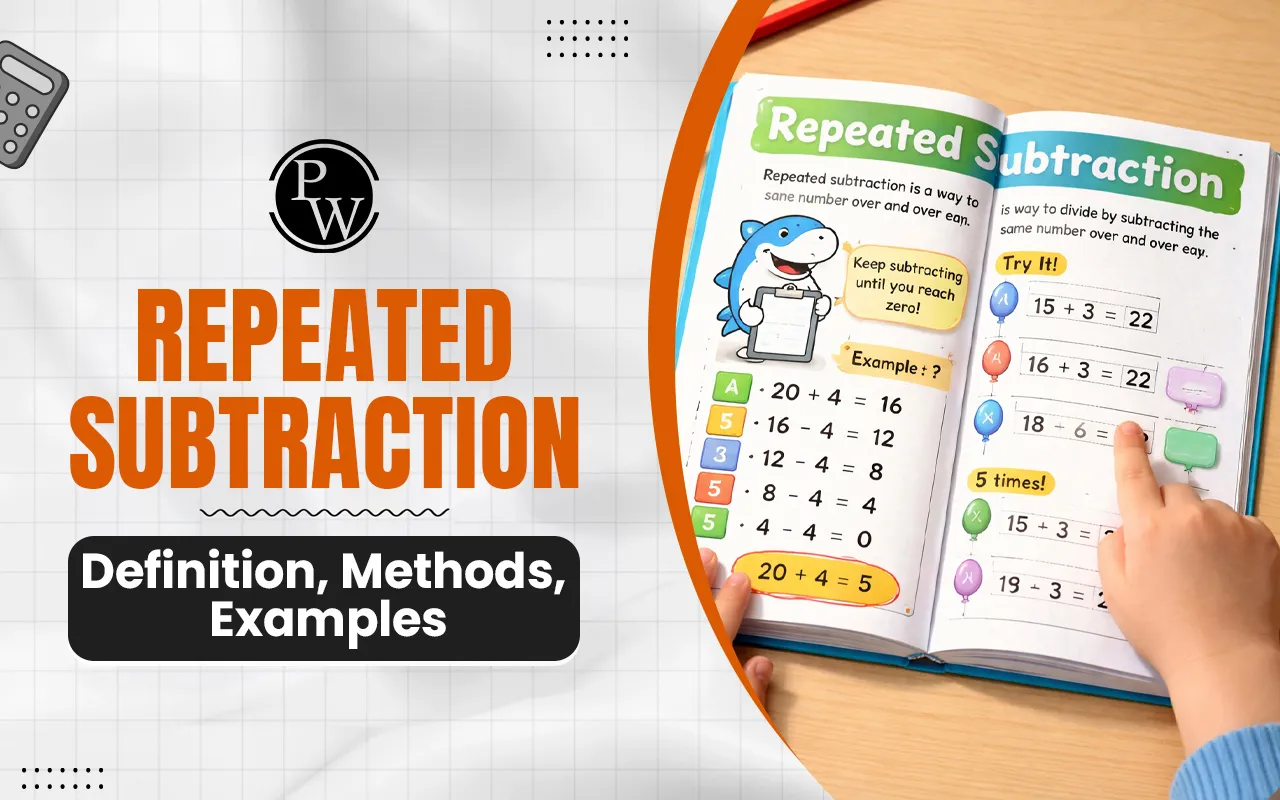
Repeated Subtraction Definition
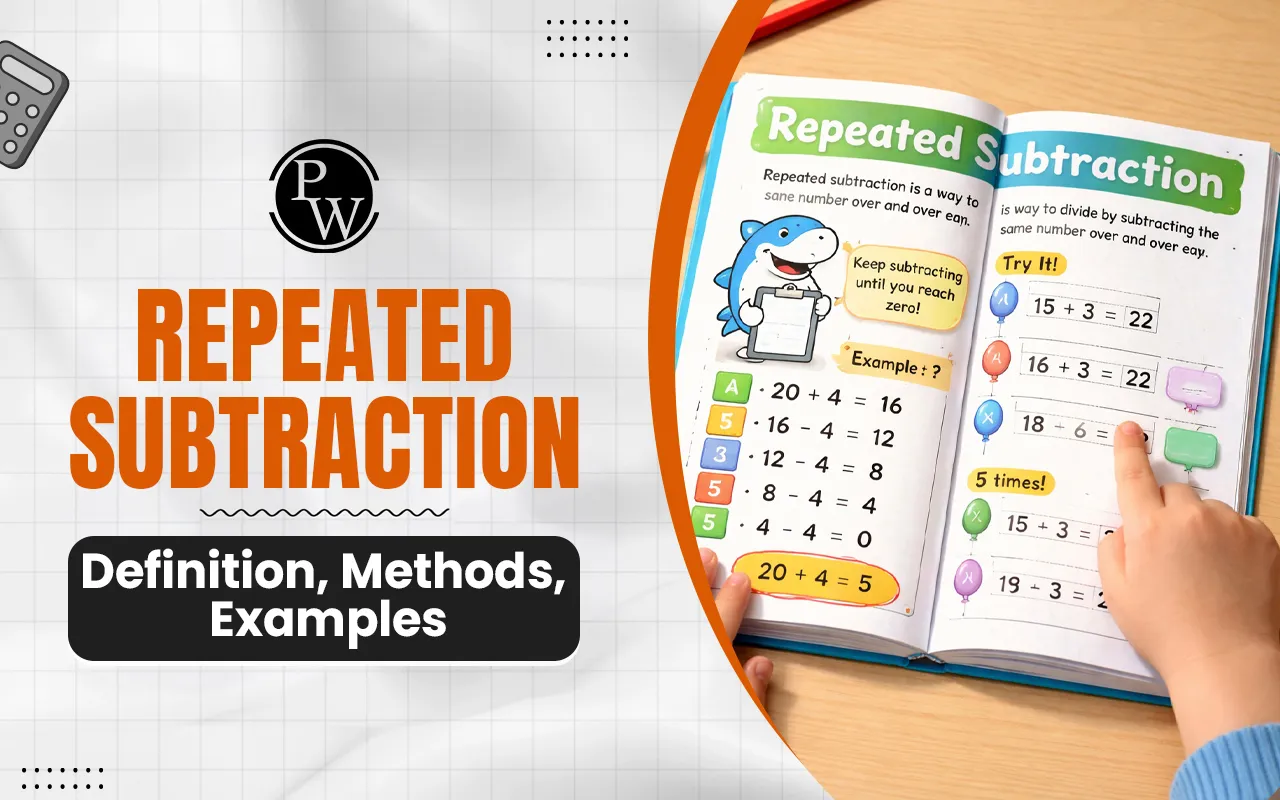
It is the process of subtracting the same number from a larger number until the result becomes zero or smaller than the number being subtracted. In school maths, this is often taught as an introduction to division.
If you are wondering what is repeated subtraction, think of it as taking away equal-sized groups from a total. For example, if you subtract 5 from 25 again and again, you get 20, 15, 10, 5, and then 0. Since 5 was removed five times, 25 ÷ 5 = 5.
This is why the method is so useful in the classroom. It helps students understand that division is not a new, strange rule. It's just a shorter way of illustrating the same equal-group procedure that subtraction can already illustrate.
Another crucial topic is how the dividend, divisor, quotient, and remainder work. The dividend is the number you start with, the divisor is the number you keep taking away, the quotient is the number of successful subtractions, and the remainder is what is left at the end.
Repeated Subtraction Methods for Basic Division
There are two classroom-friendly repeated subtraction methods that students commonly use. The first is direct subtraction on paper. The second is the number-line method, which is especially helpful for younger learners who like to see movement visually.
Method 1: Direct subtraction
In this method, the same number is subtracted one line at a time. Suppose we want to find 12 ÷ 3. We write 12 − 3 = 9, 9 − 3 = 6, 6 − 3 = 3, and 3 − 3 = 0. Since the subtraction happened four times, the answer is 4.
This method is useful because it builds patience and number sense. Students can clearly count how many equal groups were removed, and that count becomes the answer to the division question. It is simple, neat, and easy to check.
Method 2: Number line
The number-line approach turns subtraction into backward jumps. For example, to solve 15 ÷ 5, start at 15 and jump back by 5 each time: 15, 10, 5, 0. Since there are three equal jumps, the quotient is 3.
This method works well for visual learners because each jump represents one subtraction. Instead of seeing only numbers written in a column, students can actually observe how the total shrinks in equal steps until nothing more can be removed.
One more useful point is that the final result does not always have to be zero. Sometimes the process stops when the remaining number becomes smaller than the divisor. In that case, the leftover number becomes the remainder.
Repeated Subtraction Examples with Step-by-Step Answers
The best way to understand a new arithmetic skill is to work through repeated subtraction examples slowly. When students see the method in action, the link between subtraction and division becomes much clearer.
Example 1: 48 ÷ 8
Start with 48 and subtract 8 repeatedly:
48 − 8 = 40
40 − 8 = 32
32 − 8 = 24
24 − 8 = 16
16 − 8 = 8
8 − 8 = 0
The subtraction happens 6 times, so 48 ÷ 8 = 6. This example also shows how equal grouping works in word problems, such as sharing 48 apples among friends with 8 apples each.
Read More - Subtraction Property of Equality: Definition, Formula & Examples
Example 2: 70 ÷ 10
Now subtract 10 from 70 until you reach zero:
70 − 10 = 60
60 − 10 = 50
50 − 10 = 40
40 − 10 = 30
30 − 10 = 20
20 − 10 = 10
10 − 10 = 0
The subtraction happens 7 times, so the quotient is 7. This is a good example because it uses tidy tens, which makes the pattern easy to spot.
Example 3: 33 ÷ 5
This question shows what happens when a remainder is left:
33 − 5 = 28
28 − 5 = 23
23 − 5 = 18
18 − 5 = 13
13 − 5 = 8
8 − 5 = 3
Now the leftover 3 is smaller than 5, so we stop. The quotient is 6 because the subtraction happened six times, and the remainder is 3.
These solved sums reveal an important pattern. If the same number can be subtracted exactly until zero, the division is exact. If a smaller leftover remains, the division still works, but the answer includes a remainder.
Read More - How to Subtract With and Without Borrowing
Quick Revision For Repeated Subtraction in Maths
In school arithmetic, repeated subtraction in maths is often used as a bridge topic. It sits between subtraction and division, helping children move from one idea to the next without confusion. That is why teachers use it so often in primary classes.
Here are the key revision points students should keep in mind:
- It is the process of subtracting the same number repeatedly.
- It can be used to explain division.
- The number of subtractions gives the quotient.
- A leftover smaller than the divisor becomes the remainder.
- It can be shown through direct working or a number line.
This method is also helpful in simple real-life situations. It can be used to check how many boxes are needed, how many equal groups can be made, or how many times a fixed number fits into a larger number. In that sense, it trains both arithmetic and logical thinking.
Make Maths Easy and Enjoyable with CuriousJr
At CuriousJr, we help children overcome their fear of maths and build a strong foundation with confidence. Our Mental Maths online classes for students from Classes 1 to 8 focus on improving speed, accuracy, and logical thinking through simple techniques and interactive learning.
With our dual-mentor approach, students benefit from engaging live classes along with dedicated doubt-solving support after every session. Animated explanations, fun activities, and exciting challenges make maths easy to understand and enjoyable to learn.
Parents receive regular progress updates and can participate in review sessions, ensuring full transparency in their child’s learning journey.
Book a demo class today and discover how CuriousJr makes maths learning simple, interactive, and confidence-building for your child.