Percentage Increase Calculator: How to Use Percentage Increase Calculator
 Nikita Aggarwal10 Mar, 2026
What is a Percentage Increase Calculator?
A percentage rise calculator is a particular arithmetic tool that figures out how much a number has grown over time. In other words, it informs you how much bigger something has gotten since it started.
You can figure out the percentage increase by hand on paper, but it's faster and less likely to make mistakes when you use an online percentage increase calculator, especially when working with big numbers or decimals.
How to Calculate Percentage Increase (The Formula)
Before using a percent increase calculator, it is important to understand the logic the machine uses. The formula is quite simple and involves three main steps.
The Step-by-Step Formula:
-
Find the Increase: Subtract the Original Value from the New Value.
-
New Value - Original Value = Amount of Increase
-
Divide by the Original: Take that increase and divide it by the starting (Original) number.
-
Increase ÷ Original Value = Decimal Result
-
Convert to Percentage: Multiply the result by 100 to get the final percentage.
The Mathematical Equation:
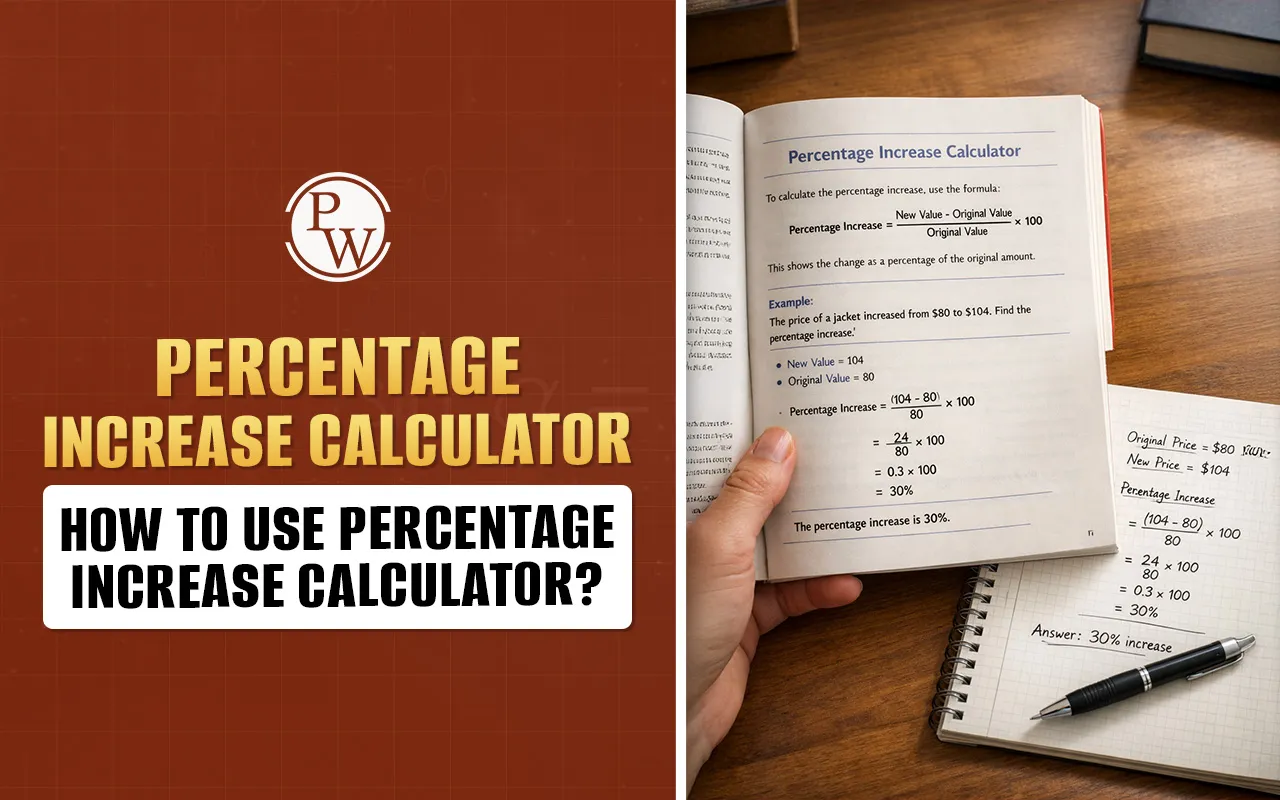
$$\text{Percentage Increase} = \left( \frac{\text{New Value} - \text{Original Value}}{\text{Original Value}} \right) \times 100$$
How to Use a Percentage Increase Calculator Online?
It's easy to use a percentage increase calculator. Most online tools have a standard layout:
-
Input the Original Value: This is the "Starting Value." If you have ₹50 yesterday, for example, type 50.
-
Input the New Value: This is the "Final Value." Enter 75 if you have ₹75 today.
-
Click "Calculate": Click "Calculate," and the program will display you the percentage right away. In this scenario, the percent increase calculator would show that the number went up by 50%.
Real-Life Examples: Seeing the Growth
Let's look at some fun scenarios where you might need to calculate percentage increase.
1. Test Score Improvement
Think about how you did on your first maths test: you got 40 points. You got 50 points on the next test after working hard with Curious Jr.
-
Increase: $50 - 40 = 10$
-
Divide: $10 \div 40 = 0.25$
-
Percentage: $0.25 \times 100 = \mathbf{25\%}$
-
Conclusion: Your score increased by 25%!
2. Growing Plants
On Monday, you planted a sunflower that was 10 cm tall. It grew to 15 cm by Sunday.
-
Original: 10
-
New: 15
-
Difference: 5
-
Calculation: $(5 \div 10) \times 100 = \mathbf{50\%}$
-
Conclusion: Your plant grew by 50% in one week!
Read More - Measurement Calculator | How to Use the Measurement Calculator?
Why Use a Percentage Increase Calculator?
You might wonder, "Why can't I just say it grew by 5?" It's easier to compare items when you use percentages.
- Standardization: The quantity is the same if one person grows from 10 to 15 (an increase of 5) and another person grows from 100 to 105 (an increase of 5). According to a percentage rise calculator, the first individual grew by 50% and the second person only increased by 5%.
-
Accuracy: It helps corporations, scientists, and students keep track of their development in a precise way.
-
Financial Literacy: Understanding % increase helps you grasp how bank interest and pricing increases work.
Common Mistakes to Avoid While Using Percentage Increase Calculator
People still have these "Oops!" situations, even using a percentage increase calculator:
-
Dividing by the New Value: This is the most common error. Always divide by the Original (starting) number.
-
Confusing Increase with Decrease: If your new value is smaller than the original, you have a percentage decrease. A good percent increase calculator will show a negative number if this happens.
-
Mixing Units: Ensure both numbers are in the same units (e.g., both in kg, or both in grams).
Read More - Age Calculator | How Age Calculator Works
Percentage Increase vs. Percentage Points
This is a bit tricky!
-
If your interest rate goes from 10% to 12%, that is a 2 percentage point increase.
-
However, if you use a percentage increase calculator, you’ll see that 12 is a 20% increase over 10.
-
Always be clear whether you are talking about the "points" or the "percentage of the original."
Practice Corner: Try it Yourself!
Can you find the percentage increase for these? (Answers below!)
-
Original: 20 | New: 25
-
Original: 80 | New: 120
-
Original: 200 | New: 300
Answers: 1. 25%, 2. 50%, 3. 50%
Make Maths Simple and Enjoyable with CuriousJr
At CuriousJr, we help children overcome their fear of maths and build a strong foundation in numbers with confidence. Our Mental Maths Online Classes for students from Classes 1 to 8 focus on improving speed, accuracy, and logical thinking through simple techniques and interactive learning.
- With our unique dual-mentor system, students attend live classes and also receive dedicated support for doubt-solving after every session. Animated explanations, engaging activities, and fun challenges make learning maths more interesting and effective.
- Parents also receive regular progress updates and can join review sessions to stay involved in their child’s learning journey.
- Book a demo class today and see how CuriousJr makes maths simple, engaging, and confidence-building for your child.