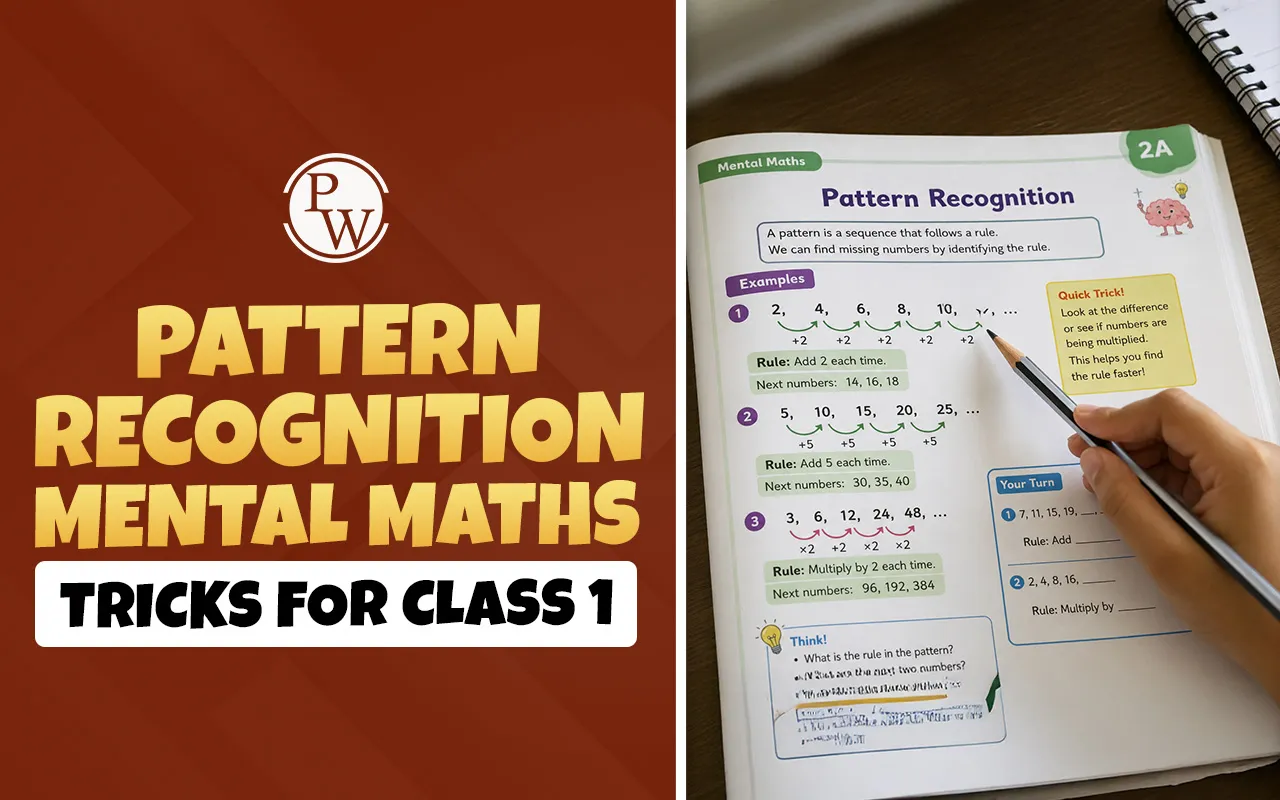
Pattern Recognition Mental Maths Tricks for Class 1
 Nikita Aggarwal29 May, 2026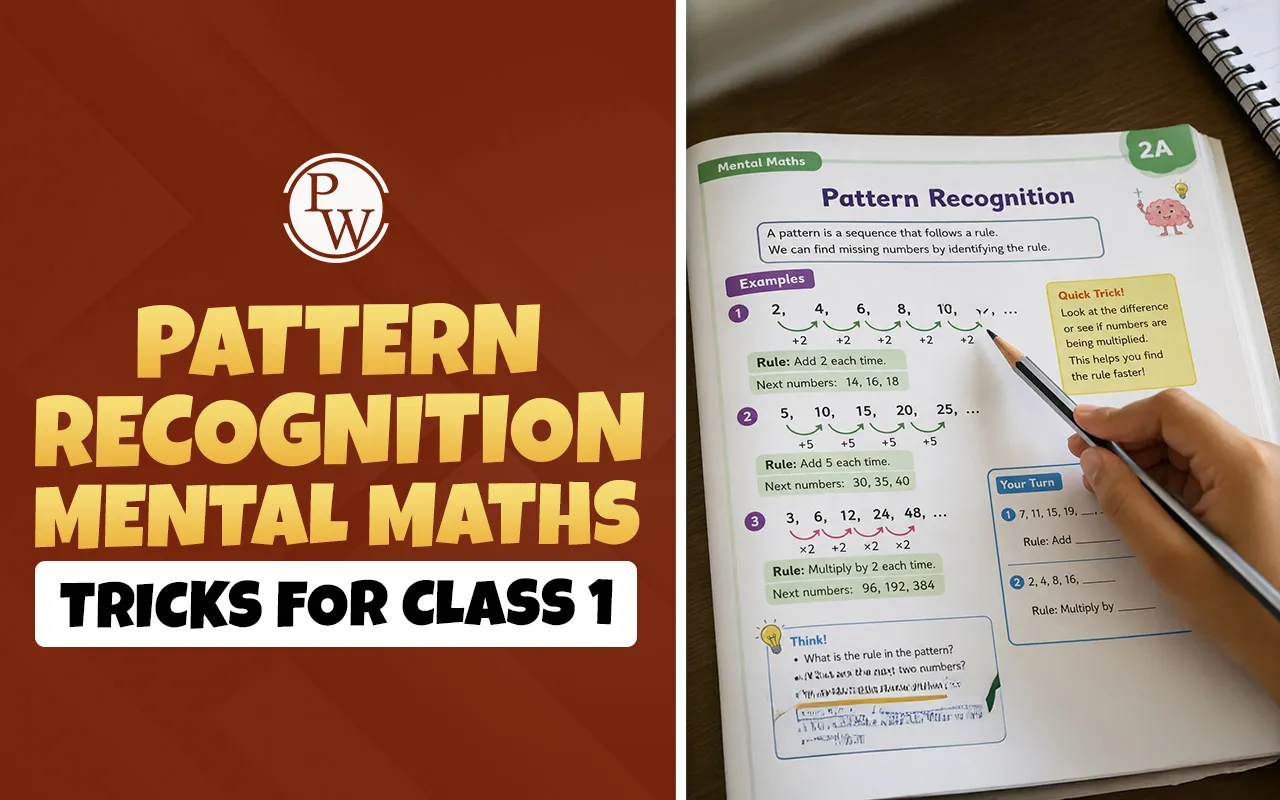
Importance of Pattern Recognition for Kids?
Children naturally look for order in their environment. They notice the rhythm of a song, the repetition in a storybook, or the alternating colours of traffic lights. In education, connecting these real-world observations to mathematical concepts is a core part of building early math reasoning skills.
When young pupils learn to spot mathematical regularities early on, they stop viewing mathematics as a set of rigid rules. Instead, they see it as a puzzle where one clue leads to the next.
Developing these recognition skills provides several distinct advantages for early learners:
-
Reduces Maths Anxiety: Recognising a repetitive structure makes an unfamiliar problem look familiar.
-
Improves Cognitive Flexibility: Children learn that a single problem can be viewed from multiple visual angles.
-
Prepares for Advanced Algebra: Understanding how a sequence grows forms the absolute foundation for future algebraic equations.
-
Enhances Working Memory: Tracking sequences trains the brain to hold and manipulate numerical information mentally.
Read More - Number Grouping Mental Maths Tricks for Class 1
Simple Pattern Recognition Mental Maths Tricks
Teaching young students to calculate mentally requires breaking numbers down into digestible, recurring pieces. Instead of counting fingers one by one, children can look at how digits interact with each other.
The following methods show how simple sequences make addition and subtraction effortless for seven-year-olds.
The Power of Making Tens
The number 10 is the most important anchor in our numerical system. Recognising pairs that combine to make 10 is an excellent example of mental Maths tricks for class 1.
The table below outlines the classic "Tens Pairs" that every young student should learn to recognise instantly to speed up mental calculations.
|
First Number |
Partner Number |
Visual Pattern Result |
|
1 |
9 |
Makes a perfect 10 |
|
2 |
8 |
Makes a perfect 10 |
|
3 |
7 |
Makes a perfect 10 |
|
4 |
6 |
Makes a perfect 10 |
|
5 |
5 |
Makes a perfect 10 |
Once a child recognises these pairs, adding larger numbers becomes simple. For instance, if a child needs to add 8 plus 5, they can mentally split the 5 into 2 and 3. They quickly combine 8 and 2 to make 10, then add the remaining 3 to get 13.
The Double Plus One Strategy
Children usually find double numbers (like 2 plus 2 or 5 plus 5) much easier to memorise than mixed combinations. We can use this natural comfort level as a tool for nearby numbers.
When faced with an equation like 6 plus 7, a child can use a simple two-step mental process:
-
Identify that 7 is just 1 more than 6.
-
Recall the double pattern: 6 plus 6 equals 12.
-
Add the extra 1 to the total: 12 plus 1 equals 13.
Read More - Mental Maths Games Using Dots for Class 1
How to Teach Pattern Recognition Mental Maths Tricks
Number lines and counting sequences are full of hidden structures. Helping your child see these structures makes counting feel like a shortcut rather than a long trek.
Here are the primary numerical sequences taught at this stage to establish strong foundational skills.
Skip Counting Patterns
Skip counting is the ultimate foundation for multiplication and advanced mental tracking. It helps children jump across the number line rhythmically.
-
The Twos Sequence (2, 4, 6, 8, 10): This teaches children to identify even numbers. The visual sequence always repeats the digits 2, 4, 6, 8, and 0 in the ones place.
-
The Fives Sequence (5, 10, 15, 20, 25): This sequence creates a highly predictable visual alternative. The numbers end strictly in either a 5 or a 0.
-
The Tens Sequence (10, 20, 30, 40, 50): This assists children in understanding place value, as the tens digit grows by exactly 1 while the ones digit stays locked at 0.
Pattern Recognition Mental Maths Tricks Using Shapes and Visual Sequences
Mathematics goes far beyond digits written on paper. For a Class 1 pupil, shapes, sizes, and colours provide the initial pathway toward logical mathematical reasoning.
Before children can master complex numerical sequences, they must first master repeating structural sequences using physical objects.
Repeating AB and ABC Sequences
An AB sequence is the simplest form of order that a child can learn. It consists of two elements alternating continuously.
The list below shows how these structural sequences progress in difficulty for young minds:
-
Basic AB Sequence: Red circle, Blue square, Red circle, Blue square.
-
AABB Sequence: Green triangle, Green triangle, Yellow star, Yellow star.
-
ABC Sequence: Large block, Medium block, Small block, Large block, Medium block, Small block.
To practice this mentally, ask your child to close their eyes while you read a sequence out loud. Stop suddenly and ask them to predict the next item using their mental image.
Fun Games to Practice Pattern Recognition Mental Maths Tricks
You do not need flashcards or boring worksheets to teach pattern recognition mental Maths tricks. The best learning happens naturally during daily routines and playtime.
Turning everyday observations into quick games keeps the brain active and shows that mathematics exists everywhere around us.
The Kitchen Utensil Game
The kitchen is a fantastic laboratory for logical sorting exercises. You can use everyday spoons and forks to create live puzzles.
-
Line up a spoon, a fork, a spoon, and a fork on the dining table.
-
Leave the next spot empty.
-
Ask your child to place the correct utensil in the blank space without your help.
-
Increase the difficulty by introducing teaspoons or butter knives to build complex structures.
The Clapping Rhythm Challenge
Physical movement helps lock sequences into a child's memory. You can use sound and touch to create non-visual mathematical puzzles.
Clap your hands twice, stomp your feet once, and then clap your hands twice. Ask your child to copy the sound structure exactly and tell you what action comes next. This simple activity trains the brain to recognise abstract structures across different bodily senses.
How CuriousJr Helps Learn Pattern Recognition Mental Maths Tricks
While daily games provide excellent foundational practice, children eventually need structured guidance to refine their analytical skills. Moving from physical toys to digital educational models can accelerate a child's intellectual development significantly.
A carefully designed learning framework ensures that your child steps up to harder problems at exactly the right pace. CuriousJr online mental maths classes are introducing interactive, gamified platforms allows children to apply their knowledge of pattern recognition for kids in a vibrant, supportive ecosystem.
Using the specialised educational mobile applications created by CuriousJr helps young students practice these exact techniques through interactive coding games and visual logic puzzles.
The platform transforms abstract numerical sequences into vivid adventures, helping Class 1 students master pattern recognition mental Maths tricks naturally while playing. By solving structured visual challenges on CuriousJr, children develop the fast, independent calculation abilities needed for academic success.