One to One Function - Definition and Examples
 Shivam Singh19 Jan, 2026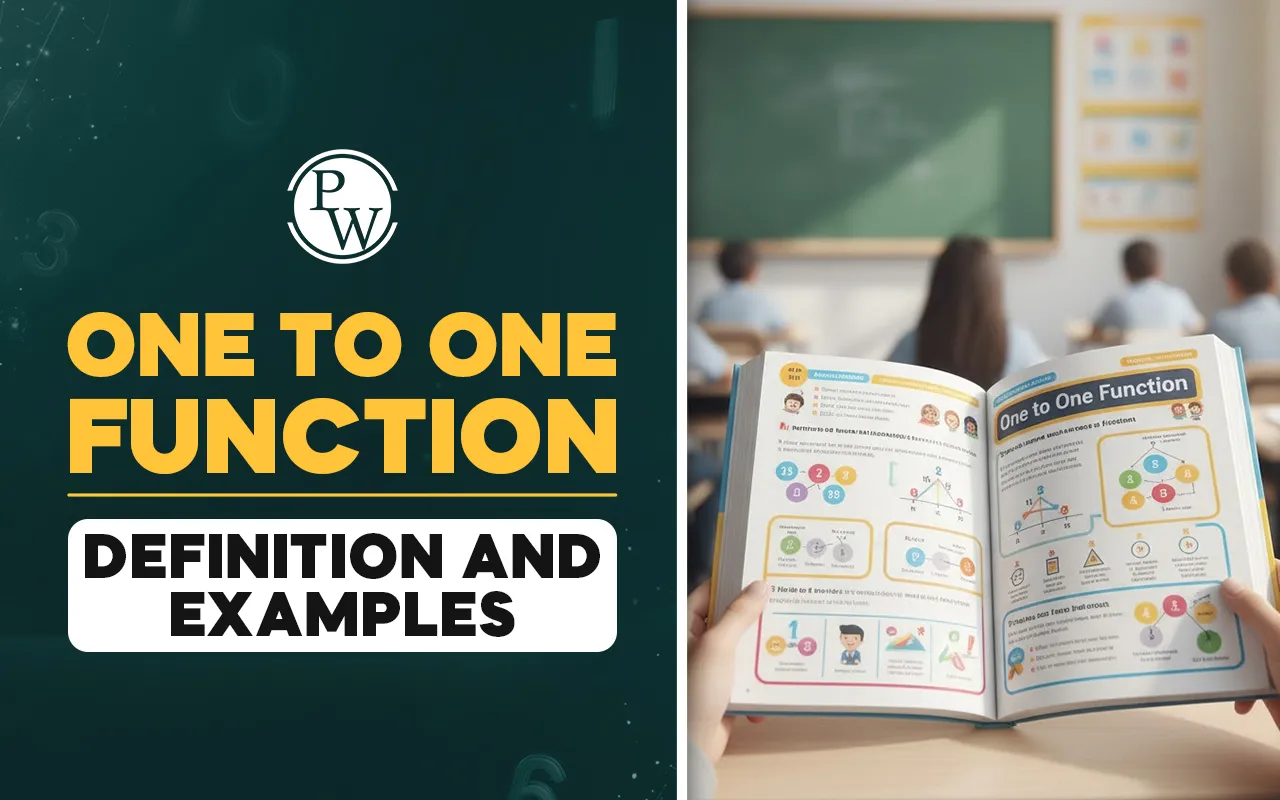
One to One Function
A one to one function, also known as an injective function, is a mathematical rule in which every input has a unique output. In simple words, no two different inputs give the same result. The one to one function definition helps in understanding relationships where each element in the domain (input set) connects to a distinct element in the range (output set).
In mathematics, functions describe how one quantity depends on another. A one to one function is a function where the value of x has a single value of y. The concept plays a significant role in algebra, geometry, calculus, and real life uses like coding, data arrangement and mapping systems. Understanding about what are one to one functions allows students to learn about how functions operate, how to recognize them, and how to find their inverses.
Read More: Coincident Lines
What are One to One Function?
One to one functions are special types of functions where every input corresponds to a unique output, and every output is linked to one input only. This means there are no repeated results for different inputs.
Mathematically, a function f(x) is one to one if f(a) = f(b) implies a = b. This ensures that each element of the domain maps to exactly one element in the range.
Examples:
-
f(x) = x + 5 → one to one function because each input gives a different output.
-
f(x) = x² → not one to one because f(2) = f(-2).
The one to one function definition helps identify functions that can have inverses, since only one to one functions have inverses that are also valid functions.
These functions are useful in many fields such as cryptography, data analysis, and computer programming, where unique mapping between elements is required.
One to One Function Graph
The one to one function graph is a visual way to understand whether a function is injective or not.
To check this, we use the horizontal line test. According to this test, if every horizontal line drawn across the graph cuts it at most once, then the function is one to one.
For example:
-
The graph of f(x) = x + 3 passes the horizontal line test, meaning it is a one to one function.
-
The graph of f(x) = x² fails this test because some horizontal lines intersect the graph twice, meaning it is not one to one.
The one to one function graph helps students visualize how inputs and outputs relate. It’s a quick and effective way to check if a function has an inverse or if it passes the test of uniqueness.
Read More: Cartesian Plane
How to Determine if a Function is One to One?
There are two main methods to check whether a function is one to one: the graphical method and the algebraic method.
1. Graphical Method (Horizontal Line Test)
Draw the graph of the function and pass horizontal lines across it.
-
If a line touches the graph only once → the function is one to one.
-
If a line touches more than once → the function is not one to one.
2. Algebraic Method
Assume f(a) = f(b) and prove that a = b.
If this is true for all values, the function is one to one.
Example:
For f(x) = 3x + 1
f(a) = 3a + 1 and f(b) = 3b + 1.
If f(a) = f(b), then 3a + 1 = 3b + 1 → a = b.
Hence, it is a one to one function.
These methods help determine the one to one function definition clearly and are useful in solving questions related to inverses and mapping in mathematics.
Properties of One to One Function
The properties of one to one function explain the key features that make it unique and easy to identify. These properties help in understanding how each input and output are connected in a special way.
1. Injectivity:
Every input has a special output. There is no single result of some two different inputs. When f(a) = f(b) can result in a = b, it means that the function is one to one.
2. Existence of Inverse:
One to one functions have inverses which are also functions. The inverse is the reverse of the mapping i.e. it transforms the outputs into their original inputs.
3. Horizontal Line Test:
A one to one function passes the horizontal line test, which implies that none of horizontal lines crosses the graph more than once. This indicates that there is only one input value per output value.
4. Domain and Range Relationship:
In a one to one function, each element of the domain (input) matches exactly one element of the range (output). This makes it possible to find an inverse function.
5. Composition Property:
When one has two one to one functions, then the outcome is also one to one function. It is helpful in more complex subjects such as transformations and composition of functions.
Read More: Pictorial Representation of Data
Steps to Find Inverse of One to One Function
One to one functions have inverses which are valid since each output in the range is associated with a single input in the domain. The inverse of a one to one function switches the position of the inputs and outputs, and we are capable of tracing the results of this to the original value.
To get the inverse of a one to one function use the following steps:
Step 1: Replace f(x) with y
Write the function as y = f(x) to make it easier to work with.
Step 2: Swap the variables
Exchange x and y to get x = f(y). This shows that you are reversing the function.
Step 3: Solve for y
Rearrange the equation so that y is by itself on one side. This expresses the inverse relationship.
Step 4: Write the inverse function
Replace y with f⁻¹(x) to represent the inverse function.
Example: Given f(x) = 2x + 3
Step 1: Write as y = 2x + 3
Step 2: Swap → x = 2y + 3
Step 3: Solve → y = (x - 3)/2
Step 4: Write inverse → f⁻¹(x) = (x - 3)/2
This shows that the inverse function undoes the operation of the original function. If f(x) doubles and adds 3, then f⁻¹(x) subtracts 3 and divides by 2.
Also Read: Reciprocal
Improve Math Speed and Confidence with PW CuriousJr’s Mental Maths Course
PW CuriousJr’s Mental Maths Classes helps students build strong calculation skills, improve accuracy, and boost confidence in solving math problems. The program is structured step-by-step, covering all key math topics to strengthen understanding and make learning easier.
The course focuses on mental calculation techniques, encouraging students to solve problems quickly in their minds. Lessons are simple, engaging, and interactive, allowing regular practice without pressure or fear of making mistakes.
Students review and strengthen the basic operations of addition, subtraction, multiplication, and division, while learning smart tricks and shortcuts to solve questions faster. Continuous practice builds mental agility, improves school performance, and enhances problem-solving confidence.
PW CuriousJr’s fun and student-focused approach makes math enjoyable and stress-free. It is perfect for learners who want to improve their math speed, think logically, and become confident in everyday calculations.
One to One Function FAQs
What is a one-to-one and an example?
Is there any way to tell whether a function is one-to-one?
What is a one to one rule in math?
Is a one-to-one relationship a function?