NCERT Solutions for Class 7 Science Chapter 3 Heat
 Nivedita Dar11 Sept, 2026

NCERT Solutions for Class 7 Science Chapter 3 Heat play an important role in helping students understand basic ideas about heat and temperature. Questions and answers on heat in Class 7 explain how energy moves from one object to another and how it affects our daily life. This chapter clearly explains the difference between heat and temperature and teaches students how to use a thermometer correctly to measure temperature.
Students also learn about the different ways heat travels, such as conduction, convection, and radiation, with simple examples. These concepts help in understanding why metal spoons become hot quickly or how heat from the Sun reaches the Earth. The chapter also explains practical topics like why we wear cotton clothes in summer and woollen clothes in winter.
NCERT Solutions provide clear, step-by-step answers that follow the latest syllabus and exam pattern. They help students revise concepts easily, prepare for exams, and build a strong foundation in science. Regular practice of these solutions improves understanding and boosts confidence.
Class 7 Science Chapter 3 Heat Questions and Answers
Question 1: State the similarities and differences between a clinical thermometer and a laboratory thermometer .
Answer: Similarities between the laboratory thermometer and the clinical thermometer
- Laboratory thermometer and the clinical thermometer thermometers consist of long narrow uniform glass tubes.
- Laboratory thermometer and the clinical thermometer have a bulb at one end.
- Laboratory thermometer and the clinical thermometer contain mercury in the bulb.
- Laboratory thermometer and the clinical thermometer use Celsius scale on the glass tube.
Differences between the laboratory thermometer and the clinical thermometer:
A clinical thermometer reads temperature 35°C to 45°C while the range of laboratory thermometer is -10°C to 110°C.
The clinical thermometer has a kink near the bulb while there is no kink in the laboratory thermometer. Due to kink, mercury does not fall down on its own in clinical thermometer.
Question2: Give two examples each of insulators and conductors of heat.
Answer:
Conductors – silver, copper
Insulators – rubber, plastic.
Question3: Complete the sentence with appropriate answers:
1.____________ can determine an object’s hotness.
2.___________ Thermometer cannot be used to measure the temperature present in boiling water.
3.__________ Degree is used to measure temperature.
4.___________ requires no medium for heat transfer for the process.
5.An ice-cold steel fork is dipped into a mug of hot water. The transfer of heat to the other end is by the process of ___________.
6.____________ Color clothes absorb heat better than clothes of light colors.
Answers:
1. Temperature can determine the object hotness .
2.Clinical Thermometer cannot be used to measure the temperature of boiling water.
3.Celsius Degree is used to measure temperature.
4.Radiation requires no medium for heat transfer for the process
5. An ice-cold steel fork is dipped into a mug of hot water. Transfer of heat to the other end is by the process of conduction.
6.Dark Color clothes absorb heat better than clothes of light colors.
Question 4: Match the following:
| 1. Land breeze blows during | (a) day |
| 2. Sea breeze blows during | (b) summer |
| 3. Dark colored clothes are preferred during | (c) night |
| 4. Light colored clothes are preferred during | (d) winter |
Answers:
| 1. Land breeze blows during | (c) night |
| 2. Sea breeze blows during | (a) day |
| 3. Dark colored clothes are preferred during | (d) winter |
| 4. Light colored clothes are preferred during | (b) summer |
Question5: Wearing more layers of clothes during winter keeps us warmer than wearing only one thick piece of clothing. Discuss why.
Answer: More layers of clothing actually keep us warmer in winters as they have a lot of space between them. That space gets filled up with air. Air is a bad conductor; it does not allow the body heat to escape out.
Question6: Mark the places in which the heat is being transferred by convection, conduction and by radiation.
Answer:
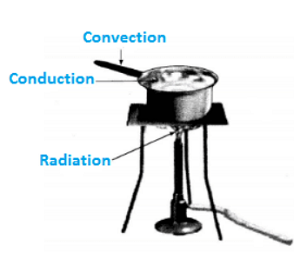
Question7: Explain why buildings in the places that have hotter climate are advised to paint the outer walls white.
Answer: Since the white color reflects heat, it helps the house to not get heated up so much.
Question8: When a liter of water at 50°C is mixed with another liter of water at 30°C what will be the temperature of the mixture?
(1) 80°C
(2) lesser than 80°C but greater than 50°C
(3) 20°C
(4) Between 50°C and 30°C
Answer: (4) Between 50°C and 30°C
Question9: In a mug that contains water at 40°C, an iron ball which is 40°C is dropped. Mention the flow of heat:
1.Flow from the iron ball to water.
2.Will not flow from water to iron ball or from iron ball to water.
3.Will flow from the water to the iron ball.
4.Both the temperatures increase.
Answer: (2) Will not flow from water to iron ball or from iron ball to water.
Question10: A wooden fork is dipped in a bowl of ice-cold water and its other end:
1.Becomes cold due to the process of convection
2.becomes cold due to the process of radiation
3.becomes cold due to the process of conduction
4.Doesn’t become cold.
Answer:
(4) Doesn’t become cold.
Question 11: Why stainless steel pans that we use at home is are provided with copper bottoms? The reason might be:
1.Such type of pans appear to be colorful
2.Copper is a much better conductor of heat than that of stainless steel.
3.Copper is much easier to clean after use when compared to that stainless steel
4.Copper bottoms in pans are more durable.
Answer:
(2) Copper is a much better conductor of heat than that of stainless steel.
Extended Learning—Activities and Projects
Question 1: Go to a doctor or your nearest health centre. Observe the doctor taking temperature of patients. Enquire:
Answer:
- why she dips the thermometer in a liquid before use.
- whey the thermometer is kept under the tongue.
- whether the body temperature can be measured by keeping the thermometer at some place other than the mouth.
- whether the temperature of different parts of the body is the same or different.
You can add more questions which come to your mind.
Question 2: Go to a veterinary doctor (a doctor treats animals). Discuss and find out the normal temperature of domestic animals and birds.
Answer: The normal temperature of domestic animals and birds are recorded as follows:
The normal temperature of Goat varies from 37 0 - 40 0 C.
The normal temperature of a dog is about 38.3 0 C
The normal temperature of a pigeon (bird) is 40 0 C.
The normal temperature of a cat is 38 0 C
Question 3: Wrap a thin paper strip tightly around an iron rod. Try to burn the paper with candle while rotating the iron rod continuously. Does it burn? Explain your observation.
Answer: The paper will not be burnt while rotating the iron rod continuously because iron being a good conductor of heat, allow heat to pass through them. As a result heat is taken away from the paper and the paper doesn’t burn.
Question 4:Take a sheet of paper. Draw a spiral on it as shown in the Fig. 4.14. Cut out the paper along the line. Suspend the paper as shown in Fig. 4.14 above a lighted candle. Observe what happens. Think of an explanation.
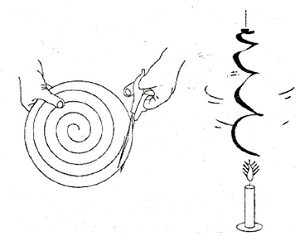
Answer: When the spiral paper is suspended at flame, then the paper spiral will keep moving because due to convection process, there will be transfer of heat and the air present above the flame will move up which results in movement of paper spiral.
Question 5: Take two similar transparent glasses of bottles having wide mouths. Put a few crystals of potassium permanganate or pour a few drops of ink in the bottle. Fill this bottle with hot water. Fill the other bottle with cold water. Cover the cold water bottle with a thick piece of paper such as a post card. Press the post card firmly with one hand and hold the bottle with the other hand. Invert the bottle and place it on top of the hot water bottle. Hold both the bottles firmly. Ask some other person to pull the post card. Observe what happens. Explain.
Answer: When the card will be removed, then due to diffusion process there will be movement of colored hot water in upward direction and cold water in downward direction. It happened because hot fluid i.e. hot water is lighter than the cold water.
Mastering Heat Class 7 Question and Answers
You need to understand how energy moves in order to do well on your tests. Heat doesn't just sit still; it moves from things that are hotter to those that are cooler until they are all at the same temperature. The basic purpose of heat class 7 questions and answers is still the same: to understand thermal energy.
When you understand these ideas, you can explain things that happen every day, such why a metal spoon gets heated in soup. It's not enough to only remember facts; you also need to see the science in your kitchen and closet. You may make sure that your study is in line with the most common academic standards across different educational boards by focusing on heat class 7 questions and answers jkbose and heat class 7 questions and answers cbse.
How to Use Thermometers and Understand Temperature
Temperature serves as a reliable measure of the hotness or coldness of an object. You can't always rely on your sense of touch because it can be quite deceptive. We use a device called a thermometer to get an accurate reading.
-
Temperature Definition: It's the degree of hotness of an object.
-
Thermometer: The device used to measure temperature.
In your heat class 7 question and answers sets, you'll often find questions about the scales used. In India, we primarily use the Celsius scale, though clinical thermometers also show the Fahrenheit scale, which ranges from 94 to 108 degrees.
Methods of Heat Transfer: Conduction, Convection, and Radiation
Heat moves in three distinct ways. It's fascinating how different materials handle this flow.
-
Conduction: This process involves heat passing from the hotter end to the colder end of an object without the object itself moving. It's the primary way heat travels through solids like metals.
-
Convection: This occurs in liquids and gases. When part of a fluid is heated, it rises, and cooler fluid moves in to take its place.
-
Radiation: Ever felt the sun's warmth? That's radiation. It doesn't require any medium (like air or water) to travel through space.
Comparing Clinical and Laboratory Thermometers
Understanding the difference between these two is a vital part of the heat class 7 question and answers cbse curriculum.
|
Feature |
Clinical Thermometer |
Laboratory Thermometer |
|
Purpose |
Measures human body temperature. |
Measures temperature of substances in labs. |
|
Range |
35°C to 42°C. |
Generally -10°C to 110°C. |
|
Kink |
Has a kink to prevent mercury from falling. |
No kink; mercury falls as soon as it's removed. |
|
Usage |
Can be tilted while reading. |
Must be kept upright while taking a reading. |
The kink is a small constriction. It ensures the mercury level doesn't drop immediately after you take the thermometer out of your mouth, allowing for an accurate reading of your body's heat.
The Role of Conductors and Insulators
Not all materials are created equal when it comes to heat. Some are generous and let heat pass through easily, while others are quite stubborn.
-
Conductors: Materials that allow heat to pass through them easily. Examples include aluminum, iron, and copper. This is why cooking pans are made of metal.
-
Insulators: These materials don't allow heat to pass through easily. Wood, plastic, and rubber are great insulators. You'll notice that pan handles are often made of plastic so you don't burn your hand.
Air and water are actually poor conductors of heat. This is why wearing two thin sweaters in winter keeps you warmer than one thick one; the air trapped between the layers acts as an insulator.
The differences between sea breezes and land breezes
Coastal areas experience a unique phenomenon due to convection. This is a common topic in heat class 7 questions and answers extra assignments.
Sea Breeze: During the day, the land heats up faster than the water. The warm air over the land rises, and the cool air from the sea rushes in to take its place. We call this the sea breeze.
Land Breeze: At night, the land cools down faster than the sea. The warm air over the sea rises, and the cool air from the land moves toward the sea. This is the land breeze.
How CuriousJr Makes Online Learning Enjoyable and Effective
Supporting a child’s education needs patience, care, and the right guidance. With CuriousJr, online learning at home becomes a positive and engaging experience for both children and parents.
Parents rely on CuriousJr’s online tuition classes because they keep students motivated, focused, and confident. We create a warm and friendly learning space where children feel comfortable learning without pressure.
Our lessons are designed to build clear understanding while encouraging curiosity and creativity. Using interactive sessions, fun activities, regular practice, and engaging learning tools, we make concepts easy and enjoyable to learn.
CuriousJr’s skilled mentors provide personalised support in our online school tuition programs, adjusting teaching methods to match each child’s learning speed. This helps students overcome difficulties and learn with confidence.
Parents also value the regular, detailed feedback from teachers, which helps them track progress and understand where their child needs extra support.
Book a demo class today and see how CuriousJr can make your child’s learning journey smoother and more enjoyable.
|
Related Articles |





Heat Class 7 Question and Answers FAQs
What is the usual temperature of a person?
Why do we like to wear light-colored clothes in the summer?
Is it possible to use a clinical thermometer to check the temperature of milk that is boiling?

Get Free Counselling Today
and Clear up all your Doubts
 Live & recorded classes available at easeDashboard for progress trackingLakhs of practice questions