
NCERT Solutions for Class 7 Science Chapter 1 Nutrition in Plants
NCERT Solutions for Class 7 Science Chapter 1 Nutrition in Plants with clear answers, diagrams, and explanations for exams and revision.
 Nivedita Dar29 May, 2026
Nutrition in plants for class 7 questions with answers provides a foundational understanding of how living organisms consume and utilize food. This chapter explores autotrophic and heterotrophic modes, explaining how green plants synthesize food through photosynthesis. By practicing these solutions, students grasp complex biological processes like chlorophyll function, stomatal gas exchange, and nutrient replenishment in soil.
NCERT Solutions for Class 7 Science Chapter 1
NCERT Solutions for Class 7 Science Chapter 1 Nutrition in Plants help students understand how plants make and obtain food. The solutions clearly explain important concepts like photosynthesis, autotrophic and heterotrophic nutrition, parasites, saprophytes, and symbiosis. All answers are written in simple language as per the latest NCERT syllabus, making them easy to learn and revise. These solutions are useful for homework, exam preparation, and quick revision. By studying them, Class 7 students can build strong basics in science, improve understanding, and gain confidence in answering textbook and exam questions.
Nutrition in Plants for Class 7 Questions with Answers
To help you prepare, here are the solved exercises based on the NCERT textbook.
Question 1: Why do organisms need to take food?
Answer: All living organisms require food to survive. It gives them the energy to perform various activities. All activities such as playing, running, walking, studying, etc. require energy. The various components present in our food such as carbohydrates, proteins, fats, vitamins, and minerals provide energy to our body. These are also important for the growth and development of the body.
Question 2: Distinguish between a parasite and a saprotroph.
Answer:
| Parasite | Saprotroph |
| The organism that grows on the body of another organism and derives nutrients from it is known as a parasite. | The organism that obtains nutrients from the dead or decaying organic matter is called saprotroph. |
| Examples of parasites are Cuscuta and orchids. | Examples of saprotrophs are fungi and some bacteria. |
| Parasites absorb prepared food from the host. | Saprotrophs digest food outside the body and absorbs digested food. |
| Example of parasites are cuscuta and orchids. | Example of saprotrophs are fungi and some bacteria. |
Question 3: How would you test the presence of starch in leaves?
Answer: Experiment to test the presence of starch in leaves:
Take two healthy green potted plants of the same type. Keep one potted plant in a dark room for one or two days to remove all the starch from the leaves. Keep the other plant in sunlight. Now, take one leaf from each potted plant and put a few drops of iodine solution on them. Then note down the observation.
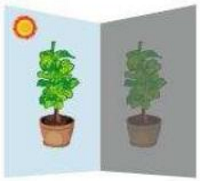
Plants are kept in light and dark conditions. No blue-black color will be observed on the leaves of the plant kept in the dark room. This indicates the absence of starch. Blue-black color will be observed on the leaves of the plant kept in sunlight. This indicates the presence of starch.
Question 4: Give a brief description of the process of synthesis of food in green plants.
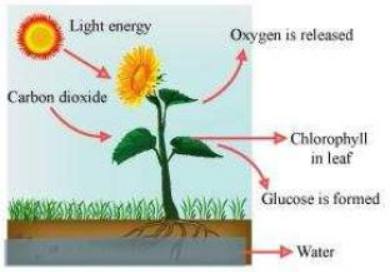
Answer: Photosynthesis is defined as the process in which chlorophyll-containing plant cells synthesize food in the form of carbohydrates, using carbon dioxide and water in the presence of solar energy.
Photosynthesis Sources of raw materials required for photosynthesis: (a) Water is taken in from the roots of the plant and is transported to the leaves. (b) Carbon dioxide from the air enters the leaves through the tiny pores called stomata and diffuses to the cells containing chlorophyll. (c) Solar energy is used to break water into hydrogen and oxygen. This hydrogen is combined with carbon dioxide to form food for the plants, which is ultimately used by the animals as well. Thus, photosynthesis can be represented by the following equation.

Question 5: Show with the help of a sketch that the plants are the ultimate source of food.
Answer:
Question 6: Fill in the blanks:
(a) Green plants are called __________ since they synthesize their own food. (b) The food synthesised by the plants is stored as __________. (c) In photosynthesis solar energy is captured by the pigment called ___________. (d) During photosynthesis plants take in ___________and release ___________.
Answer: (a) Green plants are called autotrophs since they synthesise their own food.
(b) The food synthesised by the plants is stored as starch. (c) In photosynthesis solar energy is captured by the pigment called chlorophyll. (d) During photosynthesis plants take in carbon dioxide and release oxygen.
Question 7: Name the following:
(i) A parasitic plant with yellow, slender and tubular stem. (ii) A plant that has both autotrophic and heterotrophic mode of nutrition. (iii) The pores through which leaves exchange gases. Answer: (i) Cuscuta (ii) Pitcher plant (iii) Stomata
Question 8: Tick the correct answer:
(a) Amarbel is an example of (i) autotroph (ii) parasite (iii) saprotroph (iv) host (b)The plant which traps and feeds on insects is (i) Cuscuta (ii) china rose (iii) pitcher plant (iv) rose
Answer: (a)Amarbel is an example of
(i) autotroph (ii) parasite (iii) saprotroph (iv) host (b)The plant which traps and feeds on insects is (i) Cuscuta (ii) China rose (iii) pitcher plant (iv) rose
Question 9: Match the items given in Column I with those in Column II:
| Column I | Column II |
| Chlorophyll | Bacteria |
| Nitrogen | Heterotrophs |
| Amarbel | Pitcher plant |
| Animals | Leaf |
| Insects | Parasite |
Answer:
| Column I | Column II |
| Chlorophyll | Leaf |
| Nitrogen | Bacteria |
| Amarbel | Parasite |
| Animals | Heterotrophs |
| Insects | Pitcher plant |
Question 10: Mark ‘T’ if the statement is true and ‘F’ if it is false:
(i) Carbon dioxide is released during photosynthesis. (T/F) (ii) Plants which synthesise their food themselves are called saprotrophs. (T/F) (iii) The product of photosynthesis is not a protein. (T/F) (iv) Solar energy is converted into chemical energy during photosynthesis. (T/F)
Answer: (i) Carbon dioxide is released during photosynthesis. (F)
(ii) Plants which synthesise their food themselves are called saprotrophs. (F) (iii) The product of photosynthesis is not a protein. (T) (iv) Solar energy is converted into chemical energy during photosynthesis. (T)
Question 11: Choose the correct option from the following:
Which part of the plant takes in carbon dioxide from the air for photosynthesis? (i) Root hair (ii) Stomata (iii) Leaf veins (iv) Sepals
Answer: (ii) Stomata
Question 12: Choose the correct option from the following:
Plants take carbon dioxide from the atmosphere mainly through their: (i) roots (ii) stem (iii) flowers (iv) leaves
Answer: (iv) leaves
Comprehensive Guide to Nutrition in Plants for Class 7 Questions with Answers
Every living organism requires energy to perform life processes, and this energy comes from food. In Chapter 1 of the Class 7 Science curriculum, we look at the unique ways plants manage their dietary needs. Unlike animals, most plants can prepare their own food using simple raw materials found in their surroundings. This ability sets the stage for the entire food chain on Earth.
When you study nutrition in plants for class 7 questions with answers, you'll notice a heavy focus on photosynthesis. It’s the "food factory" of the plant. Understanding where these factories are located—specifically in the leaves—is vital for scoring well in your exams. We need to look at how water, carbon dioxide, and sunlight come together to create glucose and oxygen.
Modes of Nutrition: Autotrophs vs. Heterotrophs
Plants exhibit different modes of nutrition depending on their environment and biological makeup. Most green plants are autotrophs. The term "auto" means self, and "trophos" means nourishment. These organisms use light energy to convert carbon dioxide and water into complex organic compounds. It’s a fascinating chemical miracle that happens right in your backyard.
However, not all plants have the luxury of green leaves. Some plants lack chlorophyll and must rely on food produced by other plants. These are known as heterotrophs. For example, Cuscuta (Amarbel) is a parasite that climbs on a host plant to suck nutrients directly from it. You might also encounter insectivorous plants like the Pitcher plant. These unique species trap insects to fulfill their nitrogen requirements because the soil they grow in is often nutrient-poor.
The Mechanism of Photosynthesis
Photosynthesis is the primary reason life exists as we know it. Without it, there would be no food. Carbon dioxide from the air is taken in through tiny pores called stomata, which are usually located on the underside of leaves. These pores are guarded by "guard cells" that regulate their opening and closing.
-
Chlorophyll: The green pigment that captures solar energy.
-
Raw Materials: Water and minerals are transported to the leaves by vessels that run like pipes throughout the root, stem, and branches.
-
The Reaction: During the process, oxygen is released into the atmosphere, which we then breathe.
Saprotrophs and Symbiosis
Have you ever seen fluffy, umbrella-like patches growing on rotting wood during the rainy season? These are fungi. Fungi don't have chlorophyll and don't eat like animals. Instead, they secrete digestive juices onto dead and decaying matter, converting it into a solution, and then absorbing the nutrients. This mode is called saprotrophic nutrition.
Sometimes, organisms live together and share both shelter and nutrients. This relationship is called symbiosis. A classic example is lichens, where an alga (which is autotrophic) and a fungus live in close association. The fungus provides shelter and water, while the alga provides the food it prepares through photosynthesis.
How Nutrients are Replenished in the Soil
Farmers often spread manure or fertilizers in their fields. Have you ever wondered why? Plants absorb minerals and nutrients from the soil continuously, causing the amount in the soil to decline. Fertilizers contain essential nutrients like nitrogen, potassium, and phosphorous.
A natural way to replenish the soil involves the bacterium Rhizobium. It lives in the root nodules of leguminous plants like peas, grams, and beans. Rhizobium can take atmospheric nitrogen and convert it into a usable soluble form for the plant. In return, the plant provides food and shelter to the bacteria—another beautiful example of a symbiotic relationship. This is why farmers often rotate crops with legumes to maintain soil fertility without excessive chemical fertilizers.
How CuriousJr Online Tuition Classes Support Better Learning for Your Child
CuriousJr’s online school tuition classes are specially created for students from Class 3 to Class 8. These classes help children develop strong subject understanding and build confidence in their daily school learning.
Key highlights of the program include:
-
Daily interactive sessions that keep students involved and make concepts easier to understand and remember.
-
Complete coverage of core subjects such as Maths, Science, English, and Social Studies, following the latest school curriculum.
-
Regular assessments and detailed feedback to monitor progress and support continuous improvement.
-
Personalised mentor support that focuses on each child’s strengths and helps them overcome learning gaps step by step.





NCERT Solutions for Class 7 Science Chapter 1 FAQs
Where can I get the PDF file with the answers to the class 7 questions about plant nutrition?
You may download high-quality PDF versions of these solutions on the official NCERT website or on educational sites like CuriousJr. This will make it easier to study.
What do stomata do during photosynthesis?
Stomata are small holes in the surface of a leaf that let gases pass through. They take in carbon dioxide, which is needed to make food, and let out oxygen as a waste product.
What makes the leaf the plant's food factory?
The leaf is dubbed the food factory since that's where food is made, thanks to chlorophyll and sunlight.
Do all plants make their own food?
No, most of them are autotrophic, but others are parasitic (like Cuscuta), saprotrophic (like some fungi), or even insectivorous (like the Venus flytrap).
How does PW CuriousJr help you learn about science?
PW CuriousJr offers interactive tools and logic-based learning to help students understand scientific ideas through coding and creative projects. This makes subjects like "Nutrition in Plants" more interesting.





Get Free Counselling Today
and Clear up all your Doubts
 Live & recorded classes available at easeDashboard for progress trackingLakhs of practice questions

