NCERT Solutions for Class 7 Maths Chapter 1 Integers
 Shivam Singh11 Sept, 2026
NCERT Solutions for Class 7 Maths Chapter 1
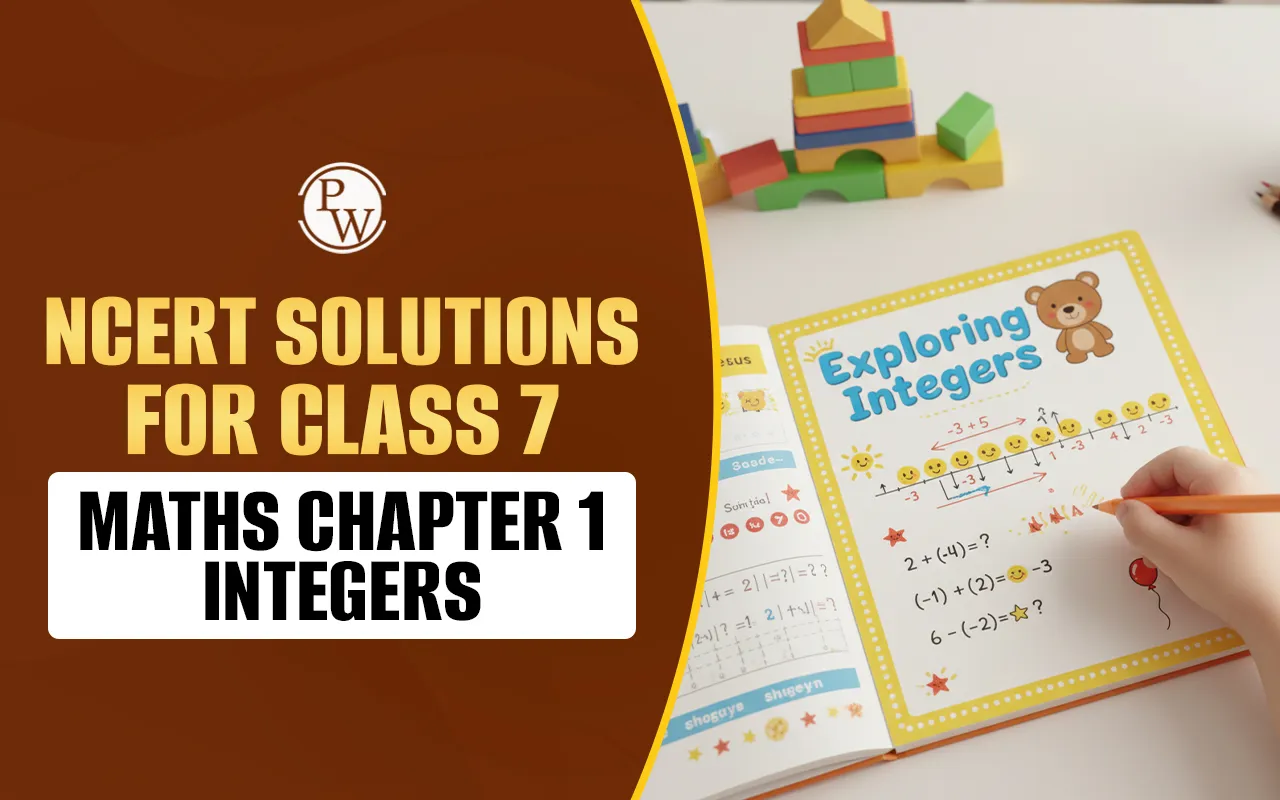
Class 7 Maths Chapter 1 Integers builds a strong foundation for understanding numbers beyond whole numbers. In integers class 7, students learn about positive integers, negative integers, and zero, which are useful in real-life situations like temperature, profit and loss, and elevation. Class 7 maths chapter 1 integers explains how integers are represented on a number line and how their order is decided.
In class 7th maths chapter 1, students also learn important operations such as addition, subtraction, multiplication, and division of integers using clear rules and examples. These rules help avoid confusion and make calculations easier. Class 7 chapter 1 focuses on concept clarity so that students can solve problems confidently in exams.
The class 7th integers chapter includes plenty of practice problems to improve accuracy and speed. With class 7 maths chapter 1 solution, students can understand step-by-step methods to solve questions correctly. The integers class 7 questions answers section is especially helpful for revision, homework, and exam preparation.
Overall, class 7 maths chapter 1 integers is an important chapter that strengthens basic maths skills and prepares students for advanced topics in higher classes. Regular practice and clear understanding are the keys to mastering this chapter.
Class 7 Chapter 1 Integers Questions Answers
Exercise 1.1 Page: 4
1. Following number line shows the temperature in degree celsius (c o ) at different places on a particular day.

(a) Observe this number line and write the temperature of the places marked on it.
Solution:-
By observing the number line, we can find the temperature of the cities as follows: The temperature in Lahulspiti is -8 o C The temperature in Srinagar is -2 o C The temperature in Shimla is 5 o C The temperature in Ooty is 14 o C The temperature in Bengaluru is 22 o C
(b) What is the temperature difference between the hottest and the coldest places among the above?
Solution:-
From the number line, we observe that The temperature at the hottest place, i.e., Bengaluru, is 22 o C The temperature at the coldest place, i.e., Lahulspiti, is -8 o C Temperature difference between hottest and coldest place is = 22 o C – (-8 o C) = 22 o C + 8 o C = 30 o C Hence, the temperature difference between the hottest and the coldest place is 30 o C.
(c) What is the temperature difference between Lahulspiti and Srinagar?
Solution:-
From the given number line, The temperature in Lahulspiti is -8 o C The temperature in Srinagar is -2 o C ∴ The temperature difference between Lahulspiti and Srinagar is = -2 o C – (8 o C) = – 2 O C + 8 o C = 6 o C
(d) Can we say the temperature of Srinagar and Shimla, taken together, is less than the temperature in Shimla? Is it also less than the temperature in Srinagar?
Solution:-
From the given number line, The temperature in Srinagar =-2 o C The temperature in Shimla = 5 o C The temperature of Srinagar and Shimla, taken together, is = – 2 o C + 5 o C = 3 o C ∴ 5 o C > 3 o C So, the temperature of Srinagar and Shimla, taken together, is less than the temperature at Shimla. Then, 3 o > -2 o No, the temperature of Srinagar and Shimla, taken together, is not less than the temperature of Srinagar.
2. In a quiz, positive marks are given for correct answers and negative marks are given for incorrect answers. If Jack’s scores in five successive rounds were 25, – 5, – 10, 15 and 10, what was his total at the end?
Solution:-
From the question, Jack’s score in five successive rounds are 25, -5, -10, 15 and 10 The total score of Jack at the end will be = 25 + (-5) + (-10) + 15 + 10 = 25 – 5 – 10 + 15 + 10 = 50 – 15 = 35 ∴ Jack’s total score at the end is 35.
3. At Srinagar temperature was – 5°C on Monday, and then it dropped by 2°C on Tuesday. What was the temperature of Srinagar on Tuesday? On Wednesday, it rose by 4°C. What was the temperature on this day?
Solution:-
From the question, The temperature on Monday in Srinagar = -5 o C The temperature on Tuesday in Srinagar dropped by 2 o C = Temperature on Monday – 2 o C = -5 o C – 2 o C = -7 o C The temperature on Wednesday in Srinagar rose by 4 o C = Temperature on Tuesday + 4 o C = -7 o C + 4 o C = -3 o C Thus, the temperature on Tuesday and Wednesday was -7 o C and -3 o C, respectively.
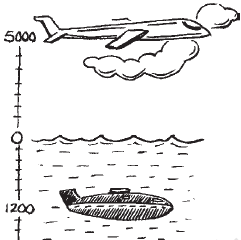
4. A plane is flying at the height of 5000 m above sea level. At a particular point, it is exactly above a submarine floating 1200 m below sea level. What is the vertical distance between them?
Solution:-
From the question, The plane is flying at a height = 5000 m Depth of submarine = -1200 m The vertical distance between plane and submarine = 5000 m – (- 1200) m = 5000 m + 1200 m = 6200 m
5. Mohan deposits ₹ 2,000 in his bank account and withdraws ₹ 1,642 from it the next day. If the withdrawal of the amount from the account is represented by a negative integer, then how will you represent the amount deposited? Find the balance in Mohan’s account after the withdrawal.
Solution:-
Withdrawal of the amount from the account is represented by a negative integer. Then, the deposit of the amount to the account is represented by a positive integer. From the question, Total amount deposited in bank account by the Mohan = ₹ 2000 The total amount withdrawn from the bank account by the Mohan = – ₹ 1642 Balance in Mohan’s account after the withdrawal = amount deposited + amount withdrawn = ₹ 2000 + (-₹ 1642) = ₹ 2000 – ₹ 1642 = ₹ 358 Hence, the balance in Mohan’s account after the withdrawal is ₹ 358.
6. Rita goes 20 km towards the east from point A to point B. From B, she moves 30 km towards the west along the same road. If the distance towards the east is represented by a positive integer, then how will you represent the distance travelled towards the west? By which integer will you represent her final position from A?

Solution:-
From the question, it is given that A positive integer represents the distance towards the east. Then, the distance travelled towards the west will be represented by a negative integer. Rita travels a distance in the east direction = 20 km Rita travels a distance in the west direction = – 30 km ∴ Distance travelled from A = 20 + (- 30) = 20 – 30 = -10 km Hence, we will represent the distance travelled by Rita from point A by a negative integer, i.e., – 10 km
7. In a magic square, each row, column and diagonal have the same sum. Check which of the following is a magic square .

Solution:-
First, we consider the square (i) By adding the numbers in each row, we get = 5 + (- 1) + (- 4) = 5 – 1 – 4 = 5 – 5 = 0 = -5 + (-2) + 7 = – 5 – 2 + 7 = -7 + 7 = 0 = 0 + 3 + (-3) = 3 – 3 = 0 By adding the numbers in each column, we get = 5 + (- 5) + 0 = 5 – 5 = 0 = (-1) + (-2) + 3 = -1 – 2 + 3 = -3 + 3 = 0 = -4 + 7 + (-3) = -4 + 7 – 3 = -7 + 7 = 0 By adding the numbers in diagonals, we get = 5 + (-2) + (-3) = 5 – 2 – 3 = 5 – 5 = 0 = -4 + (-2) + 0 = – 4 – 2 = -6 Because the sum of one diagonal is not equal to zero. So, (i) is not a magic square Now, we consider the square (ii) By adding the numbers in each row, we get = 1 + (-10) + 0 = 1 – 10 + 0 = -9 = (-4) + (-3) + (-2) = -4 – 3 – 2 = -9 = (-6) + 4 + (-7) = -6 + 4 – 7 = -13 + 4 = -9 By adding the numbers in each column, we get = 1 + (-4) + (-6) = 1 – 4 – 6 = 1 – 10 = -9 = (-10) + (-3) + 4 = -10 – 3 + 4 = -13 + 4 = 0 + (-2) + (-7) = 0 – 2 – 7 = -9 By adding the numbers in diagonals, we get = 1 + (-3) + (-7) = 1 – 3 – 7 = 1 – 10 = -9 = 0 + (-3) + (-6) = 0 – 3 – 6 = -9 (ii) square is a magic square because the sum of each row, each column and the diagonal is equal to -9.
8. Verify a – (– b) = a + b for the following values of a and b.
(i) a = 21, b = 18
Solution:-
From the question, a = 21 and b = 18 To verify a – (- b) = a + b Let us take Left Hand Side (LHS) = a – (- b) = 21 – (- 18) = 21 + 18 = 39 Now, Right Hand Side (RHS) = a + b = 21 + 18 = 39 By comparing LHS and RHS LHS = RHS 39 = 39 Hence, the value of a and b is verified.
(ii) a = 118, b = 125
Solution:-
From the question, a = 118 and b = 125 To verify a – (- b) = a + b Let us take Left Hand Side (LHS) = a – (- b) = 118 – (- 125) = 118 + 125 = 243 Now, Right Hand Side (RHS) = a + b = 118 + 125 = 243 By comparing LHS and RHS, LHS = RHS 243 = 243 Hence, the value of a and b is verified.
(iii) a = 75, b = 84
Solution:-
From the question, a = 75 and b = 84 To verify a – (- b) = a + b Let us take Left Hand Side (LHS) = a – (- b) = 75 – (- 84) = 75 + 84 = 159 Now, Right Hand Side (RHS) = a + b = 75 + 84 = 159 By comparing LHS and RHS, LHS = RHS 159 = 159 Hence, the value of a and b is verified.
(iv) a = 28, b = 11
Solution:-
From the question, a = 28 and b = 11 To verify a – (- b) = a + b Let us take Left Hand Side (LHS) = a – (- b) = 28 – (- 11) = 28 + 11 = 39 Now, Right Hand Side (RHS) = a + b = 28 + 11 = 39 By comparing LHS and RHS, LHS = RHS 39 = 39 Hence, the value of a and b is verified.
9. Use the sign of >, < or = in the box to make the statements true.
(a) (-8) + (-4) [ ] (-8) – (-4)
Solution:-
Let us take Left Hand Side (LHS) = (-8) + (-4) = -8 – 4 = -12 Now, Right Hand Side (RHS) = (-8) – (-4) = -8 + 4 = -4 By comparing LHS and RHS, LHS < RHS -12 < -4 ∴ (-8) + (-4) [<] (-8) – (-4) (b) (-3) + 7 – (19) [ ] 15 – 8 + (-9) Solution:- Let us take Left Hand Side (LHS) = (-3) + 7 – 19 = -3 + 7 – 19 = -22 + 7 = -15 Now, Right Hand Side (RHS) = 15 – 8 + (-9) = 15 – 8 – 9 = 15 – 17 = -2 By comparing LHS and RHS, LHS < RHS -15 < -2 ∴ (-3) + 7 – (19) [<] 15 – 8 + (-9)
(c) 23 – 41 + 11 [ ] 23 – 41 – 11
Solution:-
Let us take Left Hand Side (LHS) = 23 – 41 + 11 = 34 – 41 = – 7 Now, Right Hand Side (RHS) = 23 – 41 – 11 = 23 – 52 = – 29 By comparing LHS and RHS, LHS > RHS – 7 > -29 ∴ 23 – 41 + 11 [>] 23 – 41 – 11
(d) 39 + (-24) – (15) [ ] 36 + (-52) – (- 36)
Solution:-
Let us take Left Hand Side (LHS) = 39 + (-24) – 15 = 39 – 24 – 15 = 39 – 39 = 0 Now, Right Hand Side (RHS) = 36 + (-52) – (- 36) = 36 – 52 + 36 = 72 – 52 = 20 By comparing LHS and RHS, LHS < RHS 0 < 20 ∴ 39 + (-24) – (15) [<] 36 + (-52) – (- 36)
(e) – 231 + 79 + 51 [ ] -399 + 159 + 81
Solution:-
Let us take Left Hand Side (LHS) = – 231 + 79 + 51 = – 231 + 130 = -101 Now, Right Hand Side (RHS) = – 399 + 159 + 81 = – 399 + 240 = – 159 By comparing LHS and RHS, LHS > RHS -101 > -159 ∴ – 231 + 79 + 51 [>] -399 + 159 + 81
Exercise 1.2 Page: 9
1. Write down a pair of integers whose:
(a) sum is -7
Solution:-
= – 4 + (-3) = – 4 – 3 … [∵ (+ × – = -)] = – 7
(b) the difference is – 10
Solution:-
= -25 – (-15) = – 25 + 15 … [∵ (- × – = +)] = -10
(c) sum is 0
Solution:-
= 4 + (-4) = 4 – 4 = 0
2. (a) Write a pair of negative integers whose difference gives 8
Solution:-
= (-5) – (- 13) = -5 + 13 … [∵ (- × – = +)] = 8
(b) Write a negative integer and a positive integer whose sum is – 5.
Solution:-
= -25 + 20 = -5
(c) Write a negative integer and a positive integer whose difference is – 3.
Solution :-
= – 2 – (1) = – 2 – 1 = – 3
3. In a quiz, team A scored – 40, 10, 0 and team B scored 10, 0, – 40 in three successive rounds. Which team scored more? Can we say that we can add integers in any order?
Solution:-
From the question, it is given that The score of team A = -40, 10, 0 Total score obtained by team A = – 40 + 10 + 0 = – 30 The score of team B = 10, 0, -40 Total score obtained by team B = 10 + 0 + (-40) = 10 + 0 – 40 = – 30 Thus, the score of both the A team and B team is the same. Yes, we can say that we can add integers in any order.
Read More: How to Subtract With and Without Borrowing
Comprehensive Class 7 Maths Chapter 1 Solutions and Key Concepts
Getting good at numbers is an important step in your middle school journey since it prepares you for algebra. When you search for a class 7 maths chapter 1 solution, you're really seeking for a guide to help you understand signed numbers. Integers are whole integers and their negative counterparts, however they don't include fractions or decimals. This chapter shows you how to find sums and differences by moving left or right on a number line.
Students often have trouble grasping the changes in signs during operations. A dependable class 7 maths chapter 1 solutions help make it clear that adding a negative number is the same as taking away a positive number. We find these patterns over and over again in exercises 1.1 to 1.4. The class 7 maths chapter 1 solutions below are based exactly on the NCERT curriculum, so you won't miss any important steps as you study for the test.
The Role of the Number Line in Integers
In this chapter, the number line is your best buddy. It's a picture where zero is in the middle. On the right side, there are positive numbers, while on the left side, there are negative integers. You go to the right when you add a positive number. On the other hand, moving to the left is needed to add a negative integer.
We regularly see "large numbers around us" in word problems about temperature dips or taking money out of the bank. If the temperature is 5 degrees Celsius and it decreases by 10 degrees Celsius, you have to move into the negative zone on the number line. It is much easier to understand the class 7 maths chapter 1 solutions when you know how this visual movement works. It's not enough to just remember the rules; you need to see the maths unfold in real time.
Properties of Integer Operations
The NCERT solutions point forth a number of properties that make computations easier. You need to know these things to solve difficulties quickly.
-
Closure Property: When you add or subtract integers, they stay integers. This means that whether you add or subtract two whole numbers, the result is always a whole number.
-
Commutative Property: For addition, a + b is the same as b + a. But this doesn't work for taking away.
-
Associative Property: The manner you put integers together doesn't impact the answer: The sum of a and b plus c is the same as the sum of a and b plus c.
Adding zero to any whole number does not change the number (a + 0 equals a).
Rules for Multiplication and Division
Multiplication follows specific sign rules. If you multiply two integers with the same sign, the result is always positive. If the signs are different, the result is negative. For example, (-5) \times (-2) = 10, but (-5) \times 2 = -10. Division follows the exact same logic.
In the class 7 maths chapter 1 solutions, you'll find problems that require the Distributive Property: a \times (b + c) = (a \times b) + (a \times c). This is incredibly helpful when dealing with large numbers, as it allows you to break down the multiplication into smaller, manageable parts.
Step-by-Step Problem Solving Strategy
When you approach a word problem in Chapter 1, don't rush. Read the statement twice to identify whether the value is increasing or decreasing. Assign a plus (+) sign for gains, heights, or deposits. Use a minus (-) sign for losses, depths, or withdrawals. This systematic approach ensures your class 7 maths chapter 1 solutions are accurate every single time.
Let’s look at a common problem type: a plane flying at 5000m above sea level and a submarine 1200m below sea level. To find the vertical distance, you don't subtract the numbers blindly. You calculate 5000 - (-1200), which becomes 5000 + 1200. The distance is 6200m.
Read More: Adding and Subtracting of Rational Numbers
Make after-school learning easy and fun with CuriousJr
If you are searching for online tuition classes that keep your child engaged while simplifying concepts, CuriousJr School Online Tuition Classes are an ideal choice. The lessons are interactive, based on real-life examples, and include enjoyable activities that spark curiosity and improve understanding.
CuriousJr provides live and engaging classes conducted by two dedicated mentors who ensure personal attention and proper guidance. Through visual explanations, hands-on practice, regular quizzes, and worksheets, students grasp concepts faster and remember them longer. The curriculum is aligned with CBSE and ICSE, helping children develop confidence, stay motivated, and enjoy learning every day.





Class 7 Maths Chapter 1 FAQs
What is the best way to remember the signs for multiplying integers?
The easiest guideline is: "Positive signs mean the same thing, and negative signs mean the opposite." If both numbers are positive or both are negative, your response is positive. If one is different, it's bad.
Is it possible to get the class 7 mathematics chapter 1 solutions online?
Yes, there are a number of well-known educational websites, such as PW. These are set up according to NCERT rules to help you do well.
What does it mean that zero is the additive identity in integers?
Zero is the additive identity since adding it to any whole number doesn't change the value of that number. For instance, $-7 + 0 = -7$.
How does PW CuriousJr aid kids in Class 7 with maths?
PW CuriousJr helps Class 7 students master maths through interactive lessons, clear concept explanations, real-life examples, regular practice, quizzes, and personalised mentor support that builds confidence and accuracy.
Is it possible to subtract integers in any order?
-
No, subtraction is not the same in both directions. For instance, $5 - 3 = 2, whereas $3 - 5 = -2. In subtraction, the order of the numbers counts since the results are different.

Get Free Counselling Today
and Clear up all your Doubts
 Live & recorded classes available at easeDashboard for progress trackingLakhs of practice questions