M Roman Numerals | Write M in Numbers?
 Nikita Aggarwal15 Apr, 2026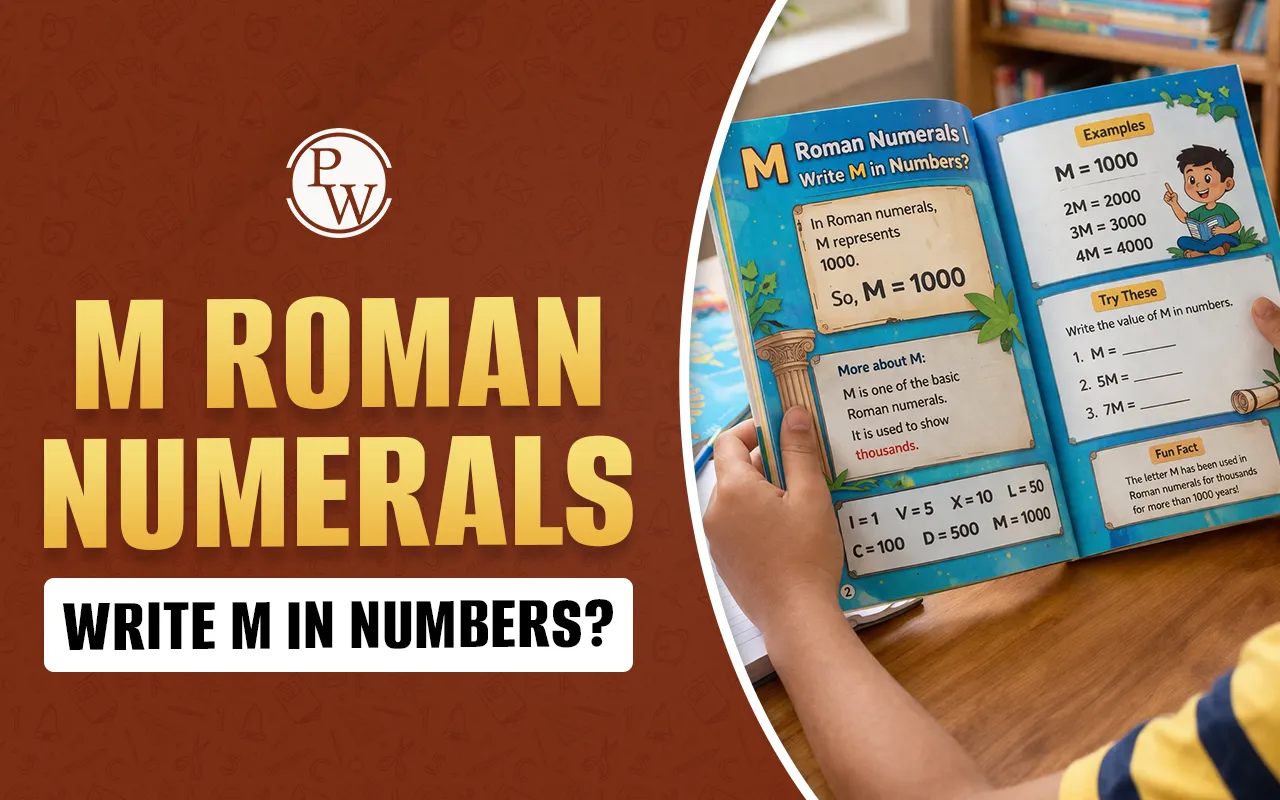
What is M Roman Numerals?
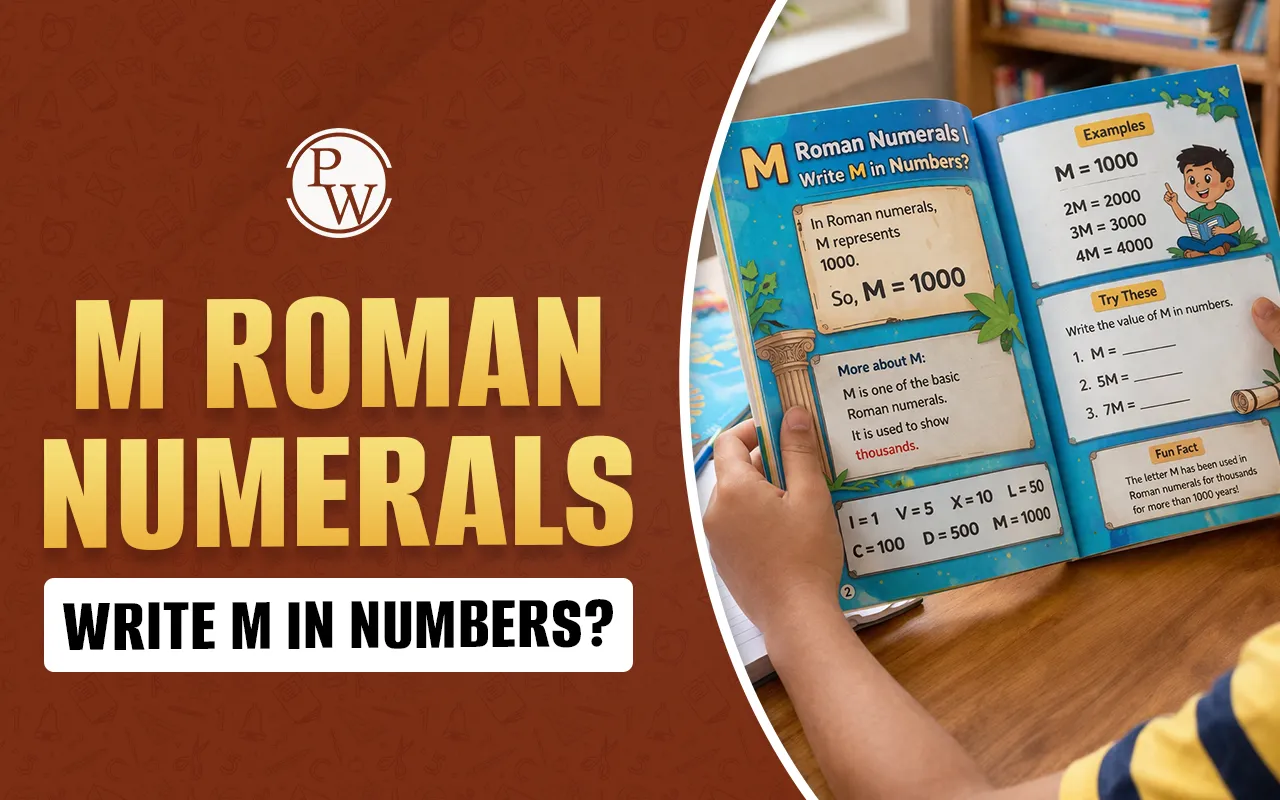
The number 1,000 is represented by M Roman Numerals . It comes from the Latin word "mille," which means "thousand."
The Romans utilised a set of seven fundamental letters to generate numbers, but we now use the digits 0-9. In this hierarchy, M is at the top. Here is a brief examination of the relationship between M and the other symbols in numbers:
-
I: 1
-
V: 5
-
X: 10
-
L: 50
-
C: 100
-
D: 500
-
M: 1000
When you see the letter M, you are looking at a single unit of one thousand. If you see MM, that represents 2,000.
How to Write M Roman Numerals?
To write M, you simply replace the letter with its numerical equivalent. However, Roman numerals often appear in combinations. To convert them correctly, you must follow two main rules: the Addition Rule and the Subtraction Rule.
1. Addition Rule
When a smaller numeral follows a larger one, you add them together.
-
MI: 1000 + 1 = 1001
-
MC: 1000 + 100 = 1100
-
MD: 1000 + 500 = 1500
2. Subtraction Rule
When a smaller numeral appears before a larger one, you subtract the smaller from the larger. For 1000 in Roman numerals, this usually involves the letter C (100).
-
CM: 1000 - 100 = 900
-
MCM: 1000 + (1000 - 100) = 1900
M Roman Numerals to Arabic Numbers
|
Roman Numeral |
Value (Arabic Number) |
Calculation |
|
M |
1000 |
1000 |
|
MM |
2000 |
1000 + 1000 |
|
MMM |
3000 |
1000 + 1000 + 1000 |
|
CM |
900 |
1000 - 100 |
|
MCM |
1900 |
1000 + 900 |
|
MMXXVI |
2026 |
2000 + 20 + 6 |
Important Rules for Using M Roman Numerals
There are a lot of strict rules to follow when using the M Roman numeral to make sure it is correct:
-
Repetition Limit: You can repeat the symbol M up to three times in a row (e.g., MMM = 3000). To represent 4000 or higher, Romans traditionally used a "vinculum" (a horizontal bar over a numeral), though this is rarely used in basic school maths.
-
Subtraction Limits: Only C can be subtracted from M. You cannot write "IM" to mean 999; you must write CMXCIX.
-
No Zero: There is no symbol for zero in the Roman system. If a place value is empty, the letter is simply omitted.
Read More - 11 in Roman Numbers (XI): Meaning, Rules, and Examples
Examples of M Roman Numeral in Number
Let's look at how to break down complex strings involving M Roman numerals.
Example 1: Convert MMCDL to numbers
-
Break it down: MM + CD + L
-
MM = 2000
-
CD = 400 (500 - 100)
-
L = 50
-
Total: 2450
Example 2: Write 1010 in Roman Numerals
-
Identify the parts: 1000 and 10.
-
1000 = M
-
10 = X
-
Result: MX
Example 3: Convert MMMCMXCIX to numbers
-
MMM = 3000
-
CM = 900
-
XC = 90
-
IX = 9
-
Total: 3999 (This is the highest number you can write using standard triple-repetition rules).
Read More - XXXI Roman Numerals | Write XXXI in Numbers?
Step-by-Step Solving Examples of M Roman Numerals
Let’s break down some tricky problems:
Solving Example 1: Large Addition
Problem: What is the value of MMMDCCCLXXXVIII?
Solution:
-
Break into parts: MMM + D + CCC + L + XXX + VIII.
-
Assign values: 3000 + 500 + 300 + 50 + 30 + 8.
-
Sum them up: 3000 + 800 + 80 + 8.
-
Result: 3888. (This is the longest standard Roman numeral without using the subtraction rule!)
Solving Example 2: The Subtraction Trap
Problem: Convert the number 1444 into Roman numerals.
Solution:
-
Break into place values: 1000 + 400 + 40 + 4.
-
1000 = M.
-
400 = CD (500 - 100).
-
40 = XL (50 - 10).
-
4 = IV (5 - 1).
-
Result: MCDXLIV.
Solving Example 3: Mixed Operations
Problem: Find the sum of MC and DL, then provide the answer in Roman numerals.
Solution:
-
Convert MC: 1000 + 100 = 1100.
-
Convert DL: 500 + 50 = 550.
-
Add the numbers: 1100 + 550 = 1650.
-
Convert back to Roman: 1000 (M) + 600 (DC) + 50 (L).
-
Result: MDCL.
Importance of M Roman Numerals
Following are the importance of M Roman numerals:
-
Year Markers: Many cornerstones of old buildings or movie credit sequences use m roman numerals to show the year (e.g., MCMLXXXV for 1985).
-
Page Numbering: Prefaces and introductions in books often use lowercase Roman numerals (m, i, v, x).
-
Formal Outlines: High-level lists often use M to denote the tenth or thousandth major section in complex legal or academic documents.
Make Maths Easy and Fun with CuriousJr
CuriousJr helps children develop a strong foundation in maths by reducing fear and building confidence. Our Mental Maths online classes for students in Classes 1 to 8 focus on improving speed, accuracy, and logical thinking through simple techniques and interactive learning methods.
With our dual-mentor approach, students attend engaging live sessions and get dedicated support to clear doubts after every class. Animated lessons, fun activities, and exciting challenges make maths learning enjoyable and easy to understand.
Parents receive regular progress updates along with review sessions, ensuring complete clarity about their child’s learning journey.
Book a demo class today and see how CuriousJr makes maths simple, engaging, and confidence-boosting for your child.