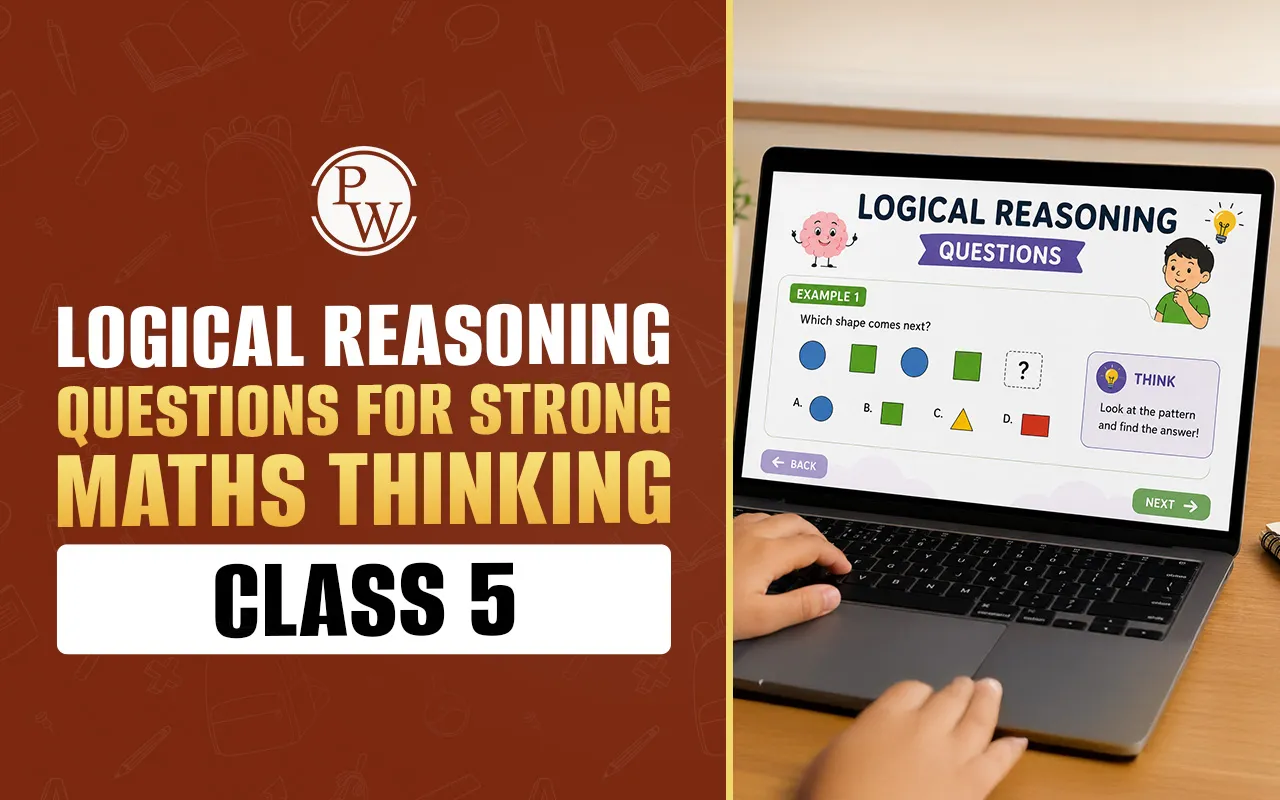
Logical Reasoning Questions for Strong Maths Thinking (Class 5)
 Nikita Aggarwal30 May, 2026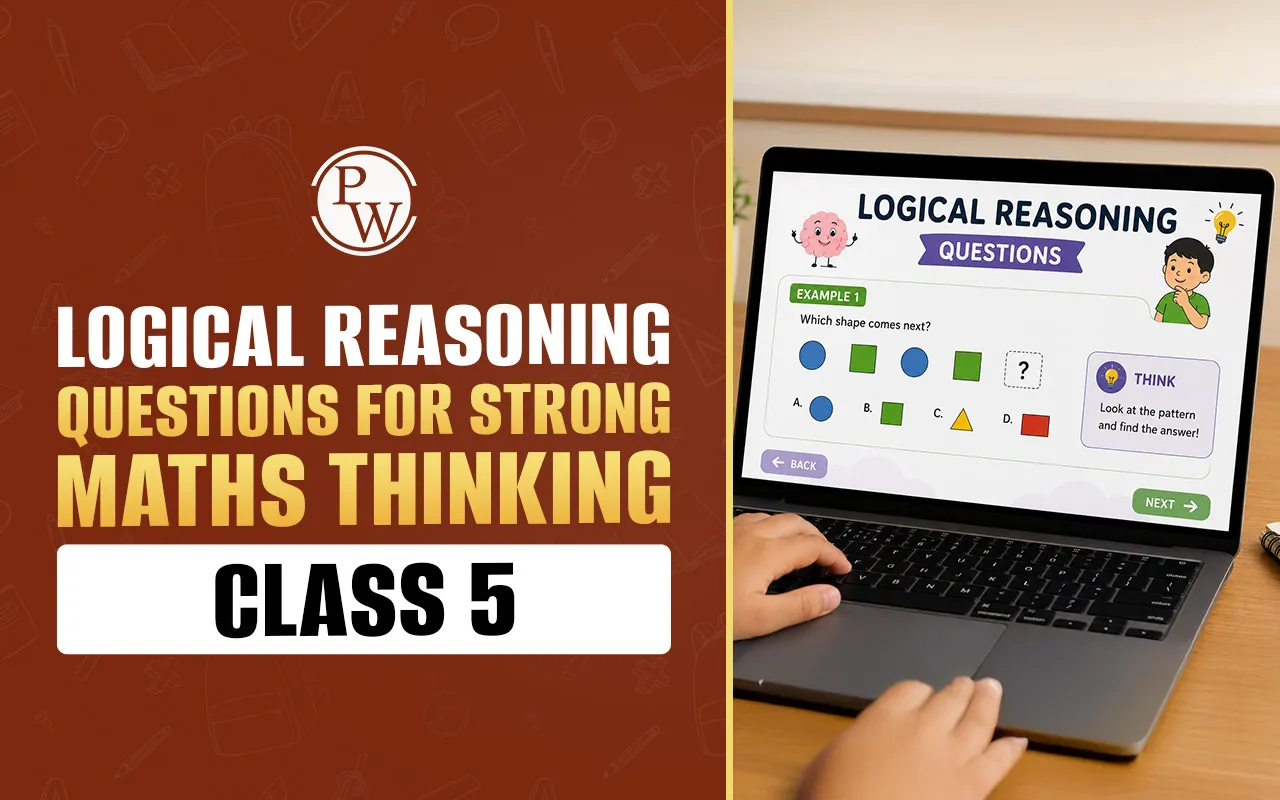
Logical Reasoning Questions Tricks for Class 5
To develop a sharp mathematical mind, students must go beyond rote paper and pencil calculations. Systematic shortcuts allow kids to process numbers easily in their head. Here are the best logical reasoning questions tricks that simplify stressful sums into simple steps.
The Decomposition Method (Break-Apart)
This trick is all about breaking smaller numbers into place values such as tens and units. Rather than adding two large numbers together at one time, students keep the first number fixed and add the parts of the second number one at a time.
How it works: Imagine a student has to work out 45 + 37 in their head.
Step 1: Keep the first number the same (45).
Step 2: Break down the second number (37) into a convenient tens value and a units value (30 and 7).
Step 3: Add the tens value to the first number: 45 + 30 = 75.
Step 4: Add the remaining units to that total 75 + 7 = 82.
Making a Friendly Ten (Compensation)
Adding is super fast when you round to the nearest multiple of ten. A number ending in 8 or 9 is very close to a “friendly” base.
How it works: Let's take the problem 59 + 26.
Step 1: Notice that 59 is 1 away from 60. Add 1 to make it 60.
Step 2: Now that you added 1 to the first number, you have to subtract 1 from the second number to keep it balanced. 26 - 1 = 25.
Step 3: Add the new, simpler numbers together: 60 + 25 = 85.
Left to Right Addition
Usually children are taught in the classroom to compute from left to right. But for mental maths class 5 calculations to be efficient, working from left to right (beginning with the largest place value) helps avoid overload of memory.
How it goes: Consider the problem 342 + 526.
Step 1: Add the hundreds first. 300 + 500 = 800
Step 2: Add the tens: 40 + 20 = 60.
Step 3: Add the units values 2+6=8.
Step 4: Immediately add the totals in your head: 800 + 60 + 8 = 868
Logical Reasoning Questions Tricks for Class 5 Aptitude Questions
Standard school exams and competitive tests generally feature specific formats of math problems. Understanding these formats allows students to categorize questions instantly and choose the right approach.
|
Question Type |
Focus Area |
Example Scenario |
|
Single-Step Problems |
Straightforward operation interpretation |
Finding the total weight when given a single item value. |
|
Multi-Step Problems |
Order of operations and tracking data |
Calculating total costs after buying multiple items and subtracting a discount. |
|
Measurement Word Problems |
Unit conversion and scaling |
Scaling height from inches to feet or dividing liquid capacities evenly. |
|
Explanation Questions |
Articulating mathematical arguments |
Verifying if a mathematical statement is correct and proving why. |
Read More - Missing Number Series Challenges for Brain Development (Class 5)
Logical Reasoning Questions Tricks with Examples
Logical Reasoning practice develops agility and structural thinking. Let us go through real world examples that often come up in aptitude questions, with step-by-step breakdowns.
Problem 1: The Multistep Toy Purchase Problem
Sophia buys 6 cupcakes and a cookie for £2.05 Ahmed buys 3 cupcakes. Altogether he pays 90p. What is the price of one cookie?
Step 1: Know What You Know. We know from Ahmed’s purchase that 3 cupcakes cost exactly 90p.
Step 2: Add more information. Sophia bought 6 cupcakes, which is double what Ahmed bought. So, 6 cupcakes will cost 90 pence multiplied by 2, which is 1.80 pounds.
Step 3: Find the missing variable. The bill for Sophia is 2.05 pounds. Now subtract the price of 6 cupcakes from her total. 2.05 - 1.80 = 0.25 pounds.
Problem 2: Recall the Starting Number
Arlo picked a secret number. He multiplied his number by 8 and subtracted 47 from the result. His last answer was 1049. What was Arlos first number?
Step 1: Work all the way backwards from the final answer. Finally, subtracting 47. To reverse this , add 47 to the final total : 1049 + 47 = 1096 .
Step 2: Reverse the last operation. Arlo took his middle number and multiplied it by 8. To get the opposite divide 8/1096.
Step 3 : Do the division . 1096 ÷ 8 = 137 .
Problem 3: The pile of measurement boxes
An empty storage space. 8 feet tall. Inside it are 5 identical shipping boxes, stacked by a worker. Assuming each box is 2.4 inches tall, how many inches of empty space are left at the top of the tower?
Step 1: Change the total height to a single, consistent unit. Convert the 8' ceiling height since the answer requires inches. Multiply 8 x 12 inches, which equals 96 inches.
Step 2 : Find the total height of the stacked boxes. Take the height of a box (2.4 inches) and multiply it by the number of boxes (5). 2.4 inches x 5 = 12 inches
Step 3: Find the remaining gap by subtracting the height of the box tower from the total ceiling height: 96 inches - 12 inches = 84 inches.
Read More - Place Value Tricks for Faster Large Number Calculations (Class 5)
Logical Reasoning Questions Tricks to Solve Maths Brain Puzzles
Students who are working on higher-level maths brain teasers often miss how the variables relate to each other. Kids who can spot structural patterns are better at breaking down word puzzles.
[Read the Entire Question]
│
▼
[Identify Given Information & Identify the Goal]
│
▼
[Spot the Math: Choose Operations (+, -, ×, ÷)]
│
▼
[Apply Logical Reasoning Tricks for Mental Calculation]
│
▼
[Verify the Final Answer against the Context]
To develop comfort with this flow, encourage students to make these habits daily:
Circle the Target. Circle the question being asked at the end of the text so you don’t stop calculating halfway through a multi-step problem.
Cut Filler Words: Cut narrative details that have no numerical value or structural constraints.
Verify the Units: Look at the answer box carefully to see whether the required unit matches the numbers given in the question text.
Avoid Common Mistakes with Logical Reasoning Questions Tricks
It is very easy to make small mistakes even with the tricks to logical reasoning questions. Knowing the pitfalls can help keep the calculations accurate.
-
Forgetting carried over tens: When students are adding in their heads, they sometimes forget the tens they carried over. The Fix The Left-to-Right method is to calculate the bigger numbers first so you never have to carry big numbers in your head.
-
Ignoring the Order of Operations: In mixed puzzles, children often just read the calculations from left to right. The Fix: Remember that multiplication and division are equally important and should be done before addition and subtraction. Always do them from left to right in the order they appear in the math sentence.
-
Decimal Points Not Aligned: Students frequently fail to line up place values when comparing or adding decimal values (e.g., 8.397 is thought to be larger than 8.41 because it has more digits). The Fix: Fill in empty decimal places with a placeholder 0 so that all numbers are the same length (e.g. it’s obvious that 8.410 is larger than 8.397).
The overall aptitude is considerably enhanced if such diagnostic checks are routinely incorporated into daily routines. If you just spend 10 minutes each day practicing deliberately, you’ll lay a strong foundation for the more complex topics later on.
Learn Logical Reasoning Questions Tricks with CuriousJr
Building strong mental maths and estimation skills becomes much easier when students practice through interactive activities instead of memorising formulas. Many children in Class 5 aptitude questions struggle with speed-based calculations because they rely too heavily on long written methods during exams.
This is where CuriousJr online mental maths kids class helps students improve logical reasoning development questions tricks through engaging mental maths exercises and practical problem-solving activities. The platform focuses on estimation methods, number sense, fast calculations, and logical thinking techniques that make maths feel easier and more enjoyable. Through short practice sessions, visual learning tasks, and interactive challenges, students gradually build confidence, improve calculation speed, and strengthen their overall exam performance.





Logical Reasoning Questions for Strong Maths Thinking (Class 5) FAQs
What is the quickest way to do fast addition in logical reasoning questions tricks?
How can we get better school exam scores by practicing logical reasoning?
Why are maths brain teasers harder than normal school sums?
Can I use rounding tricks of mental maths for decimals?

Get Free Counselling Today
and Clear up all your Doubts
 Live & recorded classes available at easeDashboard for progress trackingLakhs of practice questions