
Integer Word Problems Broken Into Simple Steps (Class 6)
 Nikita Aggarwal30 May, 2026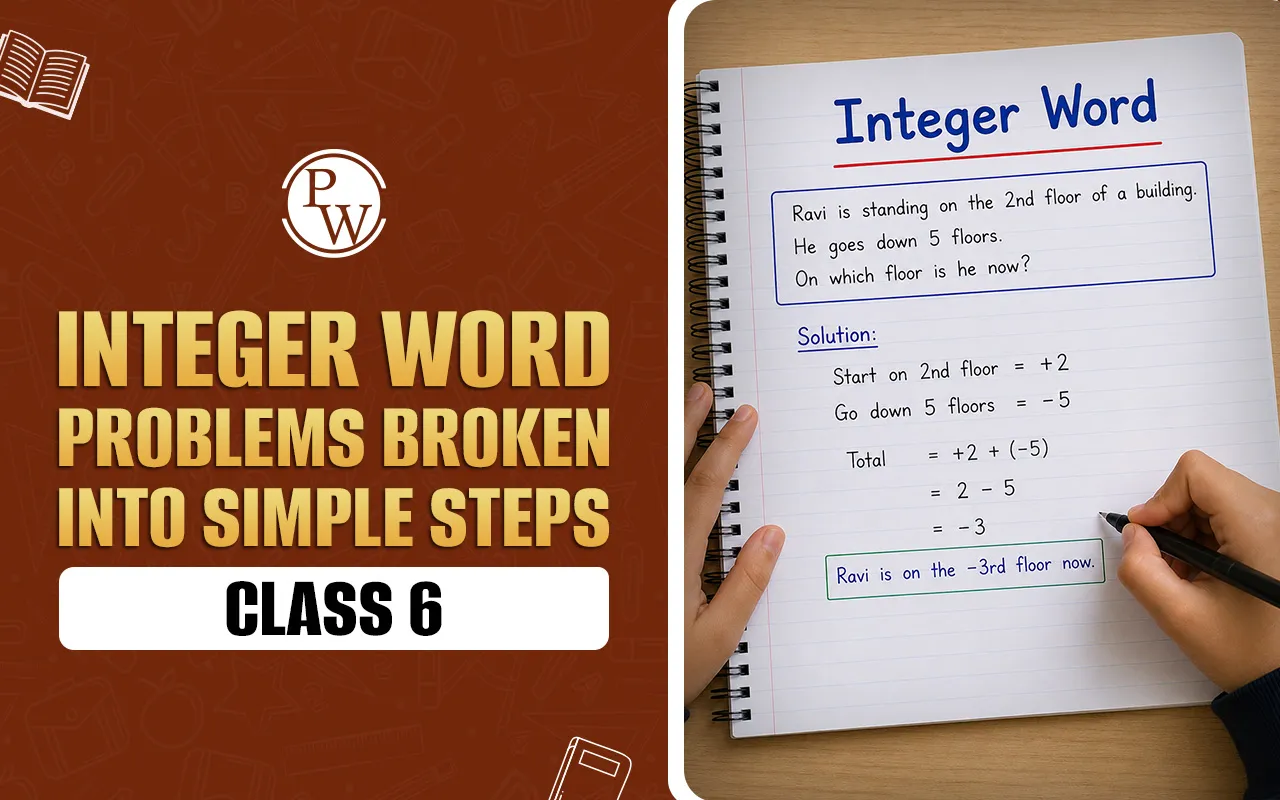
Integers and Number Lines Overview
Prior to exploring shortcuts, it is critical to understand the meaning of integers and their characteristics. An integer is a whole number that can either be positive, negative or equal to zero. It is important to note that they never contain fractions or decimals.
To visualize how these numbers interact, the number line is your most valuable tool. Think of zero as the central home base on your line.
Negative Numbers Left (<---) (--->) Positive Numbers Right
<───┰───┰───┰───┰───┰───┰───┰───┰───┰───┰───┰───┰───┰───┰───┰───┰───┰───>
-8 -7 -6 -5 -4 -3 -2 -1 0 1 2 3 4 5 6 7 8 9
Positive numbers always sit to the right of zero, growing larger as you move forward. Negative numbers always live to the left of zero, and they represent values that are less than nothing.
A common trap in class 6 word problems is forgetting that a larger negative digit actually represents a smaller overall value. For example, -8 is much lower than -2 because it sits much further to the left on our horizontal number line. Remembering this simple visual layout prevents major errors when comparing everyday values like depths or debts.
Integer Word Problems Tricks for Class 6
To build absolute confidence in exam halls students need to learn to instantly translate English words into mathematical signs. To avoid the lengthy and confusing calculations, you can look for certain code words within the question text. Here are the most dependable tricks for integer word problems. These tricks help to immediately separate positive actions from negative actions.
Keyword translation method
Each word problem has a trail of clues. Some verbs and nouns tell you exactly if a number should have a plus or minus sign. When you learn to identify these markers, you will be able to write correct equations the first time.
-
Positive Integer Markers (+): Search for words that indicate increase, height or accumulation. These include phrases like deposit, above sea level, profit, climb, rise and gain.
-
Negative Integer Markers (-): Search for words that express loss, depth or reductions. Such as withdrawal, below sea level, loss, descent, drop, debt.
The Multi-Sign Consolidation Shortcut
When you set up calculations, you often end up with two math signs right next to each other, such as subtracting a negative number. This looks very confusing to a young learner . But before you can do any arithmetic you can clean up your equation by using a simple sign-matching rule .
-
Two identical signs positive turn If two plus signs (++) or two minus signs (--) are adjacent, they automatically combine to form a single positive sign (+). For example, if you subtract a loss, you’re actually adding value.
-
Two different signs become negative When you have a plus and minus sign sitting next to each other (+- or -+), they always come together to form a single negative sign (-).
Read More - Coding-Decoding Mental Maths Tricks for Class 6
The Temperature Gap Jump
The questions about changes in weather are very popular in competitive maths tests. The zero-bridge method, instead of messy formulas, lets you find the difference between a freezing night temperature and a warm daytime temperature.
Step 1: Find the number of steps going from the negative temperature to zero.
Step 2: Count how many steps it takes to go from zero to the final positive temperature.
Step 3: Add those two clean values together for Total gap.
"If a frozen mountain town goes from -4 degrees Celsius to 12 degrees Celsius, don’t sweat the signs,” he says. Just think: It takes 4 degrees to get to zero, then another 12 degrees to get to the afternoon high. Combine 4 and 12 for an instant answer of 16 degrees.
Integer Word Problems Tricks for Integer Operations
When you perform actual calculations during negative numbers practice, you must stick to a clear set of operational laws. These laws guide how you combine signs during addition, subtraction, multiplication, and division.
|
Mathematical Operation |
Scenario of Signs |
How to Process the Calculation |
Final Sign Result |
|
Addition |
Both numbers are negative |
Add the actual values together ignore the signs |
Always Negative (-) |
|
Addition |
One positive, one negative |
Find the difference between the two values |
Takes the sign of the larger digit |
|
Multiplication |
Signs match (Positive x Positive or Negative x Negative) |
Multiply the numbers normally |
Always Positive (+) |
|
Multiplication |
Signs conflict (Positive x Negative or Negative x Positive) |
Multiply the numbers normally |
Always Negative (-) |
|
Division |
Signs conflict (Positive ÷ Negative) |
Divide the numbers normally |
Always Negative (-) |
Read More - Finding Remainders Using Vedic Method for Class 6
Integer Word Problems Tricks with Examples
Let us apply our integer word problems tricks to real-world test questions. These step-by-step breakdowns show how to dismantle long paragraphs and turn them into simple, error-free equations.
Problem 1: The Submarine Depth Shift
A research submarine is cruising at the depth of 450 metres below sea level. To avoid a rock formation underwater, the pilot decides to ascend the submarine by 125 metres. How deep will the submarine be now?
-
Step 1: Identify your starting integer. Your submarine is "below sea level." Hence, the first part of your mathematical expression must be a negative integer: -450.
-
Step 2: Identify your action keyword. The submarine "ascends." This means you must use a positive sign for the second part of your expression: +125.
-
Step 3: Build your mathematical expression. Your mathematical expression should be like this: -450 + 125.
-
Step 4: Apply your arithmetic rule. You will subtract the smaller number from the bigger one because you are working with a positive and negative integer. Hence, 450 – 125 = 325.
-
Step 5: Decide on the sign. Check what numbers you are working with. As the bigger number was negative, your answer will have a minus sign.
-
Answer: The depth of the submarine is now -325 metres or 325 metres below sea level.
Problem 2: The High Street Bank Account Balance
At the start of the month, Rohan has the initial sum of 250 pounds in his bank account. He withdraws 400 pounds on Monday to buy school supplies. On Friday, he makes a cash deposit of 150 pounds. What will be his final balance?
-
Step 1: Note down the initial sum. Rohan has the initial sum of +250.
-
Step 2: Analyze the first operation. Rohan makes a "withdrawal". This means that money leaves his account, so we should subtract. Subtract 400 pounds from the initial sum: 250 – 400.
-
Step 3: Calculate the intermediate sum. Since 400 > 250, we get the negative result: 250 – 400 = -150 pounds.
-
Step 4: Analyze the second operation. Rohan makes a "deposit" on Friday. This means that money enters his account, so we should add 150 pounds to the current sum: -150 + 150.
-
Step 5: Calculate the final sum. Since it is known that the sum of a negative number and a positive of the same absolute value equals zero, we get: -150 + 150 = 0 pounds.
-
Answer: Rohan's final balance is 0 pounds.
Problem 3: The Multi-Step Elevator Ride
Elevator in the tall building starts its way from the ground floor, which is 0. Then, it goes upward for 8 floors, goes downward for 12 floors, and again goes upward for 3 floors. On which floor does the elevator stop?
-
Step 1: Translate each code into numbers. Ground floor – 0. "Goes upward for 8" – +8. "Goes downward for 12" – -12. "Goes upward for 3" – +3.
-
Step 2: Put all codes together in one expression. Create a complete expression of all movements: 0 + 8 - 12 + 3.
-
Step 3: Make calculations starting from the beginning. Start calculating from the first movement: 0 + 8 = 8.
-
Step 4: Make the next step. Subtract 12 from 8: 8 - 12 = -4. It means that an elevator is now 4 floors under the ground floor.
-
Step 5: Make the last step of calculation. Add up the result with the last number: -4 + 3. Subtract 3 from 4 and take the sign of the larger number, which is negative.
-
Answer: The elevator stops on -1 floor (basement).
Integer Word Problems Tricks to Improve Mental Maths Speed
To perform exceptionally well during exams, students must build high-speed tracking habits. Learning class 6 mental maths means you can spot patterns and relationships before your pencil even touches the answer booklet.
[Read the Word Problem]
│
▼
[Highlight Directional Keywords] (Up/Down, Gain/Loss)
│
▼
[Assign Math Signs (+ or -)]
│
▼
[Consolidate Double Signs] (e.g., Change '--' to '+')
│
▼
[Execute the Mental Math Calculation]
To integrate these habits into your weekly revision, try focusing on these three training areas:
-
Sign Isolation Drills: Read through a page of math problems without doing any calculations. Spend two minutes simply circling the keywords and writing a small plus or minus above them.
-
Zero-Point Rebound Games: Practice calling out balances. Start at a random negative number, like -7, and challenge yourself to figure out exactly what value is needed to climb back up to a positive target like 5.
-
Context Matching: Connect negative digits to daily life. Think of multi-storey car parks, mountain trail elevations, or sub-zero freezer settings to ground abstract abstract numbers in reality.
Common Mistakes to Avoid in Integer Word Problems Tricks
Even when employing smart tricks for integer problem solving, little mistakes can make you lose important points. Be aware of the following typical examination tricks that will help you give absolutely correct answers.
-
Using Incorrect Order When Writing Numbers: In cases where you need to use subtraction, students may write numbers in such an order that the largest one comes first without considering the context of the question. For instance, if your task is to subtract 10 from -3, then writing 10 - (-3) is incorrect. Your answer should be -3 - 10. Remember, you always start with your starting point.
-
Omitting the Negative Sign in the Final Box: After solving complicated mathematical problems, many students neglect the negative sign when writing the answer in the last box. If you have reached -45 in your calculations, then simply writing 45 is incorrect.
Learn Integer Word Problems Tricks with CuriousJr
Building confidence in integers becomes much easier when students practice through interactive activities and step-by-step guidance instead of memorizing rules. Young learners often struggle with negative numbers because they cannot connect mathematical signs with real-life situations.
This is where CuriousJr online mental maths class helps students improve their mental maths and problem-solving skills through fun learning methods. The platform focuses on quick calculations, logical reasoning, number patterns, and smart maths tricks that make topics like integers easier to understand. Through live interactive classes, regular practice questions, and simple mental maths techniques, students gradually build speed, accuracy, and confidence while solving tricky integer word problems.




Integer Word Problems Broken Into Simple Steps (Class 6) FAQs
What are the best integer word problems tricks for finding keywords?
Why does subtracting a negative number turn into addition?
How does negative numbers practice help with daily life skills?
What should I do if an integer question has no keywords?




Get Free Counselling Today
and Clear up all your Doubts
 Live & recorded classes available at easeDashboard for progress trackingLakhs of practice questions

