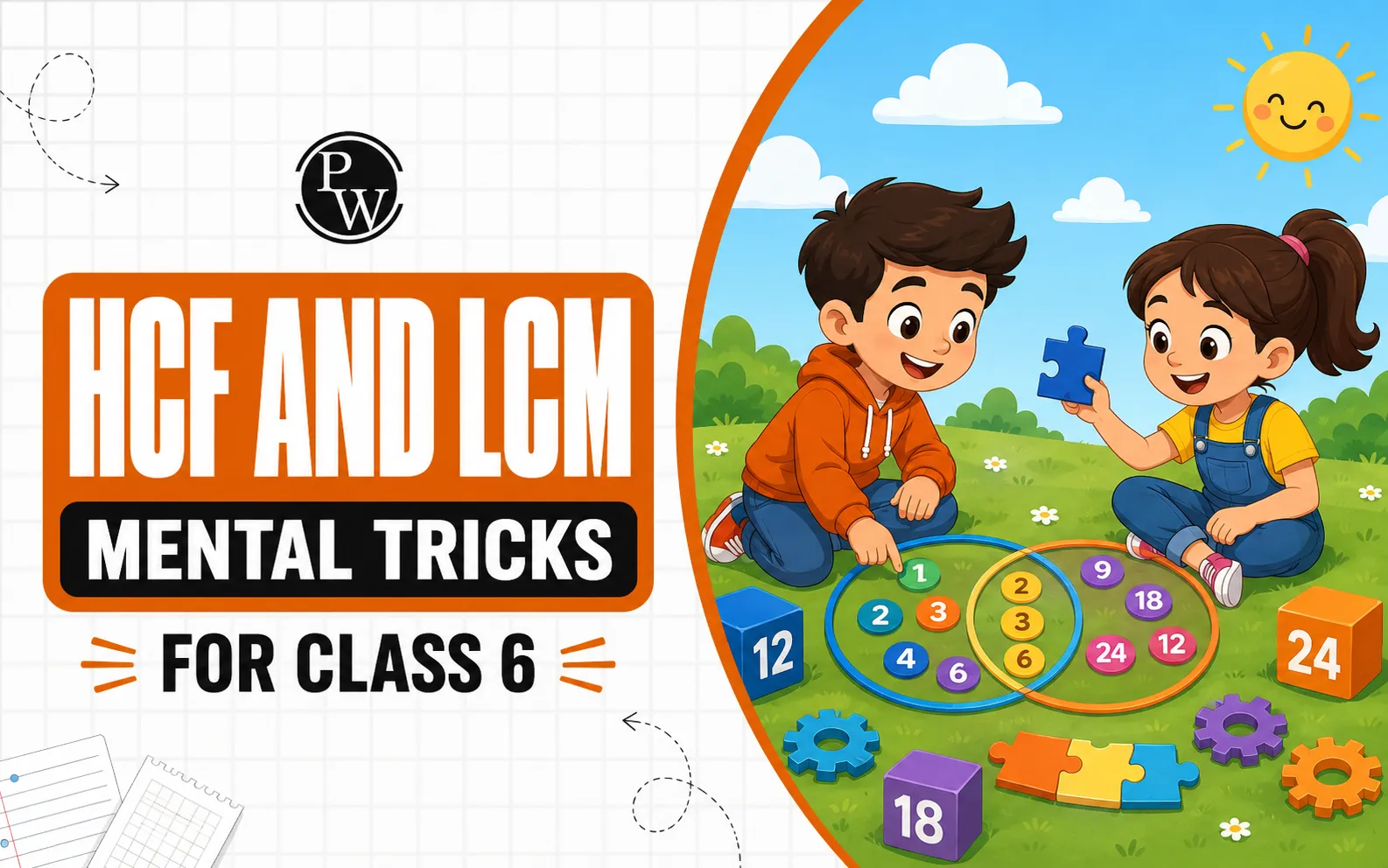
HCF and LCM Mental Tricks for Class 6
 Nikita Aggarwal30 May, 2026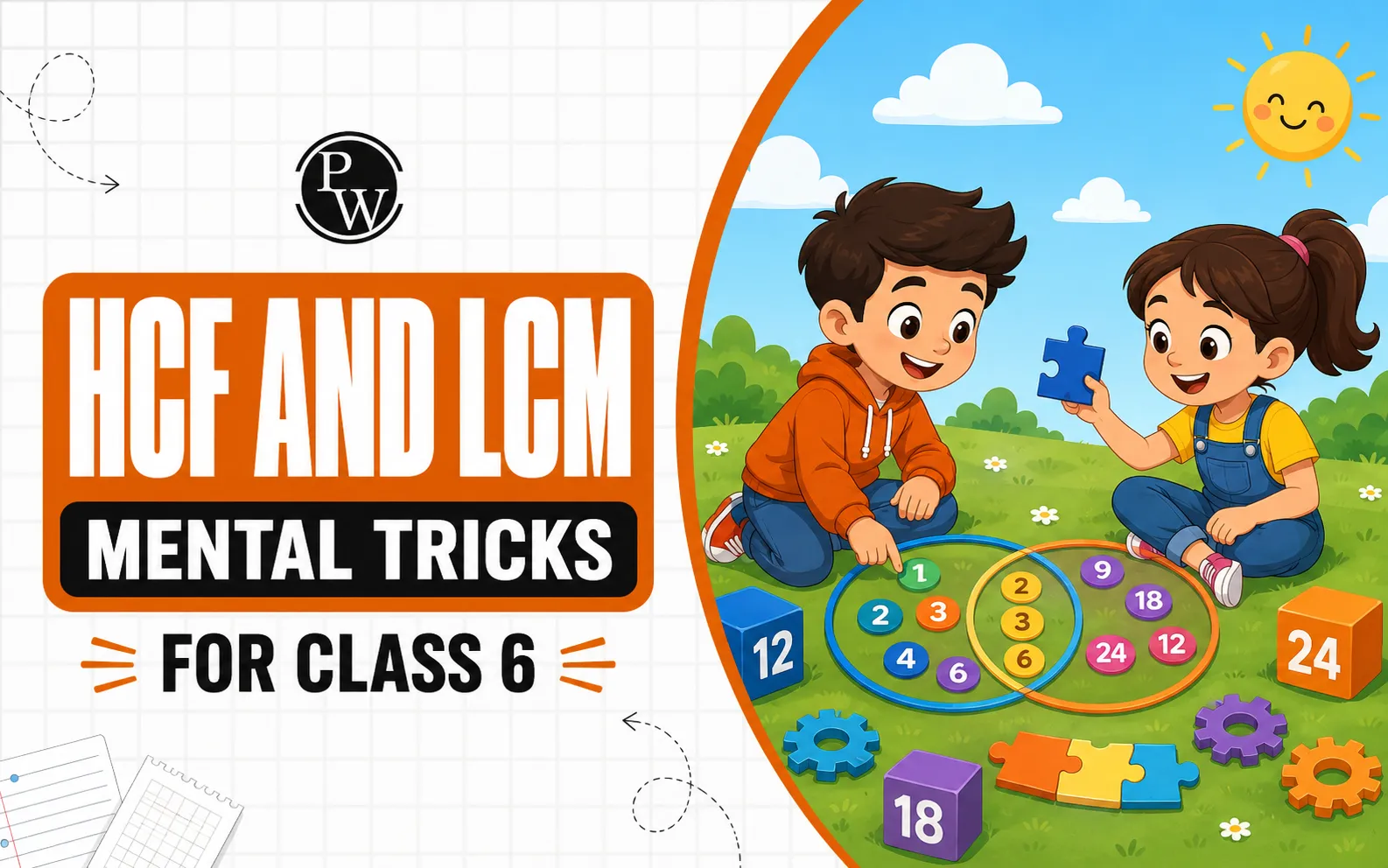
Importance of HCF and LCM Mental Tricks
Students often struggle with large numbers because they rely on paper-and-pen methods for every single calculation. Using HCF LCM mental tricks helps develop a better sense of number theory. Instead of seeing numbers as isolated figures, you begin to see their DNA—their factors and multiples. This mental agility is a core part of class 6 mental maths.
When you learn these shortcuts, you reduce the risk of simple subtraction or multiplication errors. Most HCF LCM tricks rely on looking at the difference between numbers or identifying common patterns. This approach makes maths feel less like a set of rigid rules and more like a puzzle. Using these class 6 mental maths strategies also prepares you for higher-grade topics like algebraic expressions and fractions, where finding common denominators quickly is essential.
How to Find HCF Using Mental Tricks
The Highest Common Factor is the largest number that divides two or more numbers exactly. While the school method involves listing all factors, the HCF LCM mental tricks allow you to find it by observation.
The Difference Method
One of the most effective HCF LCM trick is the difference method. If you have two numbers, their HCF must be either the difference between them or a factor of that difference.
-
Step 1: Find the difference between the two numbers.
-
Step 2: Check if that difference divides both numbers.
-
Step 3: If it does, that is your HCF. If not, look for the largest factor of that difference.
For example, to find the HCF of 12 and 18:
-
Difference = 18 - 12 = 6.
-
Check: Does 6 divide 12? Yes. Does 6 divide 18? Yes.
-
The HCF is 6.
This maths shortcuts technique works because any factor that divides two numbers must also divide their difference. It saves immense time compared to listing out 1, 2, 3, 4, 6, 12 for 12 and 1, 2, 3, 6, 9, 18 for 18.
How to Find LCM Using Mental Tricks
The Lowest Common Multiple is the smallest number that is a multiple of two or more numbers. The fast factorization method is much quicker than drawing traditional factor trees. In this mental version, you take the largest number and "test" it against the smaller ones.
If you need the LCM of 4, 8, and 12:
-
Identify the largest number: 12.
-
Check if 12 is divisible by 4? Yes.
-
Check if 12 is divisible by 8? No.
-
Multiply the largest number by 2: 12 x 2 = 24.
-
Is 24 divisible by 8? Yes.
-
The LCM is 24.
This is a classic example of HCF LCM class 6 tricks where you use multiplication tables instead of long divisions. By focusing on the largest number, you drastically narrow down the possibilities.
Read More - Integer Word Problems Broken Into Simple Steps (Class 6)
Common HCF and LCM Mental Tricks for Small Numbers
When dealing with small numbers in mental maths, you can use specific rules to find answers instantly. These HCF LCM mental tricks are based on the relationship between prime and composite numbers.
-
Co-prime Numbers: If two numbers have no common factors other than 1 (like 5 and 7), their HCF is always 1, and their LCM is always their product (5 x 7 = 35).
-
Multiples: If the larger number is a multiple of the smaller number (like 5 and 20), the smaller number is the HCF (5) and the larger number is the LCM (20).
-
Consecutive Numbers: For any two consecutive numbers (like 14 and 15), the HCF is always 1.
Applying these HCF LCM tricks during a test allows you to write down the answer the moment you see the numbers, leaving more time for difficult word problems.
Advanced HCF and LCM Mental Tricks for Large Numbers
For larger numbers, you can combine the fast factorization method with divisibility rules. This is a key part of HCF LCM class 6 tricks.
If you are asked to find the HCF of 48 and 72:
-
Notice both are even, so 2 is a factor.
-
Notice the digits of both add up to multiples of 3 (4+8=12, 7+2=9), so 3 is a factor.
-
Since 2 and 3 are factors, 6 is a factor.
-
Look closer: 48 is 24 x 2 and 72 is 24 x 3.
-
The HCF is 24.
Using these maths shortcuts involves breaking numbers down into smaller, manageable chunks mentally. If you can spot that 12 or 24 goes into both numbers, you don't need to do any written prime factorization.
Read More - Circle Basics Made Easy for Beginners (Class 6)
HCF and LCM Mental Tricks Daily Practices
To get better at 6 class mental maths, you should practice these shortcuts with everyday numbers. Whether it is looking at page numbers in a book or prices at a store, try to find the HCF and LCM.
Quick mental drill for HCF:
-
Numbers: 20, 30. Difference is 10. Does 10 divide both? Yes. HCF = 10.
-
Numbers: 15, 25. Difference is 10. Does 10 divide 15? No. Factors of 10 are 5, 2. Does 5 divide both? Yes. HCF = 5.
Quick mental drill for LCM:
-
Numbers: 6, 10. Largest is 10. 10 is not div by 6. 10 x 2 = 20 (no). 10 x 3 = 30 (yes). LCM = 30.
Learning HCF LCM mental tricks is about building confidence in your ability to manipulate numbers without a calculator. As you become more familiar with the factorization method, your speed and accuracy in school exams will improve significantly.
HCF and LCM Mental Tricks in Word Problems
Word problems often hide the need for HCF or LCM. Recognizing the "keywords" is one of the best HCF LCM mental tricks.
-
HCF Keywords: "Greatest," "Maximum," "Largest," "Dividing into equal groups."
-
LCM Keywords: "Smallest," "Minimum," "Next time they meet," "Intervals."
If a problem asks for the maximum length of a tape that can measure two distances exactly, your brain should immediately switch to HCF/LCM tricks. If it asks when two bells will ring together again, you need the LCM. Using the class 6 maths shortcuts mentioned earlier, you can solve these scenarios much faster than your peers who are still drawing division grids.
HCF and LCM Mental Tricks VS Traditional Methods
Traditional methods like long division or prime factorization are safe but slow. The HCF LCM mental tricks prioritize speed and logic.
|
Feature |
Traditional Method |
Mental Tricks Shortcut |
|
Speed |
Slow and steady |
Very fast |
|
Effort |
Requires paper and pen |
Can be done in your head |
|
Best for |
Very large, complex numbers |
Class 6 exams and competitions |
|
Accuracy |
High, but prone to small errors |
High, once patterns are learned |
By integrating the fast-factorization method into your routine, you move away from rote memorization and towards genuine mathematical understanding. This shift is the essence of mental maths.
Learn HCF and LCM Mental Tricks with CuriousJr
CuriousJr Mental Maths for Class 6 helps students strengthen number sense, calculation speed, and logical thinking through interactive mental maths activities specially designed for Class 6 learners. The program covers important concepts like HCF, LCM, fractions, decimals, multiplication shortcuts, and problem-solving strategies in a simple and engaging way.
Here’s how CuriousJr helps students understand LCM and HCF mental tricks:
-
Fast Factorization Techniques: Students learn quick mental tricks using divisibility rules, multiplication patterns, and shortcut methods instead of lengthy calculations.
-
Interactive Mental Maths Practice: Fun quizzes, puzzles, and calculation games help improve speed and accuracy in solving maths problems.
-
Step-by-Step Learning: Complex topics like HCF, LCM, fractions, and factors are explained using easy examples and visual learning methods.
-
Logical Thinking Development: Activities focus on recognising number patterns and relationships, helping students solve problems mentally with confidence.
-
Live Online Classes: Small-group sessions allow students to ask doubts, participate actively, and practise mental maths regularly.
-
Exam Speed Improvement: Regular practice with HCF LCM mental tricks helps students save time during school tests and competitive exams.
By combining fun learning methods with practical shortcuts, CuriousJr helps children build strong maths fundamentals and improve confidence in mental calculations.




HCF and LCM Mental Tricks for Class 6 FAQs
How can I find HCF quickly in my head?
What is the easiest way to find LCM for Class 6?
Can I use the fast-factorization method for three numbers?
Why are LCM and HCM mental tricks important for competitive exams?

Get Free Counselling Today
and Clear up all your Doubts
 Live & recorded classes available at easeDashboard for progress trackingLakhs of practice questions