Embedded Figures Mental Maths Tricks for Class 6
 Nikita Aggarwal29 May, 2026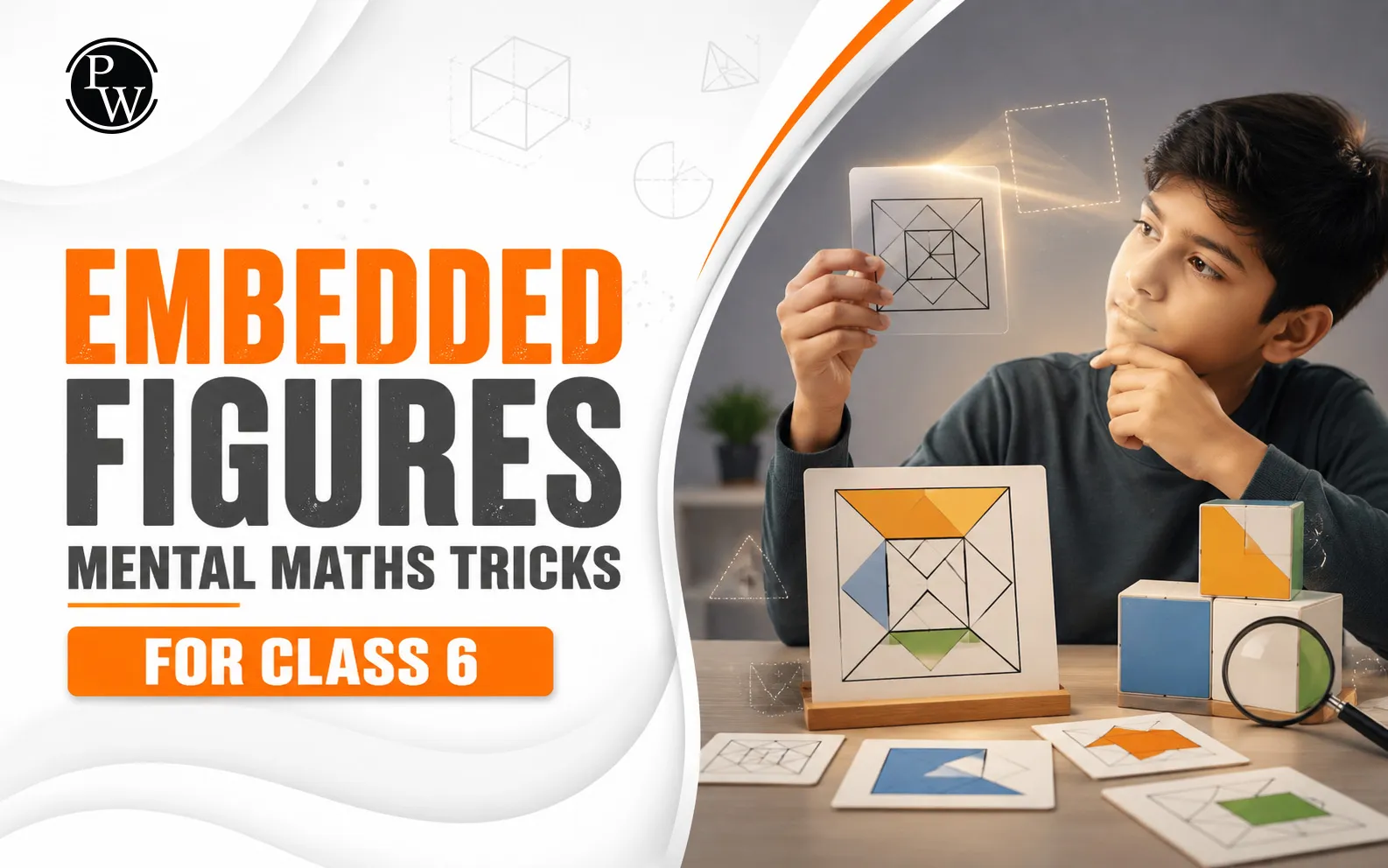
What are Embedded Figures?
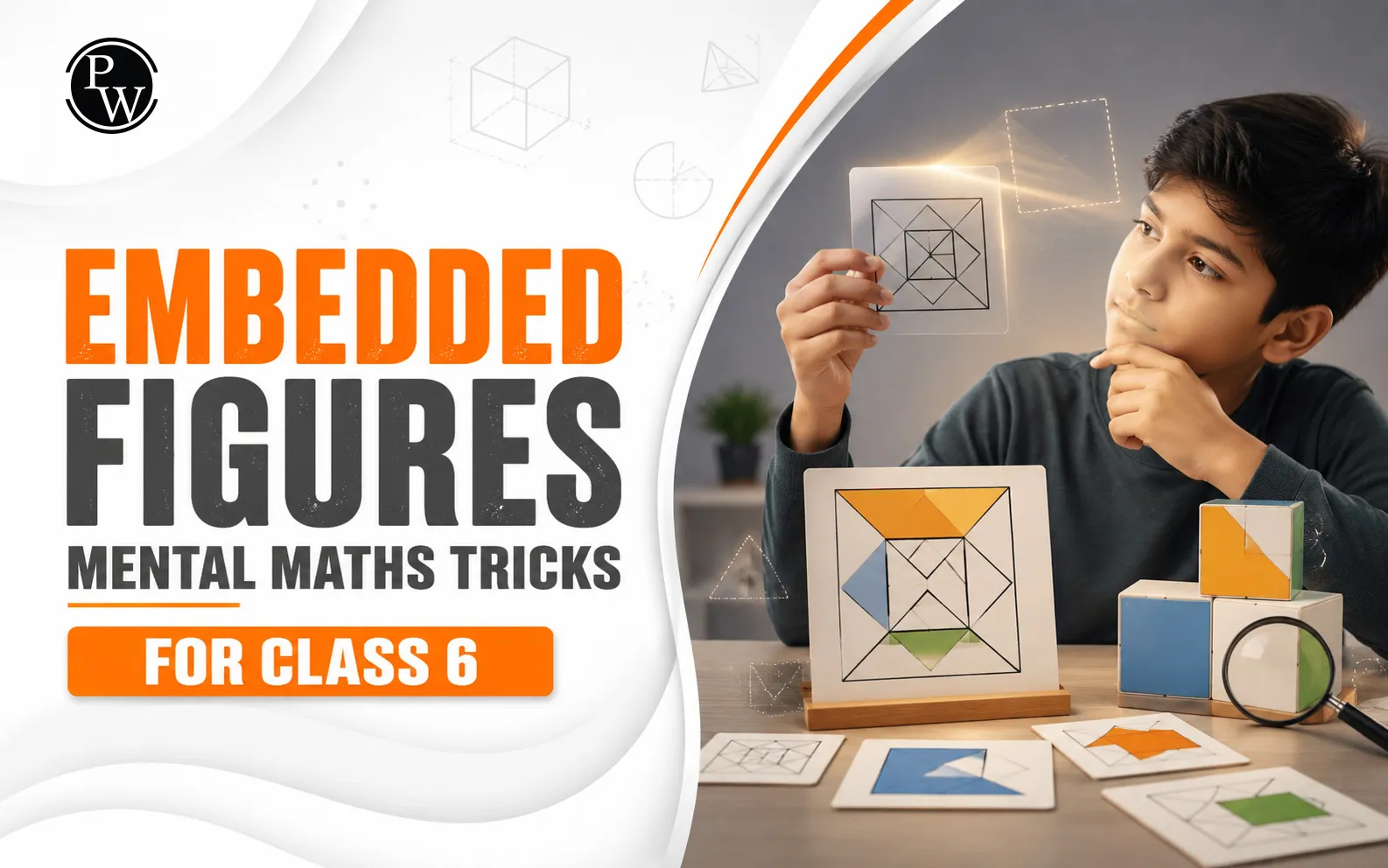
In logical and non-verbal reasoning, an embedded figure is a smaller (simpler) geometric shape or pattern entirely contained within the perimeter of another larger geometric figure instance in the diagram. The larger diagram is purposely cluttered with overlapping lines, distracting patterns and cross sections to make the hidden shape hard to identify at first.
The embedded figures test is a structured assessment that determines how aware students are of space and detail, as well as their ability to visually analyse the structures. Generally speaking, these problems come in two main flavours:
-
Type 1: Find the Hidden Part: A simple question shape (Shape X) is given, and students have to select from four complex option figures which one contains Shape X; it should completely fall within the scope of any single option figure.
-
Type 2: Identify the Contained Shape: In this question type, you are shown a complex diagram in which students have to identify one simple shape from a few options that is perfectly hidden inside it.
Such problems frequently exhibit two main structural variations. The first variation maintains the hidden shape in its exact orientation with 0 rotation applied. In the second variant, you can rotate or flip the shape, which adds an overall challenge to this task for the subject.
Best Embedded Figures Mental Maths Tricks
Instead of staring at nonverbal reasoning puzzles with blurry eyes, using visual strategies allows you to solve them quickly. Once students are taught the embedded figures mental Maths tricks, they can tune out background noise and zero in on key shapes effortlessly.
1. The Unique Feature Focus
Each target shape has a visually unique feature, such as an acute angle or an intersection of lines specific to that group, whether by curve line or corner. At first, rather than scanning the entire layout all at once, pick one key feature to anchor on. Find that particular feature in the options. If there is no option in the perfect line combination available, it can be crossed off right away.
2. Smart Elimination Method
Refrain from searching for the right answer too soon. Instead, actively try to disprove the possible wrong choices. This systematic elimination approach helps you to save time and avoid visual fatigue:
-
Scan the option choices to check if the overall dimensions match.
-
Discard options where the lines are visibly shorter, longer, or at incorrect angles.
-
Eliminate choices that miss fundamental components of the question figure.
-
Narrow down the choices to the final two options before performing a close, detailed trace.
3. Rotational Tracking Trick
Finally, if there is a change in orientation between the question and the point in the test (as you expected), it is vital to mentally rotate the prior question, such as 'Which shape can be formed given the word "x"?'. Only target the internal angles of the figure since those will stay constant whether or not a shape is inverted or rotated clockwise. An angle that is a perfect right angle (90 degrees) will always remain a right angle, which gives you an important geometric clue in your search.
4. Continuous Line Tracing
If a student suspects that there is a shape hidden in an option with so much going on, check the perimeter of it, use your eyes and trace around without lifting. An option is incorrect if a line has been extruded or given an additional bend that wasn't present in the question figure.
Read More - Doubling & Halving Vedic Maths Tricks for Class 6
Practise Sheet for Embedded Figures Mental Maths Tricks
By using these mental methods on a regular basis, we develop strong pattern recognition. Practice solving these practice problems step by step and develop your visual acuity.
Question 1: Spotting the Letter 'T'
-
Question Figure: A perfect combination of a horizontal line and a vertical line intersecting at the centre, which forms a shape just like the letter T.
-
Complex Figures to Scan:
-
Option A: A series of diamond shapes stacked vertically.
-
Option B: A perfect grid of squares resembling a small chessboard.
-
Option C: A circle with a single diagonal line running through the middle.
-
Option D: A triangle with a wavy line along the bottom base.
-
Correct Answer: Option B
Question 2: The Hidden Zig-Zag
-
Question Figure: A continued zig-zag shape that looks like the letter 'Z'.
-
Complex Figures to Scan:
-
Option A: Two parallel vertical lines intersected by a single horizontal crossbar.
-
Option B: A star shape with overlapping triangles.
-
Option C: A series of concentric circles.
-
Option D: A single rectangle with a straight vertical line dividing it down the middle.
-
Correct Answer: Option B
Question 3: Locating the Small Triangle
-
Question Figure: A small, equilateral triangle pointing directly upward.
-
Complex Figures to Scan:
-
Option A: A large square divided into four smaller squares.
-
Option B: A large hexagon with internal lines connecting opposite corners.
-
Option C: A cylinder with parallel curved edges.
-
Option D: A simple ladder pattern with horizontal rungs.
-
Correct Answer: Option B
Read More - 10-Second Addition Tricks for Class 6
Benefits of Embedded Figures Mental Maths Tricks
For instance, if embedded figures are a topic of interest to your class 6 students and you need it for experts discussing your exam papers while also passing a single paper with remarkable success. The long-term cognitive benefits of interacting with such image puzzles are as follows:
-
Enhances Visual Perception Exercises: Teaches your brain to separate signal foreground shapes from backgrounds full of noise in order to analyse complex visual data.
-
Enhances Attention to Detail: Students are trained for small features like the junctions or even certain angles of a line, which makes them overcome general mistakes in mathematics and science.
-
Develops Spatial Intelligence: By practising mental rotation and manipulation of shapes, students are building core spatial reasoning skills that serve as the basis for advanced geometry, engineering and architecture.
-
Speeds Up Exam Problem-Solving: With the implementation of elimination procedures, students would not be able to waste time, and they will attempt logic sections quicker than ever with confidence.
How Does CuriousJr Help with Class 6 Mental Maths Tricks?
CuriousJr. is an educational app highlighting analytical and Maths reasoning skills for young aspiring minds by offering an interactive activity to the children. CuriousJr online mental maths class uses the gamified hidden shapes puzzles of the future to help children develop a kaleidoscope-rich visual language, while private teachers who look intently into their students' curious books can be as dry as toast.
-
Gamified Interface: Hundreds of boring non-verbal reasoning questions are to be transformed into a unique game, an adaptable interface that gets students participating in the classroom.
-
Curated Content: Structured mental ability reasoning questions grade 6 are designed gradually from basics to complex, multilayered visual puzzles.
-
Instant Feedback Loop: It provides immediate reports and visual explanations on how to improve a student after an instant test, must take up mistakes.
-
Progress Tracking: This feature allows parents and students to track improvements in speed and accuracy over time.
-
Bite-Sized Modules: Break down intricate techniques for spatial awareness into palatable daily exercises that you can accomplish during any type of study schedule.