Diagonal of Parallelogram - Formula, Properties, Examples
 Nikita Aggarwal27 Mar, 2026
What is Diagonal of Parallelogram?
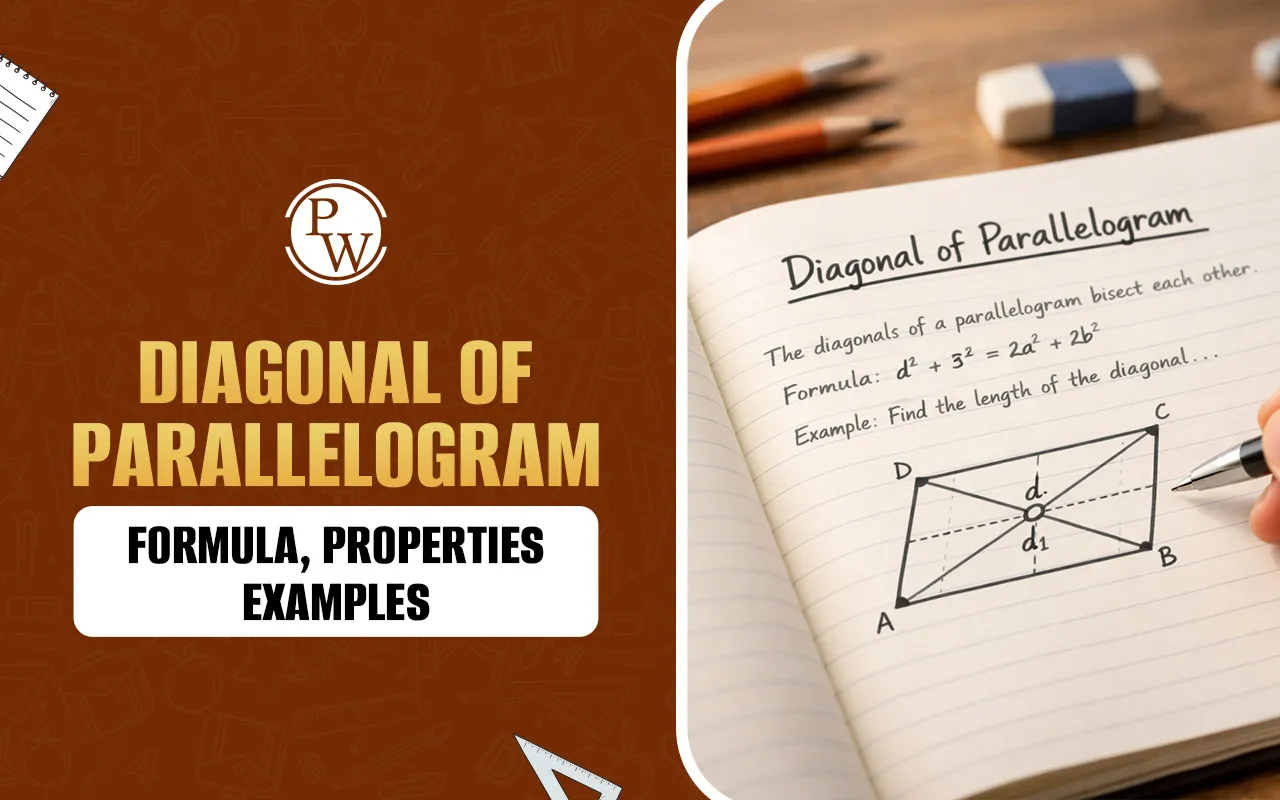
We first need a clear diagonal of parallelogram definition. A diagonal connects two corners that are not adjacent to one another in a quadrilateral with four sides and two pairs of opposite sides that are parallel. Therefore, it may be stated that any parallelogram must have two diagonals. The intersection of the two diagonals creates four smaller triangles within the overall shape.
Characteristics of Diagonal of Parallelogram:
-
A parallelogram has two and only two diagonals.
-
The diagonals are internal and located within the borders of the shape.
-
The length of the diagonals in a standard parallelogram will be unequal.
-
The two diagonals bisect each other by dividing them into equal halves.
Read More - Parallelogram Definition, Formulas, Types and Examples
Diagonal of Parallelogram Formula
If you want to determine the length of one of the diagonal of parallelogram, you will need to use mathematical formulas rather than just measuring with a ruler. By using specific formulas, we can arrive at the lengths of a and b (the lengths of two sides of the parallelogram) and the angle (x) between them.
For example, if we represent the sides of the parallelogram with the letters a and b, and the angle as the letter x, then the two diagonals commonly classified as d1 and d2 can be found using the formulas for both diagonals and the lengths of the sides (a and b) as well as the angle (x).
1. Using Law of Cosines
The most common way to calculate the diagonal of parallelogram formula involves the sides and the cosine of the interior angle.
-
For the first diagonal (d1):
The formula is: d1 = Square Root of [a² + b² - 2ab cos(x)] -
For the second diagonal (d2):
Since the adjacent angle in a parallelogram is supplementary (180 - x), the formula becomes: d2 = Square Root of [a² + b² + 2ab cos(x)]
2. The Parallelogram Law
There is another useful relationship that links both diagonals to the sides of the shape. This is often called the Parallelogram Law:
2(a² + b²) = d1² + d2²
This formula is incredibly helpful when you know the lengths of both sides and one diagonal but need to find the missing diagonal.
Diagonal of Parallelogram Properties
It is easier to solve proofs and hard geometry problems when you know the "rules" that these lines follow. Here are the main diagonal of parallelogram properties:
Bisection: The diagonals always cut each other in half. This means that the point where they cross is the middle point of both line segments.
Triangle Division: Each diagonal of parallelogram splits the shape into two triangles that are the same size. This is why the area of one of these triangles is always exactly half the area of the total parallelogram.
Intersection point: the point where the two diagonals cross. This is the shape's geometric centre.
Angle Interaction: The diagonals of a standard parallelogram do not always bisect the interior angles, nor do they always meet at 90-degree angles.
Equal: The diagonals of parallelogram are only the same length if the shape is a rectangle or a square.
How to Calculate Diagonal of Parallelogram?
If you are given a problem related to the diagonal of parallelogram examples, here are the steps to be followed to ensure accuracy:
-
Identify the Given Values: First and foremost, note down all values given to you in the problem, i.e., length of side 'a', length of side 'b', and angle 'x'.
-
Selecting the Correct Formula: Depending on whether the angle is given to you or one of the diagonals and sides is given to you, select the appropriate formula to be used for the problem. The angle is to be used for the law of cosines, and one of the diagonals and sides for the parallelogram law.
-
Substitute and Simplify: Now that you have your values and the appropriate formula to be used for your problem, simply substitute and simplify the values in the equation and ensure that you compute the square values of sides correctly before adding or subtracting them.
-
Find Square Root: Finally, to arrive at the linear value of the diagonal, compute the square root of the values that you have calculated.
Read More - Perimeter of Parallelogram - Definition, Formula, and Examples
Diagonal of Parallelogram Examples
Let’s look at a practical application to see how the diagonal of parallelogram formula works in real-time.
Example 1: Finding a diagonal using sides and an angle.
Suppose you have a parallelogram where side a = 5 cm, side b = 3 cm, and the included angle is 60 degrees.
-
We know cos(60) = 0.5.
-
Using the formula: d1² = 5² + 3² - 2(5)(3)(0.5)
-
d1² = 25 + 9 - 15
-
d1² = 19
-
d1 = √19 cm
Example 2: Using the Parallelogram Law.
If the sides of a parallelogram are 4 cm and 6 cm, and one diagonal is 7 cm, what is the length of the other diagonal?
-
Use the formula: 2(a² + b²) = d1² + d2²
-
2(4² + 6²) = 7² + d2²
-
2(16 + 36) = 49 + d2²
-
2(52) = 49 + d2²
-
104 = 49 + d2²
-
d2² = 55
-
d2 = √55 cm
Diagonals in Different Parallelograms
While all parallelograms share the bisection property, specific types have extra rules:
|
Shape |
Diagonals Equal? |
Diagonals Perpendicular? |
Diagonals Bisect Angles? |
|
Parallelogram |
No |
No |
No |
|
Rectangle |
Yes |
No |
No |
|
Rhombus |
No |
Yes |
Yes |
|
Square |
Yes |
Yes |
Yes |
Knowing these differences helps you identify the shape based solely on the behaviour of its diagonals.
Make Maths Easy and Enjoyable with CuriousJr
CuriousJr helps children build a strong foundation in maths while removing fear and boosting confidence. Our Mental Maths online classes for students from Classes 1 to 8 focus on improving speed, accuracy, and logical thinking through simple techniques and interactive learning.
With a dual-mentor system, students attend engaging live classes and receive dedicated support for doubt-solving after every session. Animated lessons, fun activities, and exciting challenges make learning maths clear and enjoyable.
Parents receive regular progress updates and review sessions, ensuring complete transparency in their child’s learning journey.
Book a demo class today and discover how CuriousJr makes maths simple, engaging, and confidence-driven for your child.