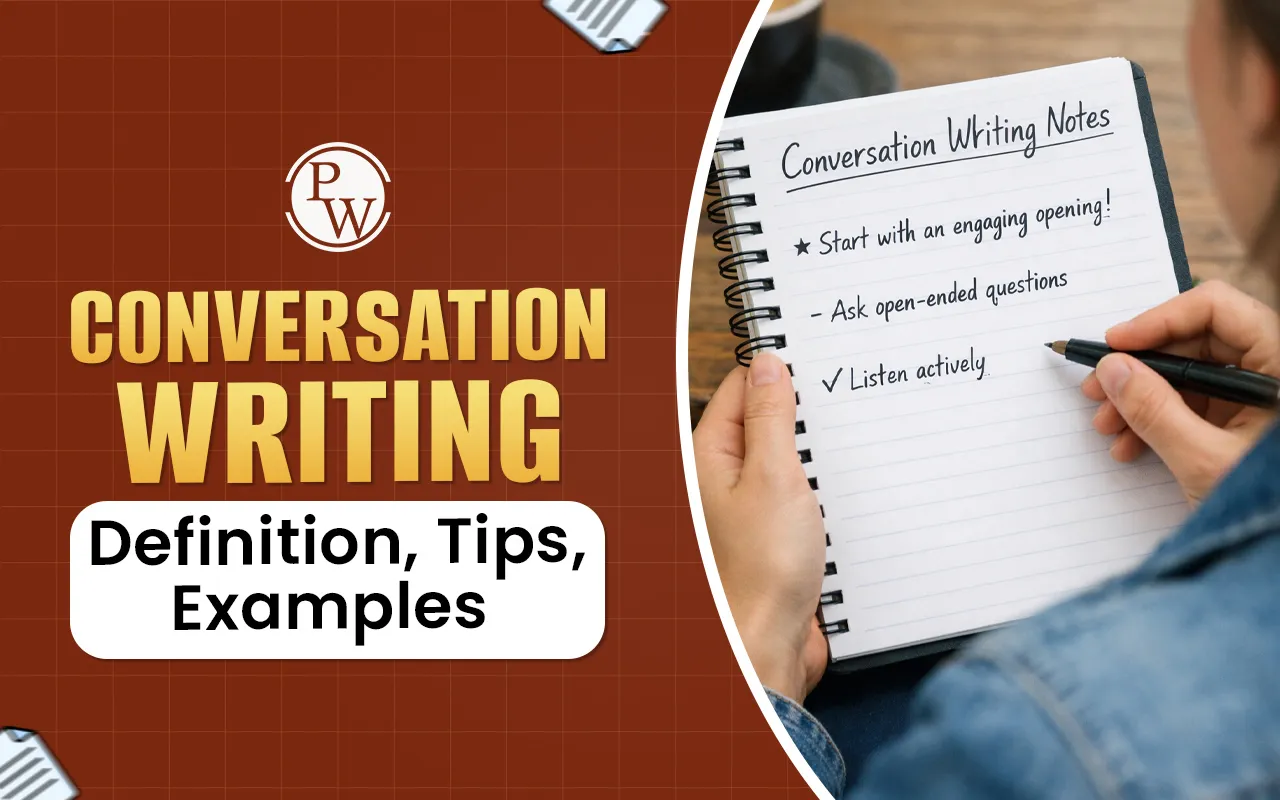
Conversation Writing - Definition, Tips, Examples
 Nikita Aggarwal10 Apr, 2026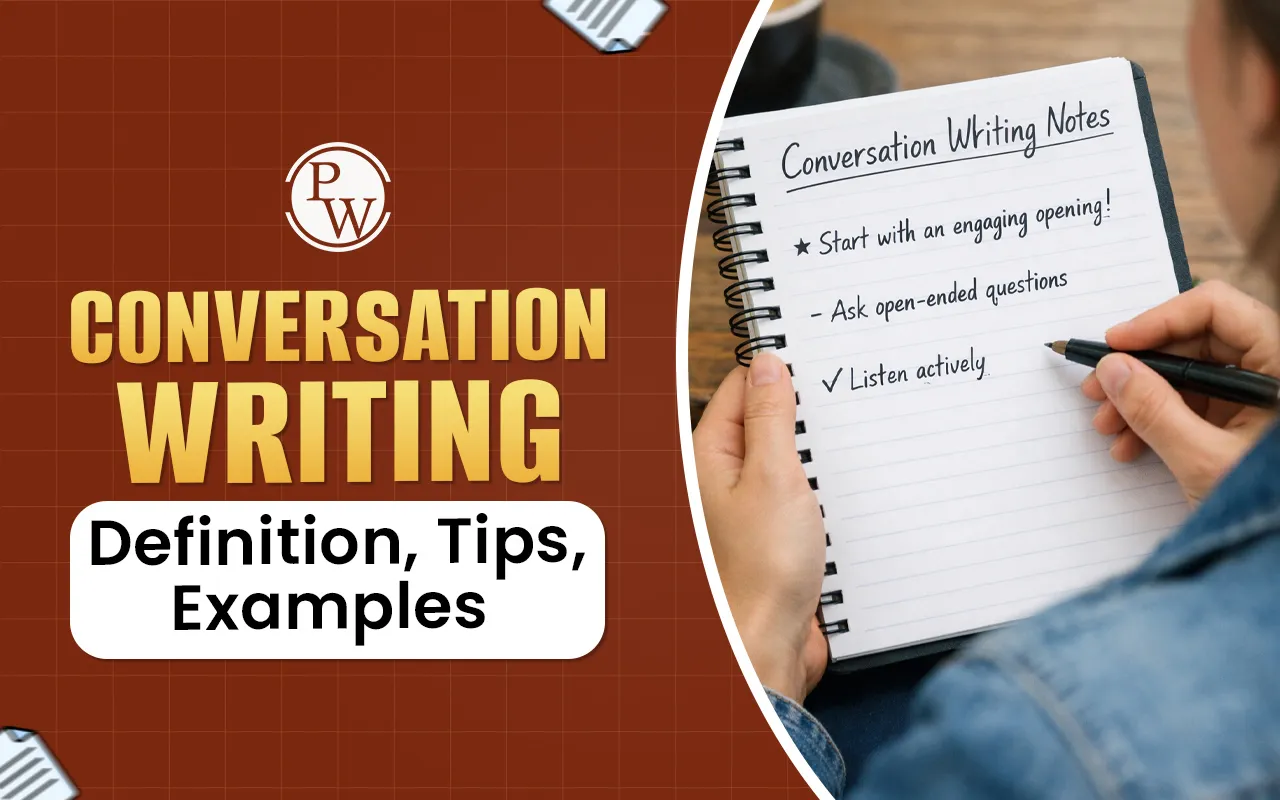
What is Conversation Writing?
Before we go into the approaches, let's make sure we know what conversation writing definition is. This style of writing is the representation of a spoken exchange between two or more people. It puts more emphasis on how people really talk, such as using pauses, casual language, and emotional clues, than on writing essays.
In an academic context, It is a functional English exercise where students create a script-like interaction. It requires an understanding of social context, as the way you speak to a teacher differs greatly from how you chat with a best friend. It isn't just about the words said; it is about the "give and take" of information and the personality behind the voice.
Importance of Conversational Tone
We are often referring to a "conversational tone." This means writing as if you were speaking directly to the reader. This style makes the text easier to read in the world of blogging and creative writing. Using "you" and "I" helps the writer connect with the reader, making the content feel like a friendly conversation instead of a lecture.
Why Conversational Writing Works?
-
Accessibility: It's easier to understand complicated ideas.
-
Engagement: Readers feel like they are part of the story.
-
Relatability: It shows how people really engage with each other.
Elements of Conversation Writing
You need to know the most crucial parts of discussions that make them feel authentic and interesting in order to produce good dialogue.
-
Character Voice: Each character should have a different voice that fits their age, personality, or background.
-
Purpose: Every communication should have a point, like giving information, showing how you feel, or moving the tale along.
-
Realism: Conversations should sound like real communication, with breaks, interruptions, and casual language.
-
Subtext: What isn't said might be just as essential as what is expressed. Subtext is the meaning or feeling that isn't obvious in the words.
Conversation Writing Tips
To move from basic scripting to professional-level dialogue, you need to follow specific strategies. Here are some expert tips to help you improve your craft:
1. Listen to Real People
The best way to learn how to write dialogue is to eavesdrop (politely!). Pay attention to how people interrupt each other, use slang, or leave sentences unfinished. Real speech is rarely grammatically perfect.
2. Use Contractions
In formal essays, you write "do not" or "it is." People almost always say "don't" or "it's." Using contractions instantly makes your dialogue sound more human and less stiff.
3. Show, Don't Just Tell
Instead of a character saying, "I am very angry," show their anger through their speech patterns. Short, clipped sentences or aggressive questions can convey emotion better than a direct statement.
4. Keep it Concise
In real life, people ramble. In a written conversation, every line should serve a purpose, either moving the plot forward or revealing something about the character. Avoid "filler" talk like "Hello, how are you?" "I am fine, thanks," unless it’s necessary for the scene’s pacing.
5. Vary Sentence Length
A mix of short and long sentences creates a natural rhythm. If every line of dialogue is the same length, the conversation will feel monotonous and boring for the reader.
Read More - Paragraph Writing - Structure and Types
Formal vs. Informal Conversation Writing in English
The table below highlights the key differences between formal and informal styles.
|
Feature |
Formal Conversation |
Informal Conversation |
|
Target Audience |
Teachers, Employers, Strangers |
Friends, Family, Peers |
|
Vocabulary |
Precise and Professional |
Slang, Idioms, and Phrasal Verbs |
|
Sentence Structure |
Full, grammatically correct sentences |
Fragments and short bursts |
|
Contractions |
Limited use |
Frequent use (e.g., gonna, wanna) |
|
Purpose |
Information exchange or requests |
Social bonding and storytelling |
It is not limited to just formal and informal styles. Depending on the goal and the situation, it can look different.
-
Narrative Conversation: Dialogue that moves the story along and helps develop the characters.
-
Creative Conversation: Making up characters, tone, and settings for stories or creative expression through imaginative discourse.
Rules of Conversation Writing
Writing conversations need to follow several guidelines to make sure they are clear and well-organised.
-
Use quotation marks (in the usual way for dialogue) to show what someone said.
-
Every time the speaker changes, start a new line.
-
To show who is speaking, use dialogue tags like "said," "asked," or "replied."
-
Don't use too many adverbs (such as "said angrily") and let the conversation express how the characters feel instead.
-
Use the right punctuation to show tone, like question marks and exclamation points.
Read More - How to Write Descriptive Writing? - Format with Examples
Conversation Writing Examples
Seeing the theory in practice is the best way to learn. Below are two examples that demonstrate the shift in tone and structure based on the relationship between the speakers.
Example 1: Informal (Two friends discussing a film)
Rahul: Yo, did you catch that new sci-fi flick last night?
Sam: Oh, the one with the Martians? Yeah, it was decent, but the ending was a total letdown.
Rahul: Really? I thought the twist was genius! I didn't see it coming at all.
Sam: Come on, man. It was so predictable. I'd figured it out by the halfway mark.
Rahul: Fair enough. You always were better at spotting those tropes than me.
Example 2: Formal (Student asking a teacher for help)
Aditi: Excuse me, Mr Sharma. Do you have a moment to discuss the latest assignment?
Mr Sharma: Of course, Aditi. What seems to be the problem?
Aditi: I am struggling to understand the second prompt regarding the Industrial Revolution. Could you please clarify the expectations?
Mr Sharma: Certainly. I am looking for an analysis of the social impacts rather than just a timeline of events.
Aditi: That makes much more sense. Thank you for your time, sir.
How to Format Your Dialogue in Writing Conversation?
Proper formatting is just as important as the words themselves. If the reader can't tell who is speaking, they will lose interest.
-
Speaker Names: Place the name of the character on the left, followed by a colon.
-
New Lines: Start a new line every time the speaker changes.
-
Action Tags: You can include stage directions in brackets, like (smiling) or (sighs), to provide context for the dialogue.
-
Punctuation: Use question marks and exclamation points to indicate the tone of voice.
Common Mistakes to Avoid in Conversation Writing
Even experienced writers can stumble when it comes to dialogue. Keep an eye out for these pitfalls:
-
Info-Dumping: Don't use a conversation to explain the entire backstory of your plot. It feels forced when characters tell each other things they both already know.
-
Overusing Names: In real life, we don't say the person's name in every sentence. "Hi John. How are you, John? I like your hat, John," sounds incredibly unnatural.
-
Perfect Grammar: While you should follow basic rules for clarity, don't be afraid to use "me and him" instead of "he and I" if that is how the character would actually speak.
Conversation Writing Practice Questions
Practice is the key to mastering conversation skills in writing. Try these exercises and topics to improve your skills:
Exercise 1: Complete the Conversation
-
A: Hi, where are you going?
-
B: ____________
-
A: That sounds interesting!
Exercise 2: Write a Short Dialogue
Write a conversation between:
-
Two friends planning a trip
-
A student asking a teacher for help
-
A customer talking to a shopkeeper
Exercise 3: Identify the Tone
Read a short conversation and identify whether it is formal or informal.
Practice Topics:
-
Friends discussing a movie
-
Doctor and patient conversation
-
Job interview scenario
-
Parent and child discussion
Regular practice with such topics will help you become more confident and creative in writing conversations.
Give Your Child a Global Advantage with CuriousJr’s Cambridge-Certified English Program
Is your child finding it difficult to speak or understand English with confidence at school or in daily life? CuriousJr helps children aged 6 to 14 improve their English skills through live online English Learning classes led by experienced teachers.
Our program is based on globally recognised Cambridge standards and is specially designed for Indian learners. It includes four structured levels—Pre A1, A1, A2, and B1—to help children gradually strengthen their grammar, vocabulary, reading, writing, listening, and speaking skills.
With small batch sizes, every child gets personal attention and the right support to learn at their own pace. The focus is on building confidence and enabling effective communication in both academic and real-life situations.
Book a demo session today and discover how CuriousJr can help your child grow in English.