

List of 206 Bones in Our Human Body, Types and Functions
 Shivam Singh26 Sept, 2026
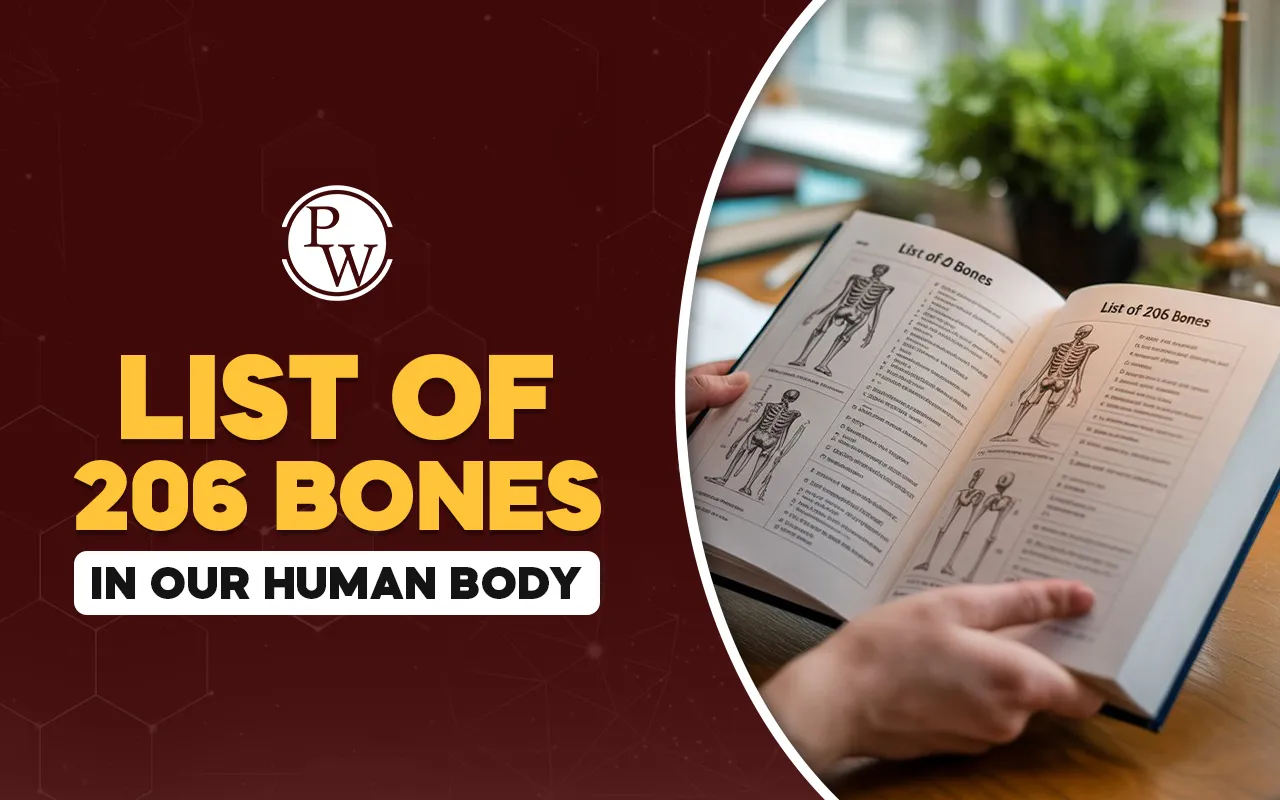
The adult human body has 206 bones. These bones form the skeleton, which gives the body structure, protects important organs, supports movement, and provides places for muscles to attach.
The 206 bones are grouped into two major divisions:
-
Axial skeleton: 80 bones
-
Appendicular skeleton: 126 bones
The axial skeleton forms the central framework of the body, while the appendicular skeleton includes the bones of the limbs and the girdles that connect them to the trunk.
What Are the 206 Bones in the Human Body?
The 206 bones in the human body make up the adult skeletal system. They differ in size, shape and function, but together they provide support, protection and movement.
The skeleton is divided into:
1. Axial Skeleton: 80 Bones
The axial skeleton forms the central axis of the body. It includes:
-
Skull
-
Middle ear bones
-
Hyoid bone
-
Vertebral column
-
Thoracic cage
The axial skeleton contains 80 bones.
Also read: What is a Cell?
2. Appendicular Skeleton: 126 Bones
The appendicular skeleton includes the bones of the arms and legs along with the pectoral and pelvic girdles.
It contains:
-
Pectoral girdles
-
Upper limbs
-
Pelvic girdle
-
Lower limbs
The appendicular skeleton contains 126 bones and is closely involved in movement and locomotion.
Read More: 5 Sense Organs
List of 206 Bones in the Human Body
Here is the complete list of the 206 bones, arranged according to the two main divisions of the skeleton.
Axial Skeleton: 80 Bones
|
Part |
Bones |
Number |
|
Skull |
Cranial and facial bones |
22 |
|
Middle ear |
Malleus, incus and stapes |
6 |
|
Hyoid |
Hyoid bone |
1 |
|
Vertebral column |
Cervical, thoracic and lumbar vertebrae, sacrum and coccyx |
26 |
|
Thoracic cage |
Sternum and ribs |
25 |
|
Total |
Axial skeleton |
80 |
1. Skull: 22 Bones
The skull has 22 bones, divided into 8 cranial bones and 14 facial bones.
Cranial Bones: 8
|
Bone |
Number |
|
Frontal |
1 |
|
Parietal |
2 |
|
Temporal |
2 |
|
Occipital |
1 |
|
Sphenoid |
1 |
|
Ethmoid |
1 |
|
Total |
8 |
The cranial bones form the protective case around the brain.
Facial Bones: 14
|
Bone |
Number |
|
Mandible |
1 |
|
Maxilla |
2 |
|
Zygomatic |
2 |
|
Nasal |
2 |
|
Lacrimal |
2 |
|
Palatine |
2 |
|
Inferior nasal conchae |
2 |
|
Vomer |
1 |
|
Total |
14 |
Together, the cranial and facial bones make up the 22 bones of the skull.
Also read: Blood and Its Components
2. Middle Ear Bones: 6
Each middle ear contains three small bones, so there are six in total:
-
Malleus: 2
-
Incus: 2
-
Stapes: 2
The malleus, incus and stapes are the tiny bones that help transmit sound vibrations through the middle ear.
3. Hyoid Bone: 1
The hyoid bone is a small, U-shaped bone in the neck. It supports the tongue and helps with functions such as swallowing and speech.
4. Vertebral Column: 26 Bones
The adult vertebral column contains 26 bones:
|
Part |
Number |
|
Cervical vertebrae |
7 |
|
Thoracic vertebrae |
12 |
|
Lumbar vertebrae |
5 |
|
Sacrum |
1 |
|
Coccyx |
1 |
|
Total |
26 |
The vertebral column supports the body and protects the spinal cord.
5. Thoracic Cage: 25 Bones
The thoracic cage contains:
-
Sternum: 1
-
Ribs: 24
The ribs and sternum form the bony framework of the chest and help protect organs such as the heart and lungs.
Appendicular Skeleton: 126 Bones
The appendicular skeleton contains 126 bones.
|
Part |
Number of Bones |
|
Pectoral girdle |
4 |
|
Upper limbs |
60 |
|
Pelvic girdle |
2 |
|
Lower limbs |
60 |
|
Total |
126 |
1. Pectoral Girdle: 4 Bones
The pectoral girdle connects the upper limbs with the trunk.
-
Clavicles: 2
-
Scapulae: 2
Also read: Online Tuition For Class 3 Students
2. Upper Limbs: 60 Bones
The two upper limbs together contain 60 bones.
|
Bone |
Number |
|
Humerus |
2 |
|
Radius |
2 |
|
Ulna |
2 |
|
Carpals |
16 |
|
Metacarpals |
10 |
|
Phalanges |
28 |
|
Total |
60 |
Each hand has:
-
8 carpals
-
5 metacarpals
-
14 phalanges
This gives 27 bones in each hand.
3. Pelvic Girdle: 2 Bones
The pelvic girdle contains two hip bones.
-
Right hip bone: 1
-
Left hip bone: 1
In adults, each hip bone is formed from three fused parts: the ilium, ischium and pubis.
4. Lower Limbs: 60 Bones
The two lower limbs together contain 60 bones.
|
Bone |
Number |
|
Femur |
2 |
|
Patella |
2 |
|
Tibia |
2 |
|
Fibula |
2 |
|
Tarsals |
14 |
|
Metatarsals |
10 |
|
Phalanges |
28 |
|
Total |
60 |
Each foot has:
-
7 tarsals
-
5 metatarsals
-
14 phalanges
This gives 26 bones in each foot.
206 Bones Name List at a Glance
For quick revision, the major bone groups can be remembered like this:
Axial skeleton: 80 bones
- Skull: 22
- Middle ear bones: 6
- Hyoid: 1
- Vertebral column: 26
- Thoracic cage: 25
Appendicular skeleton: 126 bones
- Pectoral girdle: 4
- Upper limbs: 60
- Pelvic girdle: 2
- Lower limbs: 60
80 + 126 = 206 bones
This classification makes it easier to study the names of all 206 bones without trying to memorise them as one long list. Students can explore more simple science topics, anatomy concepts, and educational learning resources on Curious Jr.
Different Types of Bones in the Human Body
Bones have different shapes and structures. In basic anatomy, they are commonly grouped into five types:
1. Long Bones
Long bones are longer than they are wide and are important for support and movement.
Examples:
-
Femur
-
Humerus
-
Radius
-
Ulna
-
Tibia
-
Fibula
2. Short Bones
Short bones are generally compact and roughly cube-shaped. They provide stability and allow limited movement.
Examples:
-
Carpals of the wrist
-
Tarsals of the ankle
3. Flat Bones
Flat bones are generally thin and flattened. Many provide protection for internal organs and offer surfaces for muscle attachment.
Examples:
-
Frontal bone
-
Parietal bones
-
Sternum
-
Ribs
-
Scapulae
4. Irregular Bones
Irregular bones have shapes that do not fit neatly into the long, short or flat categories.
Examples:
-
Vertebrae
-
Sacrum
-
Coccyx
-
Mandible
5. Sesamoid Bones
Sesamoid bones develop within some tendons and can help protect the tendon and improve its mechanical action.
Example:
-
Patella, or kneecap
Bone classification can vary slightly depending on the anatomy reference and the feature being used for classification, but these five categories are commonly taught in school-level anatomy.
Functions of Bones in the Human Body
Bones do much more than give the body its shape. They have several important functions.
Support
The skeleton provides a framework that supports the body and helps maintain its shape.
Protection
Some bones protect delicate organs.
For example:
-
Skull protects the brain.
-
Vertebral column protects the spinal cord.
-
Ribs and sternum help protect the heart and lungs.
Movement
Bones work with muscles and joints to produce movement. Muscles pull on bones through tendons, allowing actions such as walking, running, lifting and writing.
Mineral Storage
Bone tissue stores minerals, particularly calcium and phosphorus, which are important for normal body functions and bone structure.
Blood Cell Production
Bone marrow is involved in the production of blood cells. Red bone marrow contains blood-forming cells that produce red blood cells, white blood cells and platelets.
Energy Storage
Yellow bone marrow contains a large amount of fat and acts as an energy store within the skeleton.
Why Do Humans Have 206 Bones?
The commonly taught adult human skeleton contains 206 bones.
Newborns have approximately 270 bones, but this number changes as the skeleton grows. Some bones that are separate early in life gradually fuse during development, resulting in the standard adult count of 206 bones.
The exact number can differ between individuals because some people have additional small accessory bones or variations in bone fusion. Therefore, 206 is the standard reference count for the adult human skeleton rather than a number that describes every individual skeleton without exception.
Which Is the Largest Bone in the Human Body?
The femur, or thigh bone, is the longest and one of the strongest bones in the human body. It connects the hip to the knee and plays a major role in supporting body weight and movement.
Which Is the Smallest Bone in the Human Body?
The stapes is the smallest bone in the human body. It is one of the three tiny bones in the middle ear and helps transmit sound vibrations.
206 Bones in the Human Body: Quick Revision
Remember the basic structure:
206 bones = 80 axial bones + 126 appendicular bones
Axial skeleton
-
Skull: 22
-
Middle ear: 6
-
Hyoid: 1
-
Vertebral column: 26
-
Thoracic cage: 25
Appendicular skeleton
-
Pectoral girdle: 4
-
Upper limbs: 60
-
Pelvic girdle: 2
-
Lower limbs: 60
Five commonly taught bone types
-
Long
-
Short
-
Flat
-
Irregular
-
Sesamoid





206 Bones in Our Human Body FAQs
What is the number of bones in the human body?
What are the names of the 206 bones in the human body?
What are the five types of bones?
Which is the largest bone in the human body?
Which is the smallest bone in the human body?











Get Free Counselling Today
and Clear up all your Doubts
 Live & recorded classes available at easeDashboard for progress trackingLakhs of practice questions

