
Simple Present Tense: Definition, Formula & Examples
 Jasdeep Singh22 Oct, 2026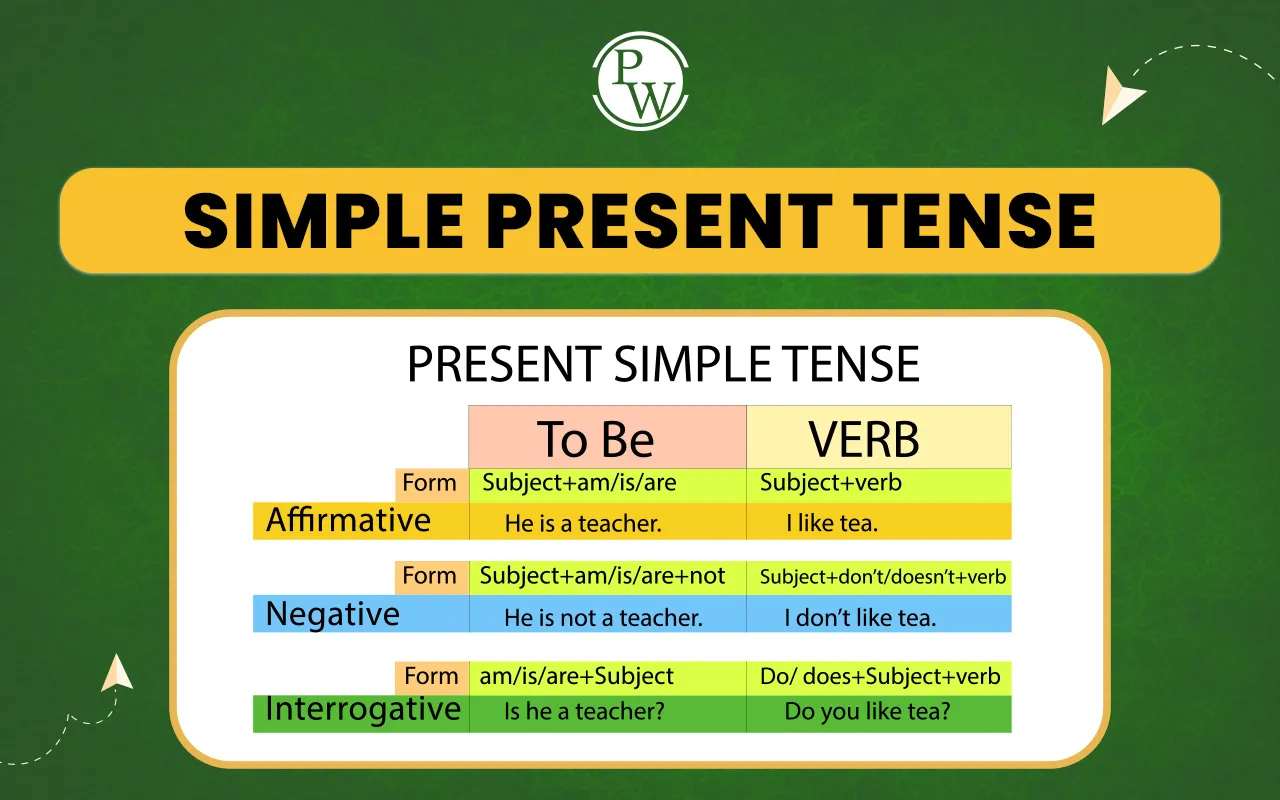
What is Simple Present Tense?
We use the simple present tense when talking about things we do regularly or facts that are generally true. For example, “I go to school every day” describes a routine, while “The Sun rises in the east” tells us a general fact. This tense is also called the present simple tense. You will often use it when talking about your family, school, hobbies, likes and dislikes, or everyday activities. Once you understand a few simple rules, making sentences with this tense becomes much easier.
Simple Present Tense Definition
The simple present tense is a verb tense used to describe habits, repeated actions, general truths, and situations that are usually true. It can also describe fixed schedules, such as school timings or train departures.
For example:
-
I play cricket every evening.
-
She reads before going to bed.
-
Birds lay eggs.
-
My father works in an office.
Each sentence tells us about a regular activity, a general fact, or a situation. The simple present tense helps us talk about these things clearly without describing an action that is happening only at this moment. With CuriousJr, students can learn English grammar, understand daily routines and habits, and use the simple present tense correctly in everyday communication.
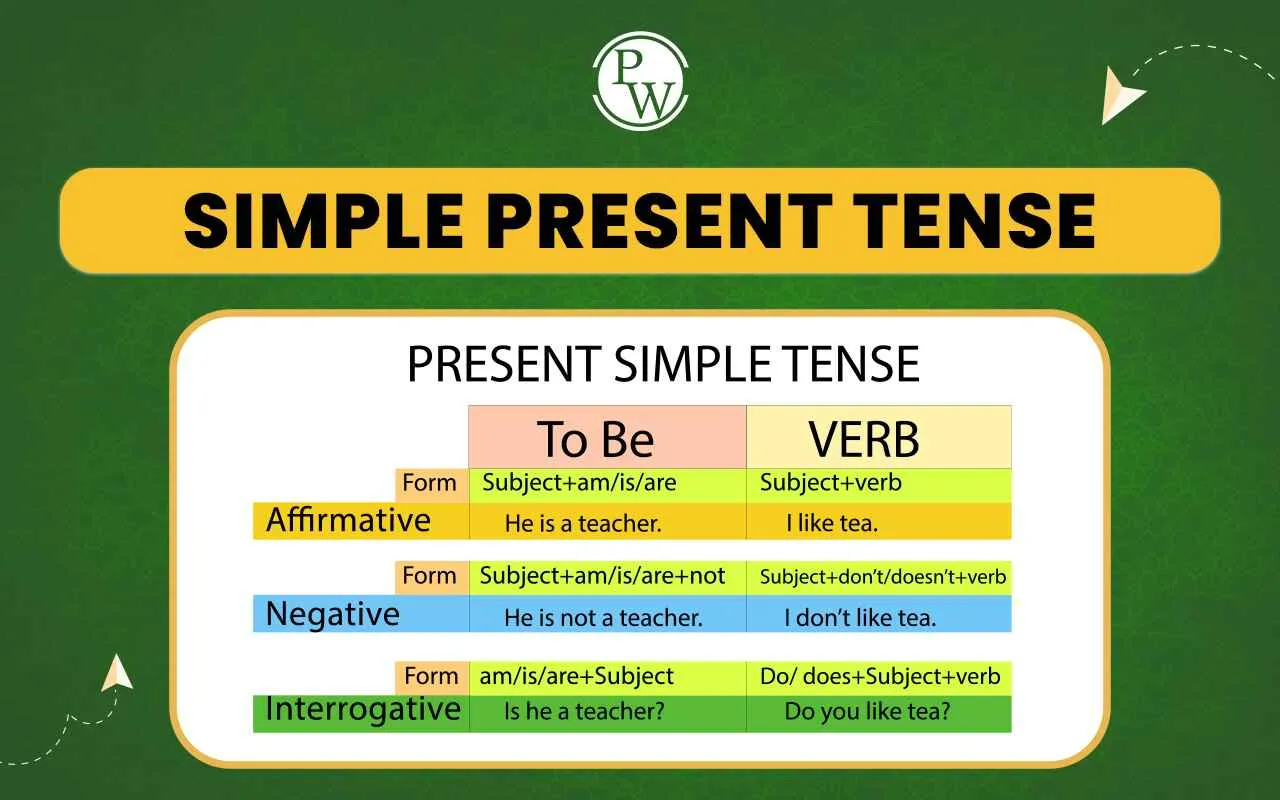
Simple Present Tense Formula and Structure
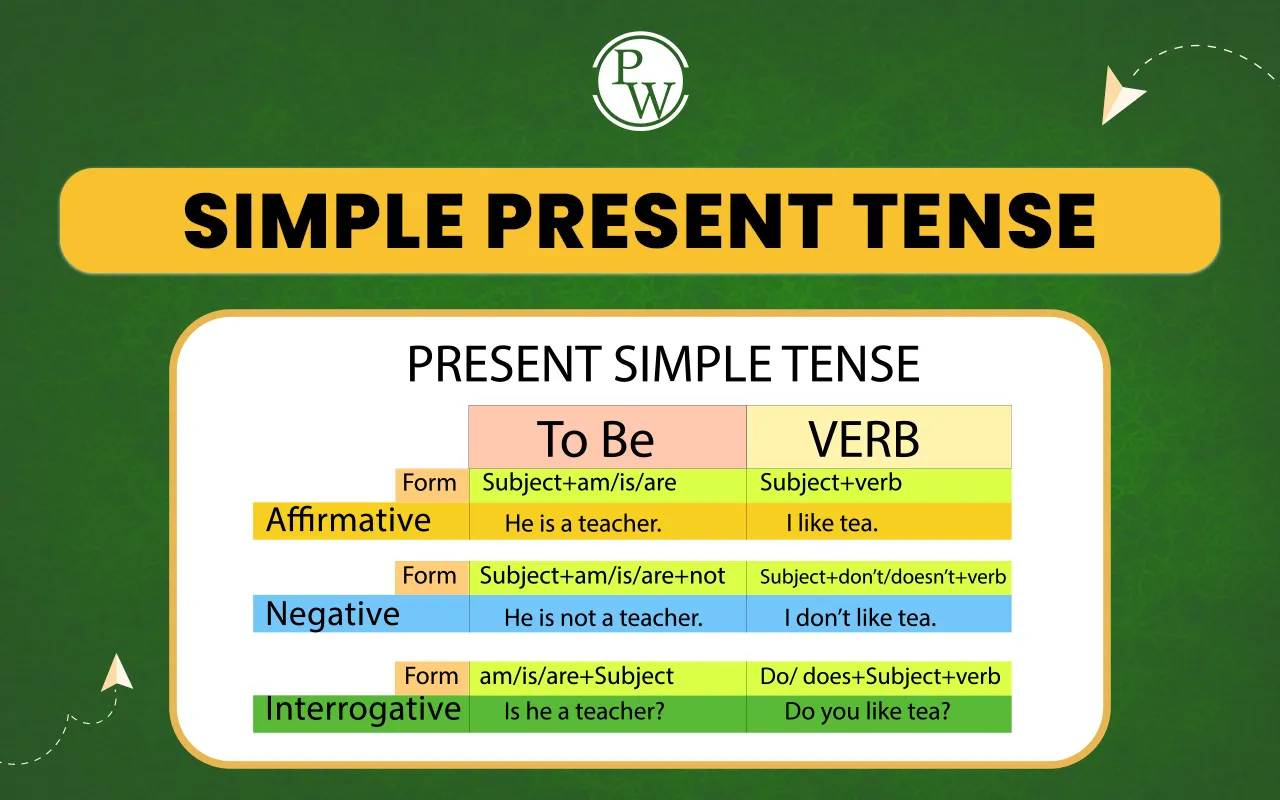
The simple present tense formula changes depending on whether you want to make a positive sentence, a negative sentence, or a question. The subject also matters because verbs sometimes change when the sentence is about he, she, it, or one person's name.
|
Sentence type |
Formula |
Example |
|
Affirmative |
Subject + verb + object |
She reads a book. |
|
Negative |
Subject + do/does + not + base verb + object |
She does not read comics. |
|
Yes/no question |
Do/Does + subject + base verb + object? |
Does she read comics? |
|
Wh-question |
Question word + do/does + subject + base verb? |
What does she read? |
1. Affirmative Simple Present Tense Structure
An affirmative sentence tells us that something happens or is true. Use the base form of the verb with I, you, we, and they. With he, she, it, or a singular name, add -s or -es to the verb.
Examples:
-
I play football.
-
We study together.
-
They visit their grandparents.
-
He plays football.
-
Riya studies every evening.
Notice the difference between “I play” and “He plays.” The action is the same, but the verb changes because the subject is different.
2. Negative Simple Present Tense Structure
A negative sentence tells us that something does not happen or is not true. Use do not with I, you, we, and they. Use does not with he, she, it, or a singular name. After do or does, always use the base form of the main verb.
Examples:
-
I do not drink coffee.
-
They do not play tennis.
-
He does not like milk.
-
Riya does not watch television at night.
You can also use the shorter forms don't and doesn't in everyday conversations. Remember that “She doesn't likes tea” is incorrect. The correct sentence is “She doesn't like tea” because the main verb stays in its base form after doesn't.
3. Interrogative Simple Present Tense Structure
An interrogative sentence asks a question. To make a yes/no question, place do or does before the subject and use the base form of the main verb. Use do with I, you, we, and they, and does with he, she, it, or a singular name.
Examples:
-
Do you play cricket?
-
Do they speak English?
-
Does he go to school?
-
Does Riya help her mother?
Questions beginning with do or does can usually be answered with yes or no. For example, “Does he play cricket?” can be answered with “Yes, he does” or “No, he doesn't.”
4. Wh-Questions in the Simple Present Tense
Wh-questions help us ask for specific information instead of just a yes or no. Common question words include what, where, when, why, and how. In most cases, use the question word followed by do or does, the subject, and the base form of the verb.
Examples:
-
Where do you live?
-
What does she eat for breakfast?
-
When do they play football?
-
Why does he wake up early?
-
How do you solve this question?
One useful exception is a question in which who is the subject. For example, “Who teaches you English?” uses “teaches” because who is doing the action.
CuriousJr English learning classes help students understand the simple present tense, practise correct sentence formation, and improve their English speaking and writing skills.
Simple Present Tense Rules
The rules of the simple present tense are easy to remember when you learn them with examples. The most important things to check are the subject, the verb ending, and whether you are writing a positive sentence, a negative sentence, or a question.
Rule 1: Use the Base Verb with I, You, We and They
When the subject is I, you, we, or they, use the base form of the verb in affirmative sentences. Do not add -s or -es to the verb with these subjects.
Examples: “I read every day,” “You speak clearly,” “We play after school,” and “They work together.”
Rule 2: Add -s or -es with He, She and It
When the subject is he, she, it, or a singular name, add -s or -es to the verb in affirmative sentences. This is one of the most important simple present tense rules because students often forget to change the verb.
Examples: “He runs fast,” “She watches cartoons,” “Aman goes to school,” and “The baby cries when hungry.”
Rule 3: Follow the Verb Spelling Rules
Most verbs take -s, as in read → reads and play → plays. Verbs ending in -ch, -sh, -ss, -x, and many verbs ending in -o take -es, as in watch → watches, wash → washes, fix → fixes, and go → goes.
When a verb ends in a consonant followed by y, change y to -ies. For example, study becomes studies and try becomes tries. If a vowel comes before y, simply add -s, as in play → plays.
Rule 4: Use Do Not or Does Not for Negative Sentences
Use do not with I, you, we, and they. Use does not with he, she, it, or a singular name. The main verb remains in its base form after do not or does not.
Examples: “We do not waste water,” “They do not eat meat,” “He does not play chess,” and “Anu does not drink coffee.”
Rule 5: Use Do or Does to Form Questions
Use do at the beginning of questions with I, you, we, and they. Use does with he, she, it, or a singular name. The main verb stays in its base form.
Examples: “Do you like music?” and “Do they study daily?” Use “Does he play cricket?” rather than “Does he plays cricket?”
Rule 6: Use Am, Is and Are with the Verb Be
The verb be follows a different pattern from most action verbs. Use am with I, is with he, she, or it, and are with you, we, or they. These forms help describe feelings, conditions, identities, and locations.
Examples: “I am happy,” “She is ready,” and “They are at home.” To make a question, place the verb before the subject, as in “Is she ready?” or “Are they at home?”
Also Read, Present indefinite tense with its definition, rules, and examples. Learn how to describe daily routines, habits, and general truths while improving English grammar and sentence formation.
Simple Present Tense Examples
Examples make it easier to understand how the simple present tense works in everyday English. Read the following sentences and notice how the verb changes according to the subject and the type of sentence.
Affirmative Sentences
-
I wake up at six every morning.
-
She sings beautifully.
-
My brother plays football.
-
We go to school together.
-
They visit their grandparents on Sundays.
-
Water boils at 100°C under standard atmospheric pressure.
-
The school opens at eight o'clock.
These sentences describe routines, general facts, or regular schedules. Notice that we say “I wake up” but “She sings.” The verb form depends on the subject, so always check who or what the sentence is about.
Negative Sentences
-
I do not eat spicy food.
-
He does not watch television at night.
-
They do not live near my house.
-
She does not drink coffee.
-
We do not waste paper.
-
The shop does not open on Sundays.
Negative sentences use do not or does not before the main verb. When checking your sentence, identify the subject first and then choose the correct helping verb. After does not, remember to use the base form, such as “does not drink,” not “does not drinks.”
Interrogative Sentences
-
Do you enjoy reading?
-
Does your brother play cricket?
-
Do they come to school by bus?
-
Does Riya speak English?
-
Where does your friend live?
-
When do your classes begin?
Questions help you ask about routines, preferences, and everyday activities. Use do or does before the subject in yes/no questions, and add a question word when you need specific information.
Also Read, Sequence of tenses in English grammar with its definition, rules, and examples. Understand how tenses work in main and subordinate clauses to improve sentence structure and grammatical accuracy.
When Do We Use the Simple Present Tense?
The simple present tense is useful in several everyday situations. It helps us describe what we do regularly, what we know to be generally true, and what happens according to a fixed schedule.
1. Habits and Daily Routines
Use the simple present tense to talk about activities that you do regularly. Words such as every day, usually, often, always, and sometimes commonly appear in these sentences.
Examples: “I brush my teeth twice a day,” “She walks in the park every evening,” and “We usually finish our homework before dinner.”
2. General Facts and Truths
Use this tense to share facts about nature, science, and the world around us. These sentences describe things that are generally true rather than something happening only at the moment of speaking.
Examples: “The Earth revolves around the Sun,” “Plants need sunlight to grow,” and “Fish live in water.”
3. Likes, Dislikes and Stable Situations
The simple present tense can describe preferences, feelings, and situations that are generally true. It is often used with verbs such as like, love, know, live, and understand.
Examples: “I like chocolate,” “She knows the answer,” and “My uncle lives in Jaipur.” These sentences tell us about preferences or situations rather than actions happening right now.
4. Timetables and Scheduled Events
Use the simple present tense to talk about fixed schedules, such as school timings, train departures, and planned programmes. The event may happen in the future, but the sentence describes an established timetable.
Examples: “The train leaves at six in the morning,” “Our school opens at eight,” and “The match starts at four o'clock.”
5. Instructions and Directions
The simple present tense is also used in instructions, recipes, and explanations. Instructions often use the base form of a verb directly, while descriptions of a process may use ordinary simple present sentences.
Examples include “Turn left at the crossing,” “Add two cups of water,” and “The machine starts when you press this button.” These patterns help us explain steps clearly.
Simple Present Tense Sentences for Practice
The following sentences show how different subjects can be used in positive, negative, and question forms. Read them aloud and identify the subject and verb in each sentence to practise the structure.
|
Subject |
Sentence |
Type |
|
I |
I read every night. |
Affirmative |
|
She |
She dances well. |
Affirmative |
|
They |
They do not eat outside regularly. |
Negative |
|
He |
He does not drive fast. |
Negative |
|
You |
Do you play tennis? |
Question |
|
Rohan |
Does Rohan study English? |
Question |
|
We |
We visit our cousins on Sundays. |
Affirmative |
|
The baby |
The baby cries when hungry. |
Affirmative |
|
My friends |
My friends do not arrive late. |
Negative |
|
Your sister |
Does your sister sing? |
Question |
Also Read, Tenses for Class 6 students with simple definitions, rules, and examples. Learn present, past, and future tenses, understand their types, and practise sentence formation to strengthen English grammar skills.
Common Mistakes in the Simple Present Tense
Students often make a few small mistakes when using the simple present tense. Understanding why these mistakes happen will help you recognise the correct sentence and use the tense confidently in schoolwork and everyday conversations.
Mistake 1: Adding -s to the wrong subject
Incorrect: They plays cricket.
Correct: They play cricket.
Use -s or -es with he, she, it, or a singular name in affirmative sentences, not with they.
Mistake 2: Adding -s after does
Incorrect: She does not likes tea.
Correct: She does not like tea.
The helping verb does already marks the third-person singular, so the main verb stays in its base form.
Mistake 3: Using the wrong helping verb
Incorrect: Do he go to school?
Correct: Does he go to school?
Use does with he, she, it, or a singular name when making questions.
Mistake 4: Confusing routines with actions happening now
For a regular habit, say “I eat lunch at one o'clock.” If you want to describe an action happening at this moment, “I am eating lunch” is usually more appropriate.
The simple present tense describes habits and general truths, while the present continuous tense commonly describes actions in progress. Choosing between them depends on what you want your sentence to mean.
Mistake 5: Using the wrong form of be
Incorrect: She are happy.
Correct: She is happy.
Remember to use am with I, is with he, she, or it, and are with you, we, or they.
Simple Present Tense Practice Questions
Try these questions to check how well you understand the simple present tense formula and rules. Fill in each blank with the correct form of the verb given in brackets, then compare your answers with the answer key below.
-
She _____ to school every day. (go)
-
They _____ football on Sundays. (play)
-
He _____ not like spicy food. (do)
-
_____ you speak English? (do)
-
Riya _____ her homework after school. (finish)
-
My parents _____ in Delhi. (live)
-
_____ your brother watch television at night? (do)
-
The Sun _____ in the east. (rise)
-
We _____ not waste water. (do)
-
The teacher _____ English to our class. (teach)
Answers
-
goes
-
play
-
does
-
Do
-
finishes
-
live
-
Does
-
rises
-
do
-
teaches
Simple Present Tenses FAQs
What is the simple present tense?
What is the formula of simple present tense?
What are the rules of simple present tense?
What are some simple present tense examples?
What is the structure of simple present tense?