Possessive Adjectives: Definition, Uses, List and Examples
 Jasdeep Singh20 Jan, 2026
Possessive Adjectives
How do Possessive Adjectives express ownership and indicate relationships between people, ideas, and objects? If you’re looking to understand how these words enhance clarity in communication, this guide is here to help.
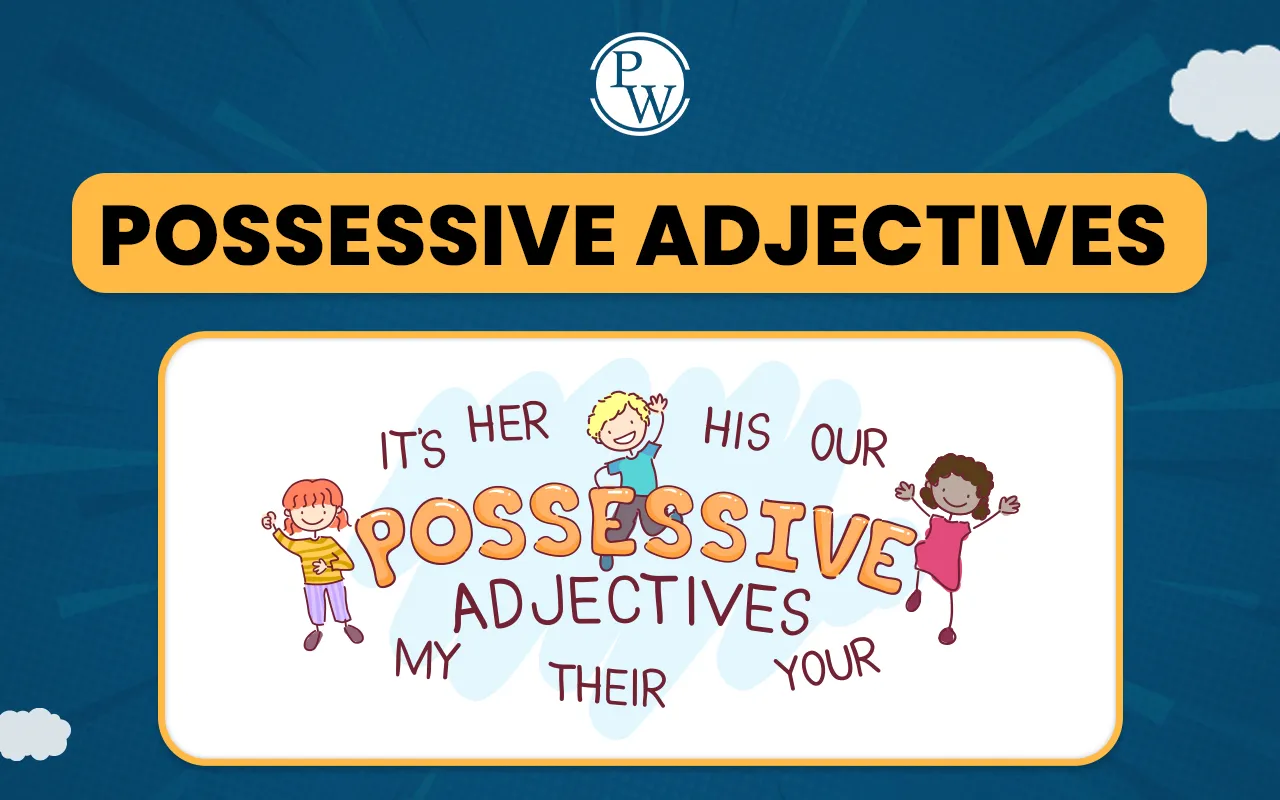
Possessive adjectives such as my, your, his, her, its, our, and their are words that show who or what a noun belongs to. For example, in sentences like “This is her project” or “Their idea was successful,” the words her and their clearly indicate ownership or connection.
Characteristics of a Good Teacher
Possessive Adjectives Definition
Possessive adjectives are words that modify or describe nouns by indicating who or what possesses the noun. These adjectives are used to show ownership or a connection between the subject and the object in a sentence. They are essential in conveying clear meaning about relationships and possessions.
For example, in the sentence, "This is my book," the word "my" shows that the book belongs to the speaker. Possessive adjectives are always placed before the noun they describe.
Examples
This is my book. My shows that the book belongs to the speaker. Her idea was very creative. Her indicates that the idea belongs to a female person (she) . Their car is parked outside. Their shows that the car belongs to a group of people (they). Our teacher explained the lesson clearly. Our means the teacher belongs to the speaker and others (we). Is this yours? Yours (possessive pronoun) matches with your (possessive adjective) to show ownership in the sentence.
How to Use Possessive Adjectives
Possessive adjectives are used directly before the noun they modify. They are typically placed at the beginning of a noun phrase and help convey the relationship between the subject and the object. Here are some examples:
- My brother is coming over for dinner.
- Can you pass me your pen?
- His parents live in the countryside.
- Our teacher gave us a challenging assignment.
- Her smile is contagious.
- Their decision will affect everyone.
Possessive Adjectives Are a Type of Pronoun
Possessive adjectives are words that act like pronouns because they replace nouns to show ownership. Instead of repeating a name or noun, a possessive adjective makes sentences clearer by showing who something belongs to. Example : Is that John's phone? No, it's his phone. In this case, his takes the place of John to show ownership, proving that possessive adjectives function like pronouns. Unlike regular adjectives (e.g., tall, blue, bright ), which describe qualities, possessive adjectives (e.g., my, your, his, her, our, their ) indicate possession or relationship. Some grammar experts classify these words as determiners because they help identify what belongs to whom in a sentence.
Examples:
Our teacher gave us homework. Our shows that the teacher belongs to the group (we). His car broke down on the way home. His indicates that the car belongs to him. Your questions are very interesting. Your shows that the questions belong to the person being spoken to. Using possessive adjectives helps avoid repetition and makes sentences clearer. It’s helpful to group possessive adjectives with possessive pronouns (e.g., mine, yours, theirs ) under the term “possessive forms” to see how they both indicate ownership but function differently.
Common Mistakes with Possessive Adjectives
Understanding possessive adjectives and similar words can be tricky. Here are some common mistakes and how to avoid them, with examples:
Mistake 1: Confusing “its” and “it’s” "Its" shows ownership (e.g., The dog wagged its tail ). "It’s" means “it is” or “it has” (e.g., It’s raining outside ). Tip : If you can’t replace it with “it is” or “it has,” don’t use it’s . Wrong : The company takes pride in it’s achievements. Right : The company takes pride in its achievements.
Mistake 2: Mixing Up “your” and “you’re” "Your" shows possession (e.g.,Your shoes are under the table ). "You’re" means “you are” (e.g., You’re going to love this movie ). Tip : If you can’t replace it with “you are,” don’t use you’re . Wrong : Your going to be late. Right : You’re going to be late.
Mistake 3: Confusing “there,” “they’re,” and “their” "There" refers to a place or is used in expressions (e.g.,The book is over there ). "They’re" means “they are” (e.g., They’re coming to visit ). "Their" shows possession (e.g., Their car is parked outside ). Tip : If you can’t replace it with “they are,” don’t use they’re . Wrong : There going to miss their bus. Right : They’re going to miss their bus.
Mistake 4: Mixing Up “who’s” and “whose” "Who’s" means “who is” or “who has” (e.g., Who’s at the door? ). "Whose" shows ownership (e.g., Whose book is this? ). Tip : If you can’t replace it with “who is” or “who has,” don’t use who’s . Wrong : Whose going to the party? Right : Who’s going to the party? Using “his/her” English lacks a non-gender-specific possessive adjective for people, so you have two main options: Use “their” : Each student should bring their lunch. (Best option, even for singular nouns) Avoid “his/her” : It’s clumsy and outdated. Wrong : Each person should bring his/her ID. Right : Each person should bring their ID.
Difference Between Possessive Adjectives and Possessive Pronouns
While both possessive adjectives and possessive pronouns indicate possession, they function differently in a sentence. Here’s how they differ:
| Possessive Adjectives | Possessive Pronouns |
|---|---|
| A possessive adjective is used before a noun to describe ownership or possession. | A possessive pronoun stands alone and replaces a noun, showing ownership. |
| Examples: my, your, his, her, its, our, their | Examples: mine, yours, his, hers, its, ours, theirs |
| Example sentence: This is my book. | Example sentence: This book is mine . |
Possessive Adjectives Questions
Choose the correct possessive adjective to fill in the blank:
- I left _______ keys on the kitchen table.
- a) my
- b) your
- c) their
- d) her
- The students finished _______ homework before going home.
- a) its
- b) his
- c) their
- d) your
- Jenny brought _______ favorite book to school.
- a) his
- b) their
- c) my
- d) her
- We spent the weekend fixing _______ car.
- a) its
- b) our
- c) their
- d) her
- The cat played with _______ toy.
- a) its
- b) their
- c) our
- d) my
Answers:
- a) my
- c) their
- d) her
- b) our
- a) its
Join Online English Learning Classes Now!!
| Related Articles | |
| Proverb | Unseen Passage |
| Preposition | Article Writing |
| Pronoun | Alphabet |
Possessive Adjectives FAQs
How do possessive adjectives differ from possessive pronouns?
Can possessive adjectives be used before pronouns?
Are possessive adjectives affected by gender?