Phrasal Verbs: Definition, Types, Examples, Practice Questions
 Jasdeep Singh20 Jan, 2026
Phrasal Verbs
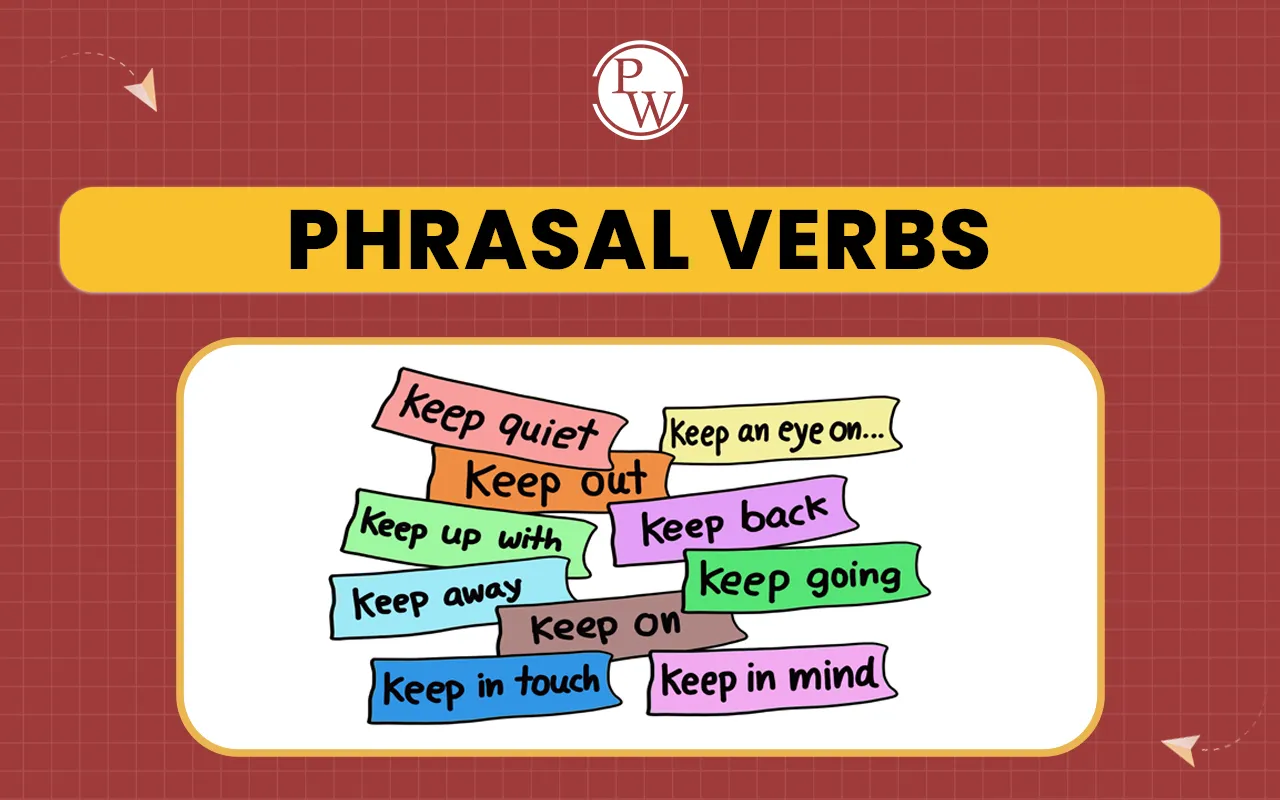
Phrasal verbs are special word combinations that make English sound more fun and friendly! They combine a simple verb, like “look” or “take,” with a little word, such as “up” or “out,” to create a new meaning.
Sometimes, the meaning is clear like “sit down,” which just means to take a seat. Other times, the meaning can be surprisinglike “give up,” which actually means to stop trying, not to hand something over! Using phrasal verbs makes conversations sound natural and easygoing.
They give you different ways to say things, like using “wake up” instead of “rise” or “run out” instead of “use up.” With phrasal verbs, English becomes more colorful and expressive!
Read More - Relative Pronouns
What Are Phrasal Verbs?
A phrasal verb is a combination of a verb with one or more words, like a preposition or adverb, to create a new meaning. For example, “give up” means to quit, which is very different from just “give” or “up.” These verbs help make English sound natural and are often used in conversations.
Example I gave up on the puzzle because it was too hard. Here, “gave up” means to stop trying, not just to “give” something.
Read More - Gerunds
Definition of a Phrasal Verb
According to the Oxford Learner's Dictionary , a phrasal verb is defined as: "A verb combined with an adverb or a preposition, or sometimes both, to give a new meaning, for example, 'go in for,' 'win over,' and 'see to.'"
Merriam-Webster Dictionary defines a phrasal verb as:
"A phrase (such as take off or look down on) that combines a verb with a preposition or adverb or both, and that functions as a verb whose meaning is different from the combined meanings of the individual words."
Why Are Phrasal Verbs Important?
Phrasal verbs are a big part of everyday English! They make our speech sound more natural, friendly, and relaxed. By combining simple verbs (like "take" or "look") with prepositions or adverbs (like "off" or "up"), phrasal verbs create phrases that give a unique meaning different from each word alone.
For Example: Take + off "The plane will take off soon." Here, "take off" means to depart, which is different from the individual meanings of "take" and "off." Look + up "You can look up the word in the dictionary." In this case, "look up" means to search for information, not just to look in an upward direction.
Read More - Auxiliary Verbs
Phrasal Verbs Types
Phrasal verbs can be categorized into different types based on their structure and how they behave in sentences. The two main categories are:
1. Transitive Phrasal Verbs
A transitive phrasal verb requires an object (a noun or pronoun) to complete the meaning of the sentence. Without the object, the sentence might feel incomplete. For example:
- "I picked up the phone."
- Here, " picked up " is the phrasal verb, and " the phone " is the object.
2. Intransitive Phrasal Verbs
An intransitive phrasal verb does not require an object. These verbs can stand alone without the need for an object to make sense. For example:
- "The meeting ran over ."
- Here, " ran over " does not need an object.
3. Separable Phrasal Verbs
Separable phrasal verbs are transitive and allow the object to come between the verb and the particle (adverb/preposition).
For example:
- "She turned off the lights."
- You can also say: "She turned the lights off ."
However, when the object is a pronoun , it must be placed between the verb and particle:
- "She turned it off ."
4. Inseparable Phrasal Verbs
Inseparable phrasal verbs cannot have the verb and particle separated by an object. The verb and particle must always stay together.
For example:
- "I will look after the children."
- You cannot say: "I will look the children after ."
Common Phrasal Verbs Examples
Some phrasal verbs are very popular in English and are used frequently. Here’s a list of common ones to get started:
Give Up – to stop trying She gave up learning the guitar.
Wake Up – to stop sleeping He wakes up at 6 AM every day.
Look After – to take care of I look after my little brother after school.
Take Off – to remove or to depart The plane took off on time.
Run Out – to use up completely We ran out of milk this morning.
How to Use Phrasal Verbs
Using phrasal verbs correctly requires attention to their structure and meaning. Let's discuss a few pointers to keep in mind:
1. Conjugation of Phrasal Verbs
When conjugating phrasal verbs, you should follow the same conjugation rules you would for a regular verb. The particle (preposition or adverb) does not change, and only the verb is conjugated. For example:
- "She picked up the package." (Past tense)
- "I will look up the information." (Future tense)
- "We are checking out the new restaurant." (Present continuous tense)
Irregular verbs within phrasal verbs still follow the same irregular conjugation patterns as regular verbs. For example:
- "He broke up with his girlfriend." (Past tense of "break")
- "They ran into some old friends at the concert." (Past tense of "run")
2. Correct Word Order
Word order is especially important when dealing with separable phrasal verbs . When using inseparable phrasal verbs, the verb and particle must remain together, whereas separable phrasal verbs allow you to place the object between the verb and particle. For example:
- Separable: "He picked up the book." or "He picked the book up ."
- Inseparable: "She looks after the children." (The verb and particle cannot be separated)
Fun Tips to Remember Phrasal Verbs
Mastering phrasal verbs can be enjoyable with a few creative tricks. Here are some fun ways to help make learning them a breeze:
- Use Flashcards: Write down each phrasal verb and its meaning on a flashcard. Quiz yourself daily!
- Play Games: Try matching verbs with different prepositions to see how many phrasal verbs you can create.
- Create Sentences: Use the phrasal verbs in your own sentences. This makes it easier to remember their meanings.
- Practice in Context: Try using phrasal verbs in real conversations with friends or family to make them stick.
Phrasal Verbs Practice Questions
Ready to test your phrasal verb knowledge? Here are some practice questions to check your understanding:
- She found the puzzle too difficult, so she ___ (gave up/gave out).
- I unexpectedly ___ (ran into/ran out) an old friend at the mall.
- During the storm, our car suddenly ___ (broke down/gave up).
- We ___ (ran out/woke up) of juice and need to buy more.
- Could you ___ (look after/look up) my plants while I’m on vacation?
Answers:
- Gave Up
- Ran Into
- Broke Down
- Ran Out
- Look After
Match the Phrasal Verbs with Their Meanings
Here’s a fun way to test your knowledge of phrasal verbs! Match each phrasal verb to its correct meaning and see how well you understand their use in everyday language. Phrasal Verbs a. Take off b. Run out c. Look after d. Break down e. Give up Meanings
- To stop trying
- To stop working
- To depart or remove
- To take care of
- To use up completely
Answers:
- a - 3
- b - 5
- c - 4
- d - 2
- e - 1
Phrasal verbs make English more expressive and fun! With regular practice, these helpful expressions will become part of your everyday language.
So try out new phrasal verbs as you learn them, and soon you’ll be using them confidently in your conversations. Happy learning!
Join Online Tuition Class for kids Now!!
| Related Links | |
| Pronouns | Antonyms |
| Singular nouns | Synonyms |
| Plural nouns | Conjunctions |
Phrasal Verbs FAQs
Can a phrasal verb have more than one meaning?
Are phrasal verbs only used in informal language?
Are phrasal verbs hard to learn?