
Integers: Definition, Types, Rules, Properties and Examples
 Jasdeep Singh28 Sept, 2026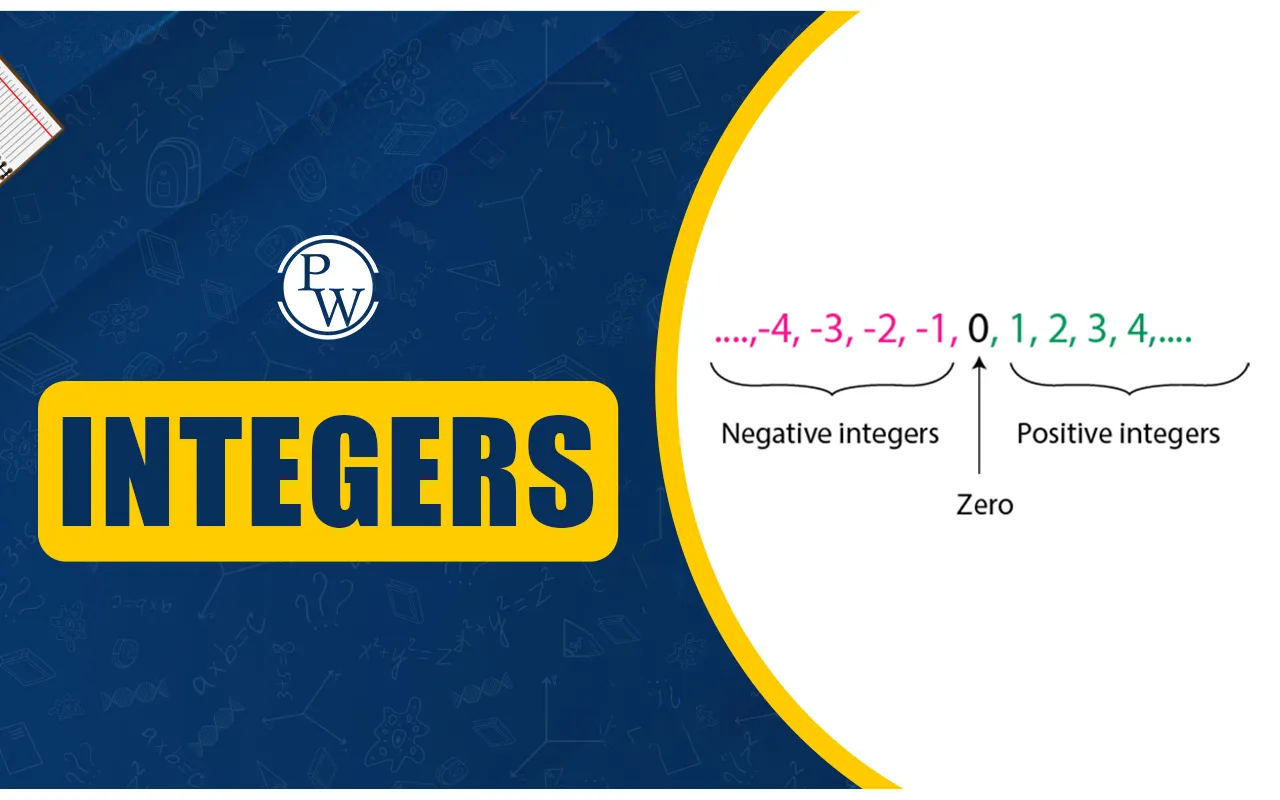
What Are Integers?
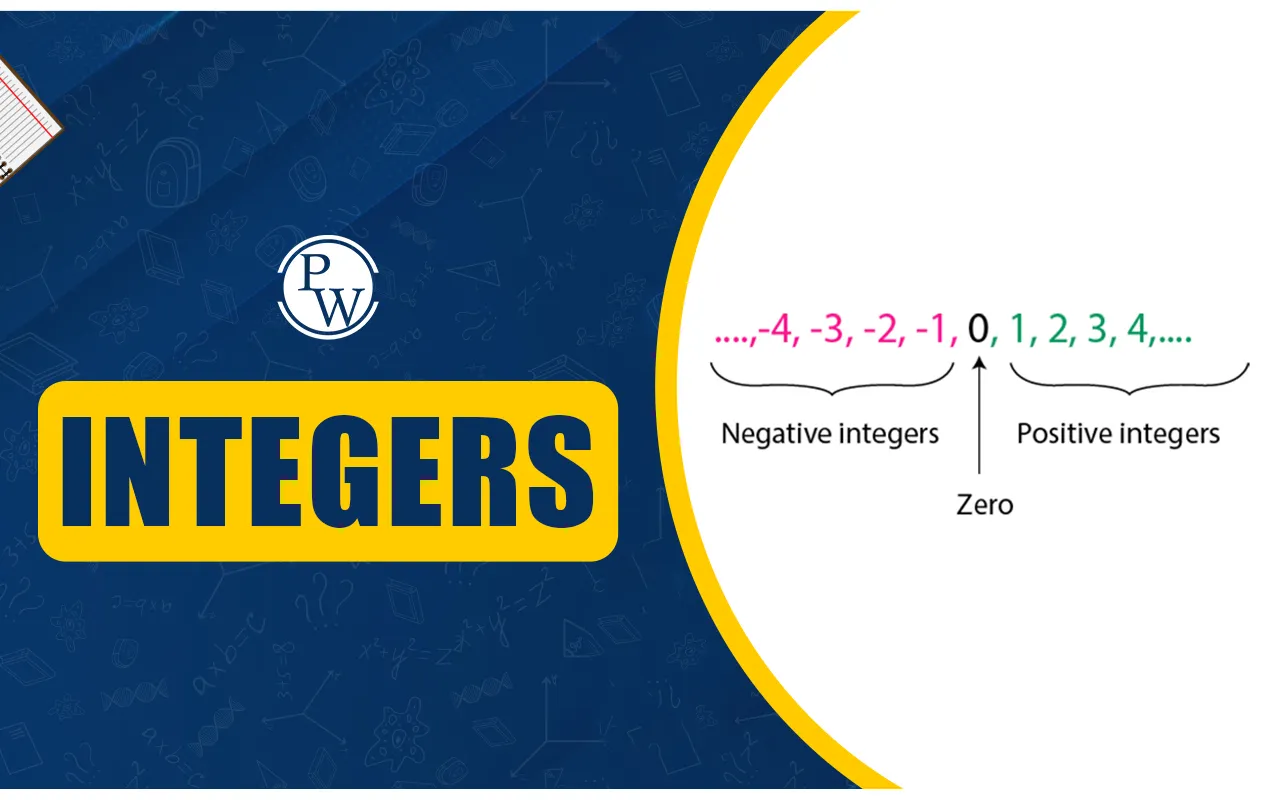
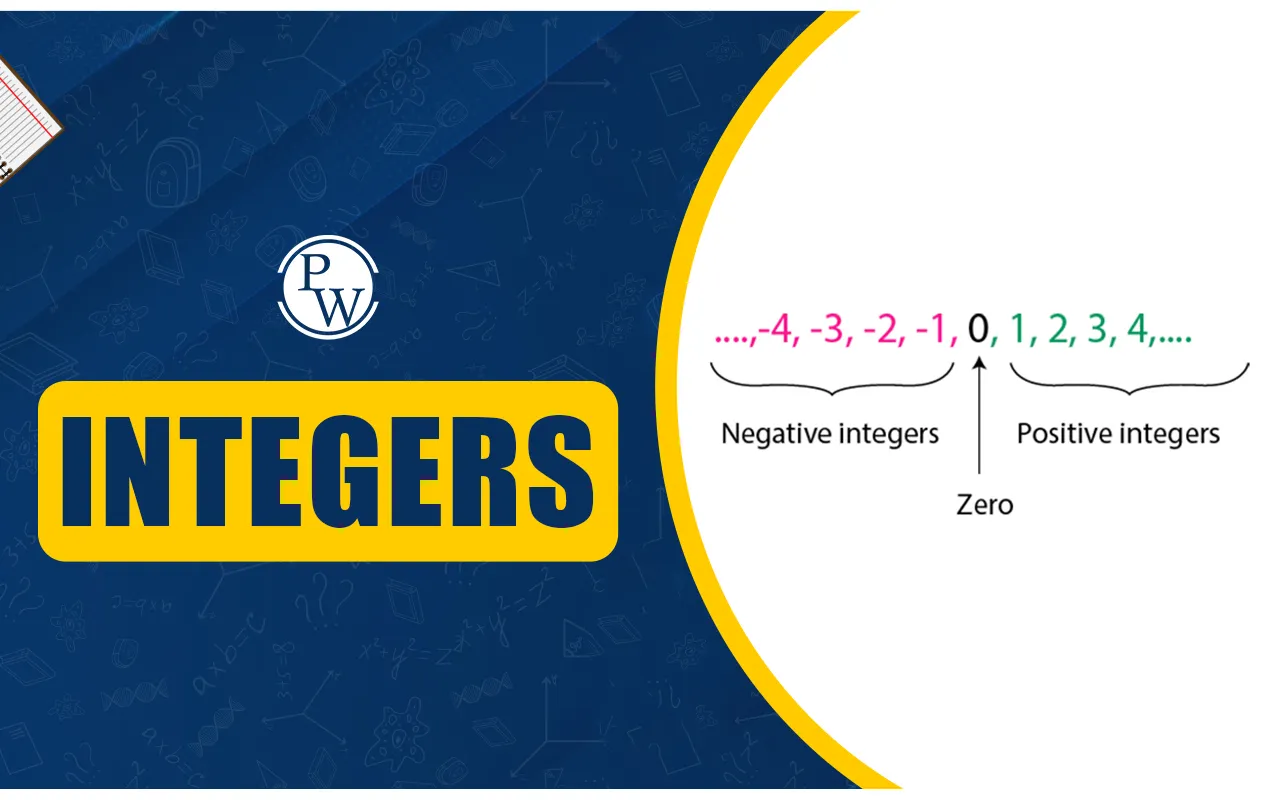
Integers are numbers that include positive whole numbers, negative whole numbers, and zero. They do not include fractions or decimals.
The set of integers is written as:
Z = {..., -5, -4, -3, -2, -1, 0, 1, 2, 3, 4, 5, ...}
For example:
-10, -3, -1, 0, 4, 8 and 25 are integers.
Numbers such as 1/2, 3.5 and -2.75 are not integers because they are fractions or decimals.
Integers are used to represent quantities above and below a reference point, such as temperature, profit and loss, elevation, and changes in scores.
Integer Meaning and Definition
An integer is a number with no fractional or decimal part. Integers can be:
-
Positive
-
Negative
-
Zero
Examples of integers:
-8, -2, 0, 5, 12, 100
Examples that are not integers:
2.5, -3.7, 1/4, 7/9
A simple way to identify an integer is to check whether the number can be written without a fractional or decimal part.
Check: Consecutive Numbers: Meaning, Types, Formulas and Examples
Types of Integers
Integers can be grouped into three categories:
-
Positive integers
-
Negative integers
-
Zero
Positive Integers
Positive integers are integers greater than zero.
Examples:
1, 2, 3, 4, 5, 6, ...
They are written on the right side of zero on a number line.
Positive integers are commonly used for quantities such as the number of books, scores, floors above ground level, or money received.
Negative Integers
Negative integers are integers less than zero.
Examples:
-1, -2, -3, -4, -5, ...
They are written on the left side of zero on a number line.
Negative integers can represent situations such as temperatures below zero, losses, debts, or positions below a reference level.
Zero
0 is an integer.
Zero is neither positive nor negative.
It lies between the positive and negative integers on a number line.
For example:
-2 < -1 < 0 < 1 < 2
Zero is also the additive identity, because adding zero to any integer leaves the number unchanged:
7 + 0 = 7
How Many Types of Integers Are There?
At the school level, integers are commonly grouped into three types:
-
Positive integers
-
Negative integers
-
Zero
For example:
| Type | Examples |
| Positive integers | 1, 2, 3, 4, 5 |
| Zero | 0 |
| Negative integers | -1, -2, -3, -4, -5 |
Together, these numbers form the set of integers.
Integers on a Number Line
A number line is one of the easiest ways to understand integers.
-
Positive integers are to the right of 0.
-
Negative integers are to the left of 0.
-
0 is in the middle.
-
Moving right means the values increase.
-
Moving left means the values decrease.
For example:
5 > 2
because 5 is to the right of 2.
Similarly:
-6 < -2
because -6 is to the left of -2.
Comparing Negative Integers
Negative integers can sometimes be confusing.
Consider:
-3 and -8
Although 8 is greater than 3 as a positive number, -3 is greater than -8.
On a number line, -3 is to the right of -8.
Therefore:
-3 > -8
A useful rule is:
Among negative integers, the number closer to zero is greater.
Also, check: Successor and Predecessor in Maths: Meaning, Definition, Examples and Rules
Opposite Integers
Two integers are called opposites if they have the same distance from zero but lie on opposite sides of zero.
Examples:
-
5 and -5
-
8 and -8
-
12 and -12
Their sum is zero:
5 + (-5) = 0
-8 + 8 = 0
The opposite of zero is zero itself.
Rules of Integers
Integer rules help us determine the sign and value of a result when adding, subtracting, multiplying, or dividing integers.
Rules for Adding Integers
When adding integers with the same sign:
-
Add their absolute values.
-
Keep the common sign.
Examples:
5 + 3 = 8
-5 + (-3) = -8
When adding integers with different signs:
-
Find the difference between their absolute values.
-
Keep the sign of the number with the greater absolute value.
Example:
8 + (-3) = 5
Example:
-8 + 3 = -5
Rules for Subtracting Integers
A useful rule is:
Subtracting an integer is the same as adding its opposite.
So:
a - b = a + (-b)
Examples:
7 - 3 = 7 + (-3) = 4
7 - (-3) = 7 + 3 = 10
-5 - 2 = -5 + (-2) = -7
-5 - (-2) = -5 + 2 = -3
Rules for Multiplying Integers
When multiplying two integers:
| Signs | Result |
| Positive × Positive | Positive |
| Positive × Negative | Negative |
| Negative × Positive | Negative |
| Negative × Negative | Positive |
Examples:
4 × 3 = 12
4 × (-3) = -12
(-4) × 3 = -12
(-4) × (-3) = 12
Rules for Dividing Integers
The same sign rule applies to division:
| Signs | Result |
| Positive ÷ Positive | Positive |
| Positive ÷ Negative | Negative |
| Negative ÷ Positive | Negative |
| Negative ÷ Negative | Positive |
Examples:
12 ÷ 3 = 4
12 ÷ (-3) = -4
(-12) ÷ 3 = -4
(-12) ÷ (-3) = 4
Remember that division by zero is not defined.
Integer Sign Rules
A quick way to remember the multiplication and division sign rules is:
Same signs → Positive
Different signs → Negative
For example:
This rule applies to both multiplication and division.
Properties of Integers
Integers follow several important properties under arithmetic operations.
The main properties commonly studied are:
-
Closure property
-
Commutative property
-
Associative property
-
Distributive property
-
Additive identity
-
Additive inverse
Closure Property
A set is closed under an operation when performing that operation on members of the set gives another member of the same set.
For integers:
-
Addition: closed
-
Subtraction: closed
-
Multiplication: closed
-
Division: not closed
Addition
(-8) + 4 = -4
The result is an integer.
Subtraction
7 - 12 = -5
The result is an integer.
Multiplication
(-10) × 3 = -30
The result is an integer.
Division
15 ÷ 4 = 3.75
The result is not an integer.
Therefore, integers are not closed under division.
Commutative Property
The commutative property means that changing the order of numbers does not change the result.
It applies to addition and multiplication.
Addition
(-5) + 8 = 8 + (-5) = 3
Multiplication
6 × (-3) = (-3) × 6 = -18
The property does not apply to subtraction or division.
For example:
8 - 3 = 5
but
3 - 8 = -5
Therefore, subtraction is not commutative.
Associative Property
The associative property means that changing the grouping of numbers does not change the result.
It applies to addition and multiplication.
Addition
3 + (4 + 6) = (3 + 4) + 6
Both sides equal:
13
Multiplication
(-2) × (5 × 3) = ((-2) × 5) × 3
Both sides equal:
-30
The associative property does not apply to subtraction or division.
Distributive Property
The distributive property connects multiplication with addition or subtraction.
For addition:
a × (b + c) = (a × b) + (a × c)
For subtraction:
a × (b - c) = (a × b) - (a × c)
Example:
5 × (3 + 7)
= (5 × 3) + (5 × 7)
= 15 + 35
= 50
Another example:
(-4) × (8 - 2)
= (-4 × 8) - (-4 × 2)
= -32 - (-8)
= -24
Additive Identity Property
Zero is the additive identity for integers.
Adding zero to any integer gives the same integer.
a + 0 = a
Examples:
9 + 0 = 9
-15 + 0 = -15
Additive Inverse Property
Every integer has an additive inverse.
The additive inverse of a number is the number that gives zero when added to it.
For any integer a:
a + (-a) = 0
Examples:
9 + (-9) = 0
-15 + 15 = 0
The additive inverse of:
-
7 is -7
-
-12 is 12
-
0 is 0
Multiplicative Identity
The multiplicative identity is 1 because multiplying an integer by 1 gives the same integer.
a × 1 = a
Examples:
8 × 1 = 8
-6 × 1 = -6
Is Multiplicative Inverse a Property of Integers?
The reciprocal relationship is important in mathematics, but it should not be treated as a closure property of integers.
For example:
5 × 1/5 = 1
The reciprocal of 5 is 1/5, which is not an integer.
Also, 0 has no multiplicative inverse because division by zero is not defined.
Therefore, unlike addition, subtraction, and multiplication, integers are not closed under taking multiplicative inverses.
Integer Properties at a Glance
| Property | Addition | Subtraction | Multiplication | Division |
| Closure | Yes | Yes | Yes | No |
| Commutative | Yes | No | Yes | No |
| Associative | Yes | No | Yes | No |
| Distributive | Not applicable in this form | Not applicable in this form | Yes, over addition/subtraction | No |
Students can practise integers, number lines, and arithmetic concepts through interactive maths learning resources on CuriousJr.
Real-Life Uses of Integers
Integers are useful whenever quantities can be represented as whole-number values above or below a reference point.
1. Temperature
Temperatures can be represented using positive and negative integers.
For example:
5°C is above zero, while -5°C is below zero.
2. Money and Debt
Positive and negative integers can represent financial changes.
For example:
-
Receiving ₹500 can be represented as +500.
-
Owing ₹200 can be represented as -200.
The exact representation depends on the situation and the convention being used.
3. Elevation
Integers can represent locations above or below a reference level.
For example:
-
+300 m can represent a location 300 m above sea level.
-
-20 m can represent a location 20 m below sea level.
4. Sports
Integers can represent scores, point changes, or penalties when the scoring system allows negative values.
For example:
A team with a score change of -2 has lost two points under that scoring system.
5. Floors of a Building
Integers can be used to label floors above and below ground level.
For example:
-
Floor 3 = +3
-
Basement 1 = -1
10 Examples of Integers in Daily Life
Here are simple examples of situations where integers can be used:
-
+10°C temperature above zero
-
-5°C temperature below zero
-
+₹500 received
-
-₹200 debt or loss
-
+3 floors above ground
-
-2 basement levels
-
+8 points gained
-
-3 points lost
-
+100 m above a reference level
-
-50 m below a reference level
The important point is that the integer represents a whole-number value with a sign.
Integers Examples
Example 1: Identify the Integers
Which of these numbers are integers?
-7, 0, 3.5, 8, 1/2, -12
The integers are:
-7, 0, 8 and -12
The numbers 3.5 and 1/2 are not integers.
Example 2: Add Two Integers
Find:
-8 + 13
Since the signs are different, find the difference:
13 - 8 = 5
The larger absolute value is 13, which is positive.
Answer: 5
Example 3: Subtract Two Integers
Find:
6 - (-4)
Change subtraction into addition:
6 + 4 = 10
Answer: 10
Example 4: Multiply Two Negative Integers
Find:
(-7) × (-3)
Two negative signs give a positive result:
7 × 3 = 21
Answer: 21
Example 5: Divide Integers
Find:
(-24) ÷ 6
Different signs give a negative result:
24 ÷ 6 = 4
Therefore:
Answer: -4
Example 6: Use the Additive Inverse
Find the additive inverse of -15.
The opposite of -15 is 15.
Check:
-15 + 15 = 0
Answer: 15
Example 7: Compare Two Negative Integers
Which is greater: -4 or -9?
On the number line, -4 is to the right of -9.
Therefore:
-4 > -9
Example 8: Temperature Change
The temperature is 12°C and falls by 5°C.
Represent the change as -5:
12 + (-5) = 7
Answer: 7°C
Example 9: Submarine Depth
A submarine starts at sea level and descends 6 metres per second. How far below sea level is it after 4 seconds?
Represent downward movement as negative:
(-6) × 4 = -24
Answer: The submarine is 24 metres below sea level.
Example 10: Loss Over Several Months
A company records a total loss of ₹48,000 over 6 months. If the loss is evenly distributed:
(-48,000) ÷ 6 = -8,000
Answer: The loss is ₹8,000 per month.
Consecutive Integers
Consecutive integers are integers that follow one another without gaps.
Examples:
3, 4, 5, 6
and
-4, -3, -2, -1
are sets of consecutive integers.
The difference between consecutive integers is always 1.
For example:
7, 8, 9
are consecutive integers.
Non-Consecutive Integers
Non-consecutive integers have one or more integers between them.
For example:
2, 5, 8
are non-consecutive because there are other integers between the numbers.
Integers vs Whole Numbers
| Feature | Integers | Whole Numbers |
| Positive numbers | Yes | Yes |
| Zero | Yes | Yes |
| Negative numbers | Yes | No |
| Fractions | No | No |
| Decimals | No | No |
| Examples | -3, -1, 0, 2, 5 | 0, 1, 2, 3, 5 |
Every whole number is an integer, but every integer is not a whole number.
For example:
-4 is an integer but not a whole number.
Integers vs Natural Numbers
Natural numbers are commonly used for counting. Depending on the textbook or convention, they may begin with 1 or include 0.
Integers include both positive and negative whole numbers as well as zero.
For example:
-3 is an integer but is not a natural number.
Because definitions of natural numbers can vary, students should follow the convention used in their textbook or syllabus.
Integers vs Fractions and Decimals
Integers do not contain a fractional or decimal part.
Examples of integers:
-5, -1, 0, 7, 20
Examples that are not integers:
1/2, 2.5, -3.75
A decimal such as 5.0 represents the same value as 5, so its value is an integer even though it is written in decimal notation.
Common Mistakes While Working With Integers
Mistake 1: Thinking every negative number is smaller in absolute value
Compare:
-2 and -8
The correct relationship is:
-2 > -8
because -2 is closer to zero.
Mistake 2: Forgetting the sign during subtraction
For:
5 - (-3)
do not subtract 3.
Instead:
5 + 3 = 8
Mistake 3: Assuming two negative numbers always give a negative product
For multiplication:
(-4) × (-2) = +8
Two negative signs give a positive result.
Mistake 4: Including fractions as integers
3/4 is not an integer.
Mistake 5: Treating zero as positive or negative
Zero is neither positive nor negative.
Mistake 6: Assuming division is closed for integers
7 ÷ 2 = 3.5
Since 3.5 is not an integer, integers are not closed under division.
Quick Revision of Integers
-
Integers include positive numbers, negative numbers, and zero.
-
Integers do not include fractions or non-integer decimals.
-
The integer set is represented by Z.
-
Zero is neither positive nor negative.
-
Positive integers lie to the right of zero.
-
Negative integers lie to the left of zero.
-
Integers are closed under addition, subtraction, and multiplication.
-
Integers are not closed under division.
-
Addition and multiplication are commutative and associative.
-
Multiplication is distributive over addition and subtraction.
-
Every integer has an additive inverse.
-
Zero is the additive identity.
-
One is the multiplicative identity.
-
For multiplication and division, same signs give positive results and different signs give negative results.