Motion of the Earth - Rotation and Revolution
 Nikita Aggarwal20 Jan, 2026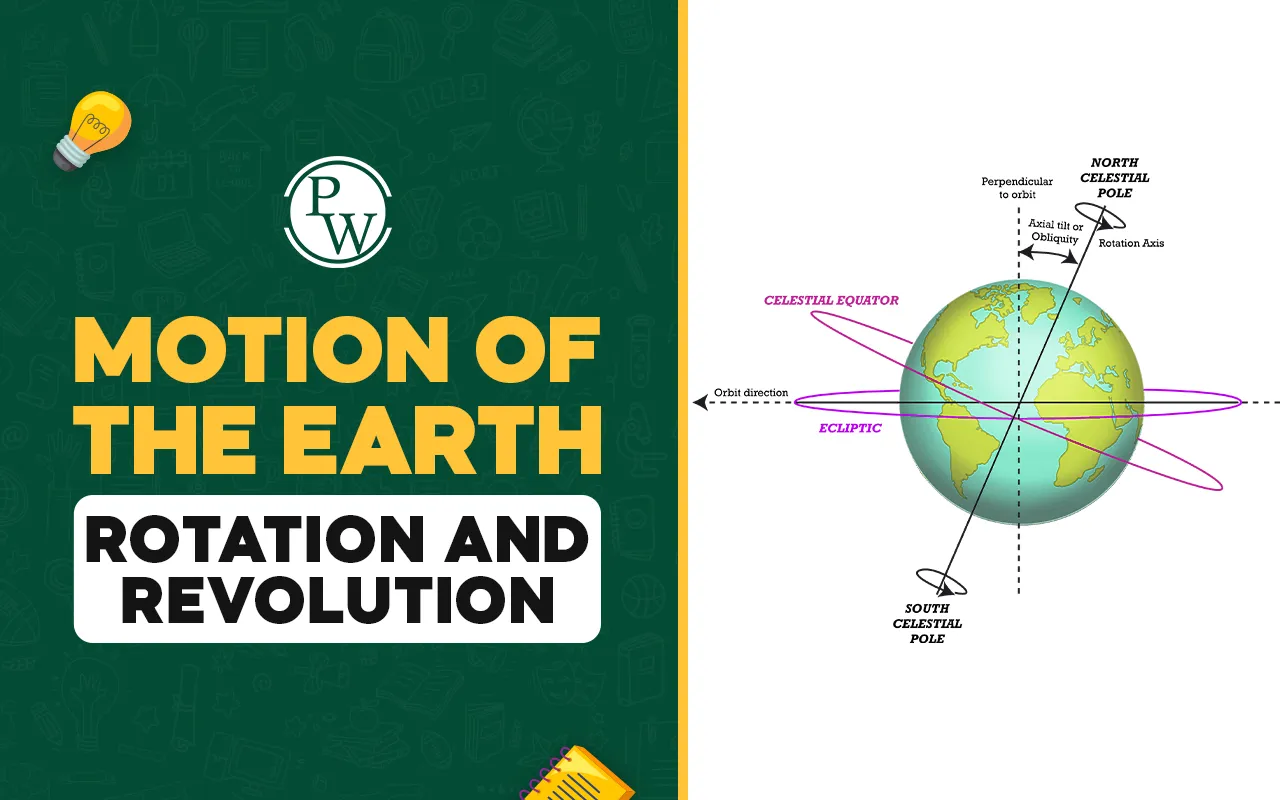
Motion of the Earth
The term motion of the Earth refers to the movements that the planet makes in space. Earth is not still. It performs several types of motion, but two of the most important are:
-
Rotation: Spinning of Earth on its own axis
-
Revolution: Movement of Earth around the Sun
Each of these motions plays a key role in shaping life on our planet. Without these movements, there would be no time system, no changing seasons, and no variation in climate. These motions also help us understand the earth motion around the sun and how it relates to other planets in the solar system.
Let us now look at each type of motion in detail.
Read more : Facts About the Earth Everyone Should Know
Rotation of the Earth
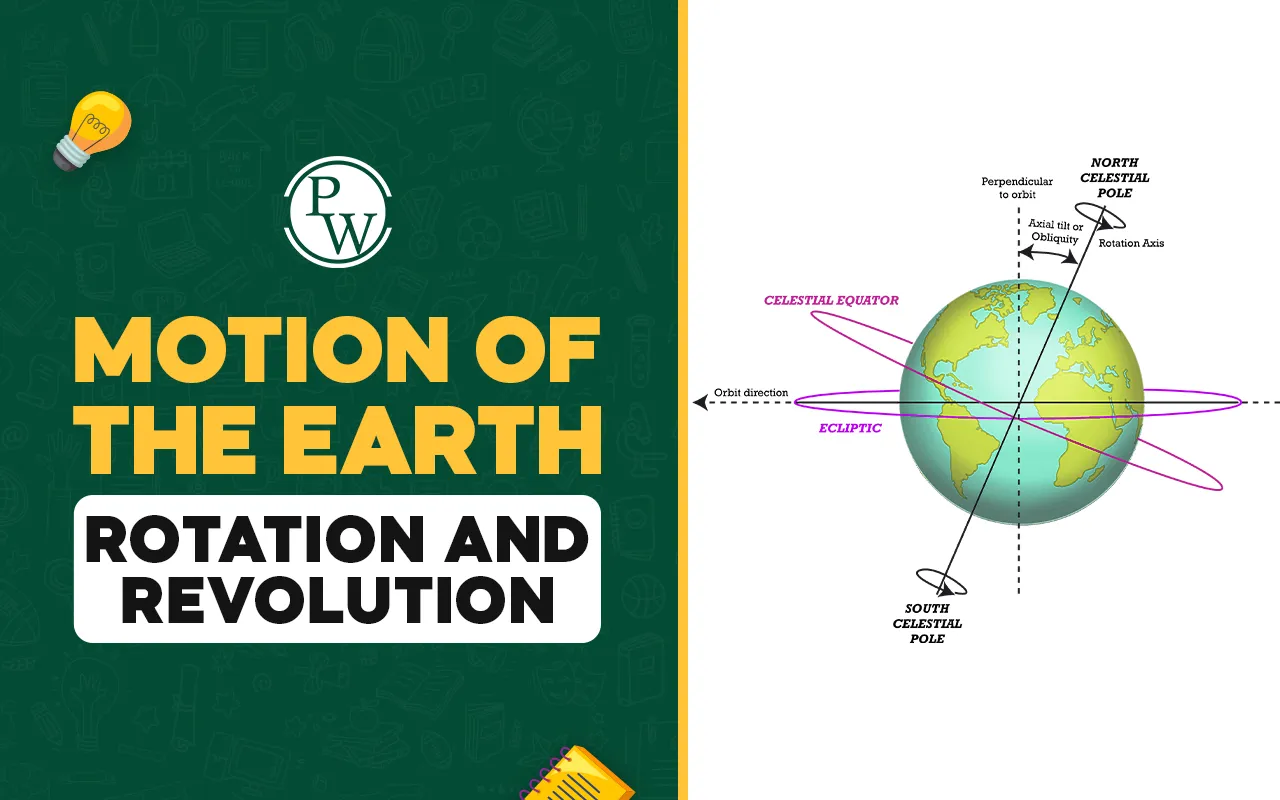
Rotation is the spinning of the Earth on its axis. The Earth’s axis is an imaginary line that goes from the North Pole to the South Pole. Earth rotates from west to east. This is why the Sun appears to rise in the east and set in the west.
One full rotation takes about 24 hours. This spinning motion is the reason we have day and night. The side of Earth facing the Sun experiences daylight, while the opposite side has night.
Effects of Rotation
The rotation of Earth has several important effects:
-
Day and Night: As Earth rotates, different parts of the world face the Sun at different times. This causes day and night.
-
Time Zones: The rotation divides the Earth into 24 time zones. Each zone represents one hour of the day.
-
Coriolis Effect: This effect causes winds and ocean currents to curve due to Earth's rotation. It influences global wind patterns.
-
Shape of Earth: Due to rotation, Earth is not a perfect sphere. It is slightly flattened at the poles and bulging at the equator.
-
Biological Clocks: Human sleep cycles and animal behavior are affected by the day and night cycle caused by rotation.
Read more: Types of Natural Disaster - Causes, Types and Facts
Revolution of the Earth
Revolution is the movement of the Earth around the Sun in an elliptical orbit. Earth takes approximately 365.25 days to complete one full revolution. This is why we have a year.
To adjust the extra one-fourth day, we add one day every four years. This extra day makes a leap year.The Earth’s axis is tilted at an angle of 23.5 degrees.
Because of this tilt, different parts of Earth receive different amounts of sunlight during the year. This is the reason for the seasons.
Also read: Latitudes and longitudes
Effects of Revolution
The revolution of the Earth leads to many seasonal and climate-related changes:
-
Seasons: As Earth revolves around the Sun, the tilt of its axis causes seasons. When the Northern Hemisphere is tilted toward the Sun, it experiences summer. At the same time, the Southern Hemisphere has winter.
-
Length of a Year: One revolution takes 365.25 days, which makes up a calendar year.
-
Solar Energy Distribution: The revolution changes how sunlight falls on different parts of Earth. This affects temperature and climate.
-
Eclipses and Tides: Though mainly caused by the Moon, Earth’s position in its orbit also affects the timing and strength of tides and eclipses.
-
Variation in Daylight: The amount of daylight changes during the year. Summer days are longer, and winter days are shorter because of the Earth’s position in its orbit.
Read more: Earthquake - Causes, Types, Magnitude and Effects
Earth’s Tilt and Its Importance
The tilt of Earth’s axis plays a crucial role in the earth motion rotation and revolution. The 23.5-degree tilt is the reason why Earth experiences seasons. If the axis were not tilted, there would be no seasonal variation.
Every place would receive the same amount of sunlight throughout the year. The tilt also explains why the equator is generally warmer than the poles and why some places have four seasons while others have only two.
Movement of the Earth Around the Sun
The movement of the Earth around the Sun is not just important for determining the year and seasons. It also impacts agriculture, climate, and ecosystems.
When Earth is closer to the Sun (around January), the Northern Hemisphere has winter.
When Earth is farther from the Sun (around July), the Northern Hemisphere has summer.
This may seem strange, but it happens because seasons depend more on the tilt of the Earth than on distance from the Sun. The earth motion around the sun also controls the amount of solar energy different regions receive, which influences farming, rainfall, and temperature patterns.
Motion of Planets Around the Sun
All planets in our solar system, including Earth, revolve around the Sun. This is known as the motion of planets around the sun. Each planet has its own speed and distance from the Sun, which determines its orbital period.
For example:
-
Earth takes about 365.25 days to complete one revolution
-
Mars takes about 687 days
-
Jupiter takes about 12 Earth years
Understanding the motion of other planets helps scientists predict their positions and study solar system behavior.
Read more: Science Facts Happens in Daily Life
Why Should Students Learn About the Motion of Earth?
Understanding the motion of the Earth is not just about science facts. It helps students make sense of the world around them. Here are some reasons why this topic is important:
-
It explains how day and night happen due to Earth's rotation
-
It helps students understand how time zones are created
-
It shows how the seasons change throughout the year
-
It connects Earth's movement to climate zones and weather patterns
-
It introduces important astronomical events like solstices, equinoxes, eclipses, and tides
-
It helps explain the calendar system, including leap years
-
It builds awareness of Earth's place in the solar system and the universe
-
It encourages interest in geography, science, and space exploration
Learning about Earth’s rotation and revolution helps students connect classroom knowledge with real-life experiences. It forms the foundation for more advanced topics in physics, astronomy, and environmental science.
Also read: What is Sound, Properties, Types, and Facts
Make Your Child Love Learning with CuriousJr Online Classes
Do you want your child to enjoy studying and stay confident in school? At CuriousJr, our school tuition online classes make learning exciting and easy to understand for students from Classes 1 to 9. Through live, interactive lessons that follow the CBSE, ICSE, and state board syllabus, we help children stay ahead while enjoying their studies.
Here’s how CuriousJr’s online school tuition supports your child’s learning:
-
Interactive lessons that make complex topics simple and engaging
-
Practice exercises based on school subjects for better understanding
-
Personalised homework help to clear doubts and complete assignments on time
-
Daily learning updates to keep parents informed and involved
-
Subjects covered: Maths, Science, Social Studies, and English
-
Regular study routine that builds focus, discipline, and consistency
. Book a demo class today and experience how our online classes make learning enjoyable and effective.
Motion of the Earth FAQs
What is the motion of the Earth?
How does Earth's rotation cause day and night?
Why do we have time zones?
What is the movement of planets around the Sun called?
How do Earth's motions affect life on Earth?