What are Like & Unlike Fractions? Definition, Examples & Operations
 Nikita Aggarwal20 Jan, 2026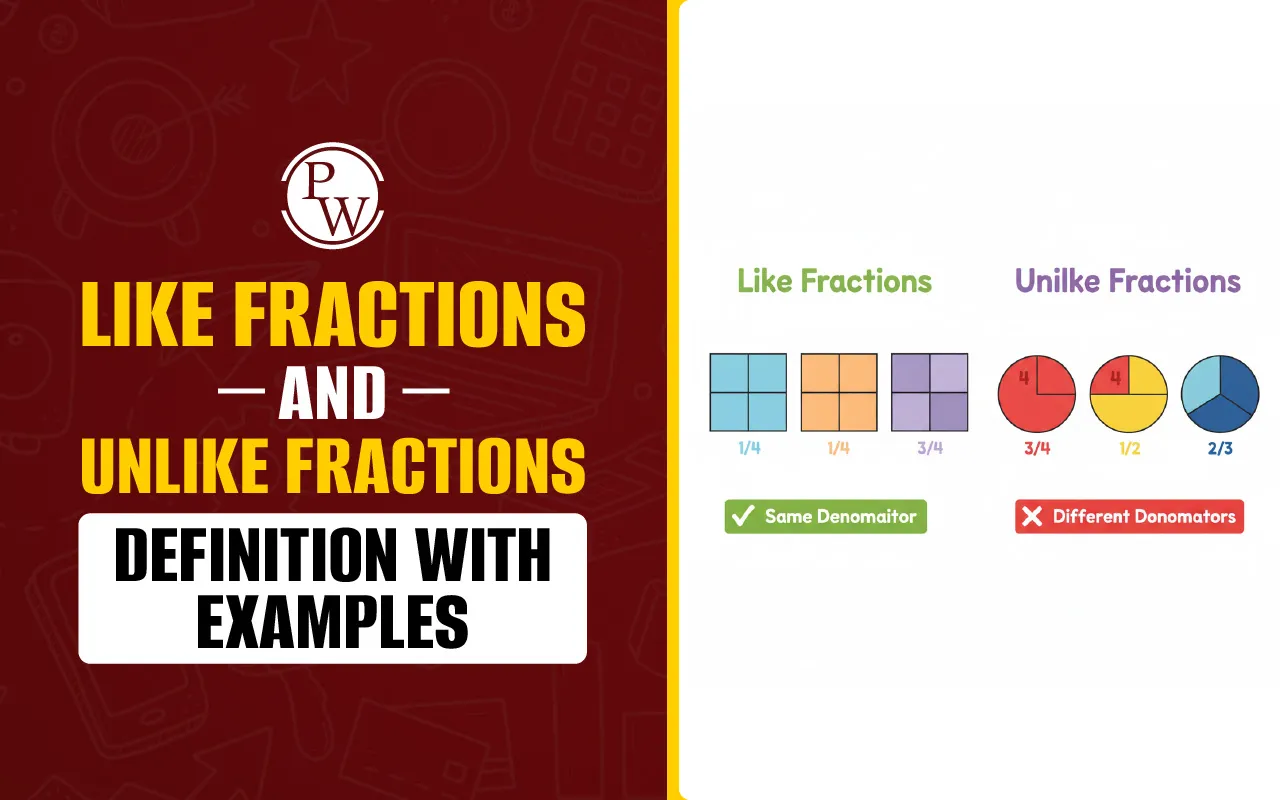
Like Fractions and Unlike Fractions
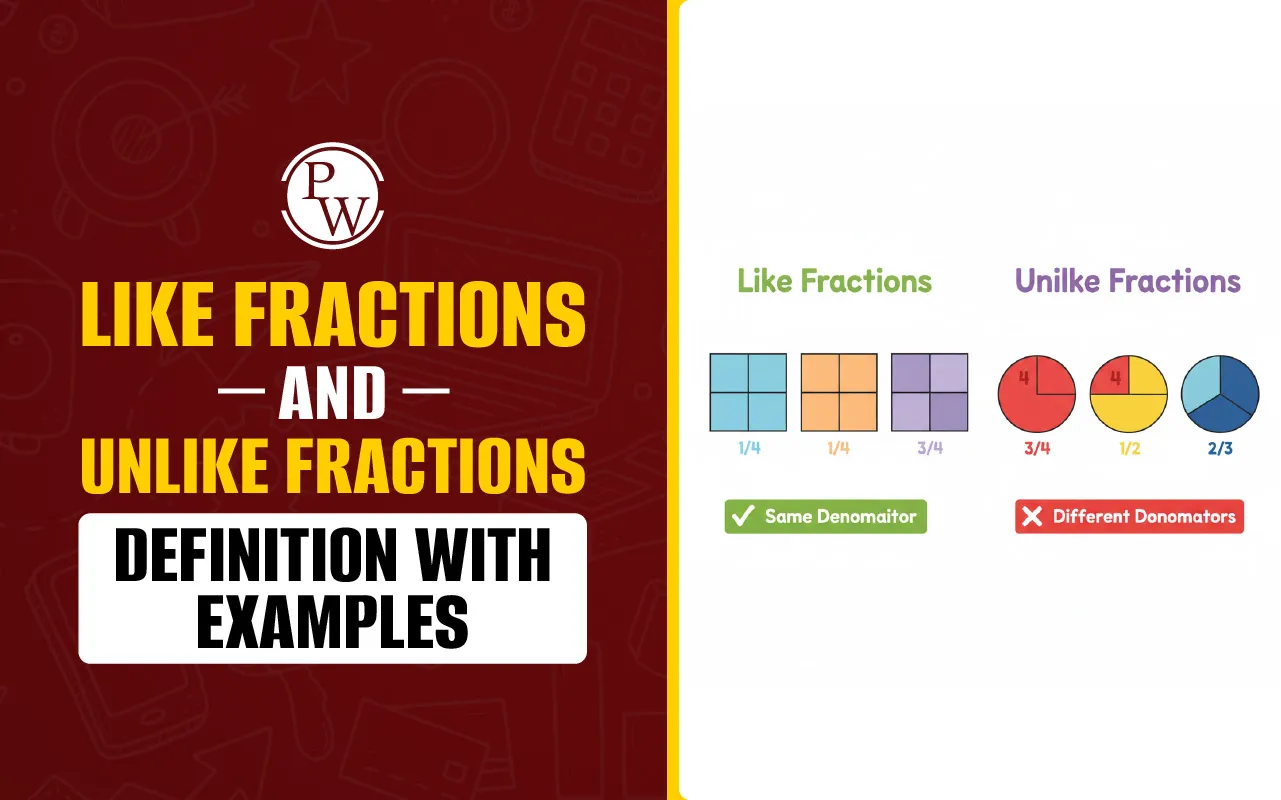
Like Fractions and Unlike Fractions are two types of fractions that differ based on their denominators.
-
Like Fractions are fractions that have the same denominator.
-
Unlike Fractions are fractions that have different denominators.
Understanding the difference between like and unlike fractions is important because arithmetic operations such as addition and subtraction of fractions are easier when the fractions are like. Unlike fractions need to be converted into like fractions before performing these operations.
What Are Like Fractions?
Definition of Like Fractions -Like fractions are fractions that have the same denominator. This means the whole has been divided into the same number of equal parts in each fraction. Since the denominators are the same, like fractions are easy to compare and combine using addition or subtraction. You only need to work with the numerators.
Examples of Like Fractions:
-
3/8, 5/8, and 7/8 — same denominator (8)
-
1/10 and 9/10 — same denominator (10)
Also read: Numerator and Denominator
What Are Unlike Fractions?
Definition of Unlike Fration - Unlike fractions are fractions that have different denominators. Each fraction divides the whole into a different number of equal parts, so you cannot directly add, subtract, or compare them until the denominators are the same. Unlike fractions must be converted into like fractions before performing arithmetic operations.
Examples of Unlike Fractions:
-
1/2 and 1/3 — different denominators (2 and 3)
-
2/5 and 3/10 — different denominators (5 and 10)
Because their denominators are different, working with unlike fractions requires an extra step, usually finding the least common denominator (LCM).
Also read: Adding Fractions
Comparing Like Fractions and Unlike Fractions
There are different ways to compare fractions depending on whether they are like fractions or unlike fractions. Let’s understand each case with simple explanations and new examples.
Comparing Like Fractions
Like fractions have the same denominator. So, when comparing like fractions, we only need to compare the numerators. The fraction with the larger numerator is greater.
Example: Compare 3/7 and 5/7
Both have the same denominator (7), so we compare the numerators.
5 is greater than 3.
Therefore, 3/7 < 5/7
Comparing Unlike Fractions
Unlike fractions have different denominators, so we can’t directly compare them. There are two common cases:
Case 1: Same Numerators, Different Denominators
When comparing unlike fractions with the same numerators, the fraction with the smaller denominator is larger. That’s because each part is larger when divided into fewer pieces.
Example: Compare 4/9 and 4/11
Both have the same numerator (4)
Compare the denominators 9 < 11
So, 4 parts out of 9 are larger than 4 parts out of 11.
Therefore, 4/9 > 4/11
Case 2: Different Numerators and Different Denominators
When both numerators and denominators are different, we first convert the fractions into like fractions (with the same denominator) by using the LCM of the denominators. Then we compare the resulting numerators.
Example: Compare 3/4 and 5/6
Step 1: LCM of 4 and 6 = 12
Step 2: Convert 3/4
3 × 3 = 9, 4 × 3 = 12 →9/12 or 3/4
Convert 5/6
5 × 2 = 10, 6 × 2 = 12 → 10/12 or 5/6
Step 3: Compare the two like fractions:
9/12 < 10/12
Therefore, , 3/4 < 5/6
Also read: Unit fractions
Arithmetic Operations on Like Fractions and Unlike Fractions
There are four basic arithmetic operations that can be performed on like and unlike fractions:
-
Addition
-
Subtraction
-
Multiplication
-
Division
Whether a fraction is like (same denominator) or unlike (different denominators), the method used to solve it will differ. Let’s explore each operation in detail.
Addition of Like and Unlike Fractions
We can simply add two or more like fractions by adding the numerators and keeping the denominators the same.
Example: Add: 5/8 + 2/8
Step 1: Add numerators: 5 + 2 = 7
Sep 2: Keep denominator: 8
5/8 + 2/8 = 7/8
For adding two unlike fractions, we first convert them to like fractions by finding the LCM of the denominators, and then add the resulting like fractions.
Example: Add 3/5 + 4/7
Step 1: Find LCM of 5 and 7 = 35
Step 2: Convert to like fractions:
3/5 = (3 × 7)/(5 × 7) = 21/35
4/7 = (4 × 5)/(7 × 5) = 20/35
Step 3: Add:
21/35 + 20/35 = 41/35 or 1 6/35
Subtraction of Like and Unlike Fractions
We can simply subtract two or more like fractions by subtracting the numerators and keeping the denominators the same.
Example: Subtract 7/9 − 4/9
Step 1: Subtract numerators: 7 − 4 = 3
Step 2: Keep denominator: 9
Answer: 7/9 − 4/9 = 3/9 or 1/3
For subtracting two unlike fractions, we first convert them to like fractions by finding the LCM of the denominators, and then subtract.
Example: Subtract 2/5 from 5/7
Step 1: LCM of 5 and 7 = 35
Step 2: Convert to like fractions:
5/7 = (5 × 5)/(7 × 5) = 25/35
2/5 = (2 × 7)/(5 × 7) = 14/35
Step 3: Subtract:
25/35 − 14/35 = 11/35
Answer: 5/7 - 2/5 = 11/35
Also read : Greatest Common Factor
Multiplication of Like and Unlike Fractions
For multiplying any two fractions (like or unlike), we:
Step 1: Multiply the numerators
Step 2: Multiply the denominators
Step 3: Simplify the result, if possible
Example: Multiply 3/10 × 4/10
Step 1: Multiply numerators: 3 × 4 = 12
Step 2: Multiply denominators: 10 × 10 = 100
Answer: 3/10 × 4/10 = 12/100 or 3/25
Example 2: Multiply 2/3 × 5/7
Step 1: Multiply numerators: 2 × 5 = 10
Step 2: Multiply denominators: 3 × 7 = 21
Answer: 2/3 × 5/7 = 10/21
Also read: Multiple of fractions
Division of Like and Unlike Fractions
To divide a fraction by another fraction (like or unlike), follow these steps:
Step 1: Flip the second fraction (take its reciprocal)
Step 2: Change division (÷) to multiplication (×)
Step 3: Multiply as usual
Step 4: Simplify the result
Example: Divide 4/9 ÷ 2/9
Step 1: Flip second fraction
2/9 becomes 9/2
Step 2: Multiply
4/9 × 9/2 = (4 × 9) / (9 × 2)
Answer: 4/9 ÷ 2/9 = 36 / 18 or 2
Example 2: Divide 3/5 ÷ 2/7
Step 1: Flip second fraction
2/7 becomes 7/2
Step 2: Multiply 3/5 × 7/2
= (3 × 7)/(5 × 2) = 21/10
Answer: 3/5 ÷ 2/7 = 21/10
Also read: Zero divided by a number
Like and Unlike Fractions Examples
Example 1: Which of the following pairs are like fractions?
A. 5/6 and 2/6
B. 3/8 and 3/9
C. 1/4 and 7/4
D. 2/3 and 4/5
Solution:
A and C are like fractions (same denominator).
B and D are unlike fractions (different denominators).
Example 2: Explain why 6/7 and 6/10 are unlike fractions, even though the numerators are the same.
Solution:
Although both fractions have the same numerator (6), their denominators are different (7 and 10). The number of parts the whole is divided into is not the same. Therefore, 6/7 and 6/10 are unlike fractions.
Also read: Division of Fractions
Support Your Child’s Learning Journey with CuriousJr
Is your child finding it difficult to keep up with subjects like Maths, English, Science, or Social Science? Many students face this challenge, and without the right support, it can impact both confidence and academic progress.
CuriousJr’s school tuition classes cover all subjects and follow the CBSE, NCERT, and ICSE syllabi, helping students stay in sync with their school curriculum. Here’s What Your Child Will Get with CuriousJr:
-
Personalised study plans for every child
-
Two teachers guiding each session for better clarity
-
Daily doubt-solving and homework assistance
-
Six days of engaging live classes each week
-
Regular progress updates for parents
With complete academic coverage across subjects and boards, CuriousJr helps children learn with confidence and consistency. Book a demo today to see how it works.