Learn Subtraction Without Borrowing (Class 4)
 Nivedita Dar22 May, 2026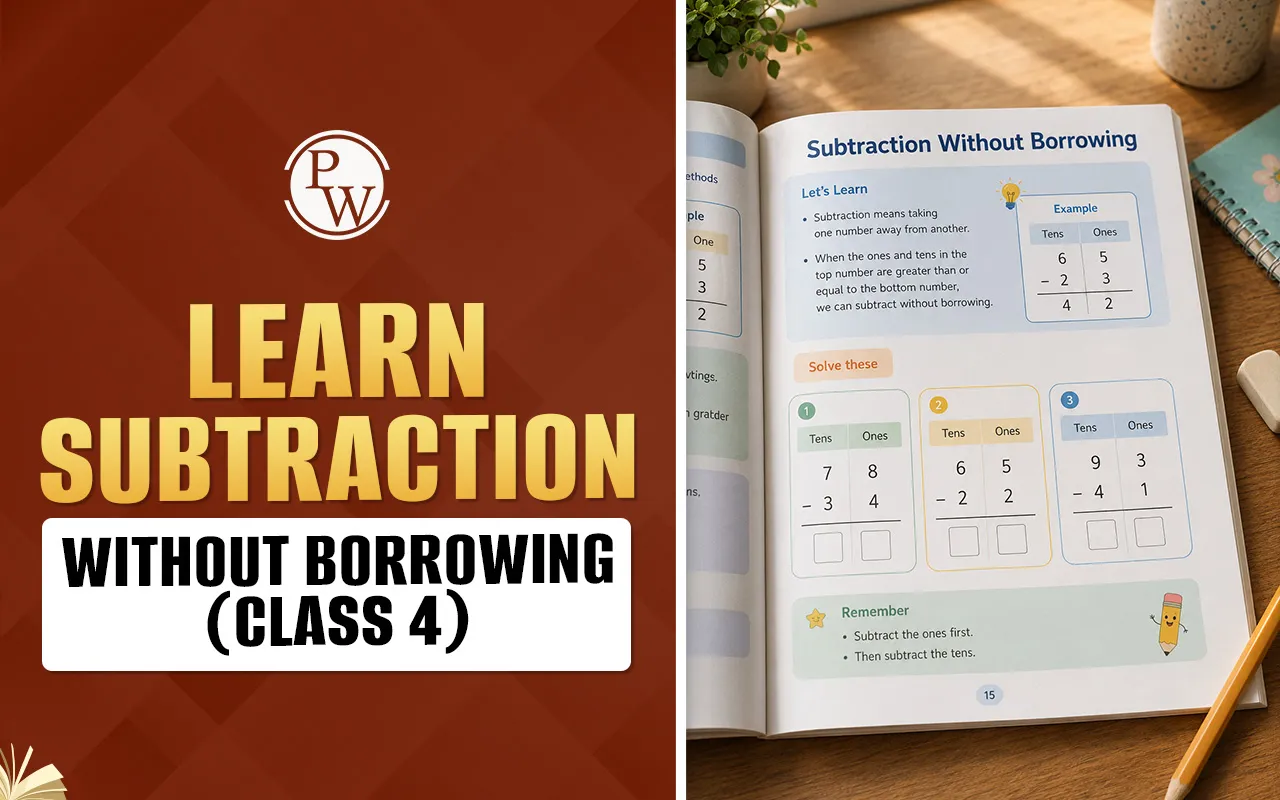
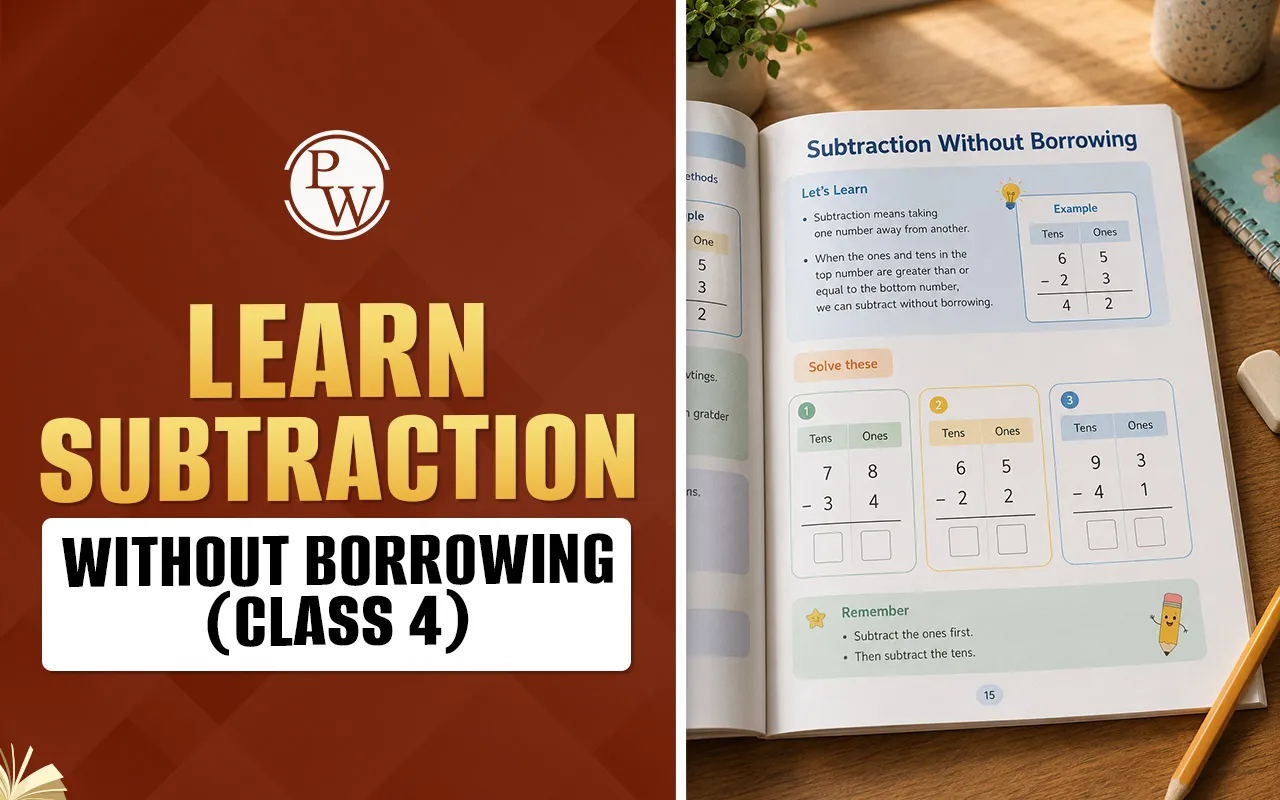
Many little ones get confused with subtraction when teachers teach them the concept of "borrowing" or "regrouping". You're not the only one who always scratches out numbers or who gets confused by lines of zeros. Subtraction tricks class 4 are an effective way to gain a better understanding of mathematics and learn how to apply it.
This article will help you learn subtraction tips you can use so you can complete your homework much quicker and with so much more confidence.
What are Subtraction Tricks?
Math in the 4th grade moves from the basics of numbers to 4-digit numbers. Typically, students are taught subtraction by "borrowing" from the next neighbour when the top number is less than the bottom number, in what is known as "column subtraction".
But this is the stage where students often make mistakes. Learning subtraction tricks class 4 is aimed at building a better number sense and working out subtraction without crossing any digits.
Mental maths subtraction is performing subtraction methods that enable the brain to work with values as whole units instead of individual digits. No longer viewing 500-274 as a series of borrowing steps, you see the relationship among these numbers.
Best Subtraction Tricks Class 4
You need a toolkit of strategies that you can use in different contexts and with different kinds of problems to become a math whiz. These easy subtraction tricks do not involve borrowing and are easy to use.
1. The Column Alignment Rule
You need a solid foundation before you use any trick. Numbers should be written in the appropriate columns for alignment.
-
Units under Units: The last digits must match up perfectly.
-
Tens under Tens: Maintain the vertical lines.
-
Space it out: Ensure ample space between columns to avoid handwriting issues.
The first step to accuracy is to subtract the correct values, and proper alignment is important.
Read More - Speed Maths Test for Class 4 (Try Now)
2. The tens and ones rule
A simple subtraction trick for class 4 is to decompose numbers into tens and ones before subtracting. This will make the problem much less daunting.
If you need to solve 85 - 32:
First, subtract the tens: 80 - 30 = 50.
Next, subtract the ones: 5 - 2 = 3.
Add the results: 50 + 3 = 53.
This is an excellent technique for problems that do not require borrowing and is a valuable way to develop the mental muscles needed for larger 4-digit numbers.
Read More - Mental Division Tricks for Class 4
3. The Vedic Subtraction Method (All from 9, Last from 10)
Vedic subtraction is a mythical ‘shortcut' to subtract any number from a base, such as 100, 1,000, 10,000, etc. It eliminates the fear of carrying over multiple zeros.
Step 1: Subtract each digit of the number from 9.
Step 2: Take the last digit (ones) away from 10.
Example: To solve 1,000 - 642:
-
9 - 6 = 3
-
9 - 4 = 5
-
10 - 2 = 8
Result: 358
This is much quicker than the old-fashioned way and is an integral part of the higher mental math skills.
4. The Constant Difference Trick
Change a subtraction problem that seems difficult because of a 9 or an 8 at the bottom if you can! The constant difference rule states that when the same number is added to both numbers in an expression, the result of the addition remains the same.
Problem: 63 - 29
Add 1 to both numbers to make them 'friendlier.'
-
63 + 1 = 64
-
29 + 1 = 30
Now solve 64 - 30 = 34
This is a lot easier than borrowing from 6 to help the 3
Practice Set for Subtraction Tricks Class 4
Instead of just looking at tables, let's dive into active practice. Use the subtraction tricks for class 4 discussed to solve these challenges.
Quick Mental Drill
Try to solve these in your head using Vedic subtraction or by breaking numbers into parts.
-
1,000 - 357 (Think: 9-3, 9-5, 10-7)
-
500 - 124 (Think: 4 - 1 for hundreds, then 9 - 2 and 10 - 4 for the rest)
-
87 - 45 (Break numbers into tens and ones before subtracting)
-
64 - 39 (Use Constant Difference: add 1 to both)
-
4,567 - 1,234 (Subtract left to right: 4-1, 5-2, 6-3, 7-4)
Fill in the blanks
Test your knowledge of the rules.
-
7896-2341 ________.
-
78-54 ________
-
98-________ = 21
-
456 - ______ = ______ - 100
Word Problems
-
The Library Challenge: A school library has 8,956 books. If 3,421 books are issued to students, how many books are left? (Hint: Use the Left-to-Right method since no borrowing is needed!)
-
The Birthday Party: Sarah has 100 balloons. She uses 63 balloons for decorations. Use the Vedic subtraction (9-6 and 10-3) to find out how many are left.
-
The Toy Shop: A toy car costs 75 rupees. Arjun has 42 rupees. How much more does he need? Break numbers into tens and ones before subtracting to find the answer.
Fun Activity
Find the missing numbers in these "No-Borrowing" puzzles:
-
7 _ 8 - 2 3 _ = 5 1 4
-
9 _ _ - 4 1 2 = 5 3 6
-
_ 5 4 - 3 _ 1 = 5 2 3
Benefits of Subtraction Tricks Class 4
Below are the benefits of the subtraction tricks that will help with your academics:
-
Eliminates "Zero Confusion": When subtracting from numbers such as 1,000, there are potential pitfalls of borrowing across zeros. The Vedic subtraction method can solve this instantaneously.
-
Higher Accuracy: Most errors occur during the ‘regrouping' stage. If you are not borrowing, you don't need to worry about reducing the neighbour's value.
-
Improves Mental Speed: Learning mental arithmetic skills can help you solve problems quickly, while other people are still searching for a pencil.
-
Boosts Confidence: If you have several strategies to solve a problem, then maths is not scary. You think of yourself as a “math architect” and use the tool that is best for the task.
-
Preparation for Competitions: These tricks are the foundation for Olympiads and mental math competitions, where speed is the most important factor.
How Does CuriousJr Help with Class 4 Mental Maths?
The mathematical strategies are brought to life in a unique way at CuriousJr. With CuriousJr online mental maths classes , learn math subtraction tricks class 4 in a fun place where you will be using interactive modules to help you learn the lesson, while a textbook will just tell you what to do.
-
Gamified Learning: Helps get students excited and engaged in subtraction drills.
-
Visual Logic: The platform uses visual aids to explain Vedic subtraction, making it easier for young minds to understand.
-
Instant Feedback: Students are corrected right away, so they know when they are missing numbers to make the numbers correct and well-aligned.
-
Progress Monitoring: Parents and students can see increases in speed and accuracy over time.
-
Mental Focus: The modules encourage mental subtraction, reducing reliance on calculators and/or finger counting.
-
Foundational Strength: These simple subtraction tricks are useful for preparing students for the advanced maths of higher grades.