Is 1 a Prime Number?
 Nikita Aggarwal22 Dec, 2025
Is 1 a Prime Number?
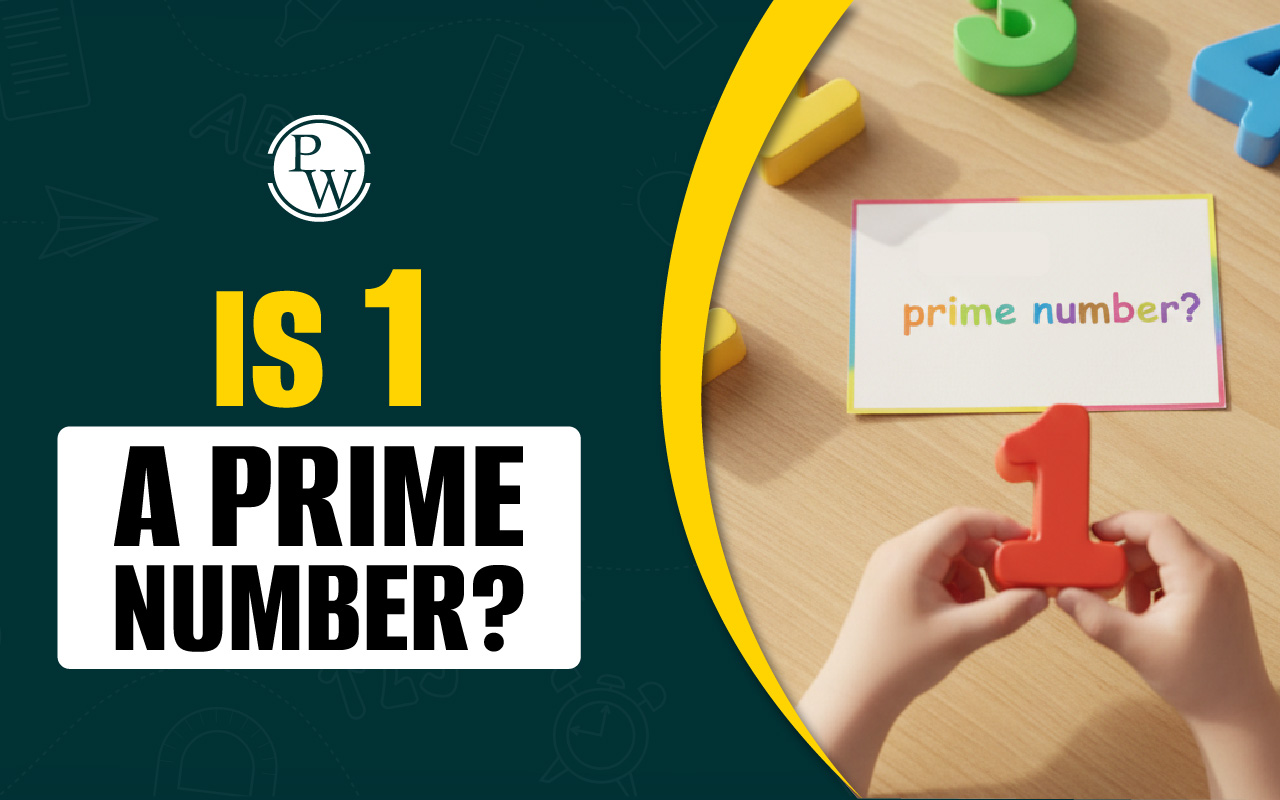
Is 1 a prime number? This is one of the most common questions that students ask while learning about prime numbers. Many children get confused because 1 looks like a simple number, but it still doesn’t fit easily into any group. To understand whether 1 is a prime number or not, it is important to first understand what prime numbers are.
Prime numbers are special numbers that can be divided only by 1 and the number itself. They are very important in maths because they form the base for many concepts like factors, multiples, and advanced-level topics in higher classes. Numbers like 2, 3, 5, 7, and 11 are examples of prime numbers. So, the answer to the question 'Is 1 a prime number?' is no, 1 is not a prime number. Keep reading to learn more about how to find a no. is prime or not.
Read more: (a + b)³ Formula
Is 1 a Prime Number or Not?
In exams, the question “1 is a prime no. or not?” is usually asked to check if students clearly understand the rule of prime numbers and how to find them correctly. A prime number is a number that has two factors: 1 and the number itself.
For example, 2 is a prime number because it has two factors: 1 and 2. But the number 1 has only one factor, which is 1. Since it does not have two factors, 1 is not a prime number. So, we can say that 1 is neither a prime nor a composite number.
How to Find Whether a Number Is Prime or Not
To find whether a number is prime or not, we can use a simple method. As we learnt, a prime number is a number that has only two factors, which are 1 and the number itself. If a number can be divided evenly by any other number, then it is not prime. Here’s how to find a no. is prime or not:
-
If the number is less than 2, it is not a prime number.
-
If the number is 2, then it is a prime number.
-
If the number is even and greater than 2, it is not prime.
-
For other numbers, try dividing them by smaller numbers like 2, 3, 5, or 7.
-
If the number divides completely, meaning it leaves no remainder, then it’s not a prime.
-
If it doesn’t divide by any number except 1 and itself, then it is a prime.
Read more: Sum of Squares: Formula, Steps, Error, Examples
If 1 Is Not a Prime Number, Then What Is It?
After learning the answer to 'Is 1 a prime number?', you must be wondering what 1 is if it is not a prime number. The number 1 is not a prime no. or a composite number. In maths, it stands alone because it has only one factor, which is itself. A prime number must have exactly two factors, while a composite number has more than two. But since 1 has only one factor, it does not fit into either group.
So, 1 is called a natural number, a whole number, a positive integer, and also an odd number. It is special because every other number is made by multiplying or adding 1; that’s why it is also known as the building block of all numbers.
Is 1 a Prime Number? Common Questions Answered
In school exams, students are generally asked simple but confusing questions about the number 1. These help test how well you understand number types. So, to help you, here are some common questions with their answers:
-
Is 1 a prime number?
-
No, 1 is not a prime number because it has only one factor, not two.
-
Is 1 a composite number?
-
No, 1 is not a composite number either. A composite number has more than two factors, but 1 has only one.
-
Is 1 an even number?
-
No, 1 is not an even number because it is not divisible by 2.
-
Is 1 an odd number?
-
Yes, 1 is an odd number because it is not divisible by 2.
-
Is 1 a perfect square?
-
Yes, 1 is a perfect square because 1 × 1 = 1.
-
Is 1 a perfect cube?
-
Yes, 1 is a perfect cube because 1 × 1 × 1 = 1.
-
What are the multiples of 1?
-
The multiples of 1 are 1, 2, 3, 4, 5, 6, 7, 8, 9, 10, and so on. Because every number can be divided by 1.
Read more: Brackets in Maths
Make Maths Easy and Fun for Kids With CuriousJr
Do you also see your child getting stuck or losing focus while solving maths problems? Many parents face this challenge. Children either find maths confusing or feel scared of it. But with the right kind of support, your child can actually start enjoying maths and become confident in solving questions.
CuriousJr’s Online Tuition Classes for Maths are designed to make this possible. These classes are not only interactive but also structured to match your child’s school syllabus, so learning stays effective and simple. Here’s what your child will get:
-
Live interactive classes where teachers explain every topic in an easy-to-understand way
-
Daily practice and assignments to help your child strengthen basic concepts
-
Homework support so they never struggle alone at home
-
Regular feedback and progress reports to keep you informed about your child’s growth
-
With the two-teacher model, one teacher focuses on explaining concepts, while the other clears doubts after classes, making sure no child is left behind.
If you want your child to build a strong maths foundation and feel confident in every class, book a demo class with CuriousJr today and see how learning can become both fun and effective.