
How CuriousJr Helps Improve Calculation Speed Without Memorising Tables
 Mishika Gupta10 Aug, 2026
Many children find calculations difficult because they depend mainly on memorising multiplication tables. Although tables are useful, memorising them alone may not help students solve unfamiliar calculations quickly. Students also need to understand numbers, recognise patterns, and choose easier ways to reach an answer.
Students can improve calculation speed through number bonds, estimation, number splitting, mental addition and subtraction, and pattern recognition. CuriousJr Mental Maths helps students practise these skills through live classes, guided learning, exercises, and quizzes so students can improve speed and accuracy without depending only on memorisation.
Which Mental Maths Techniques Can Make Calculations Faster?
Students can make calculations easier by understanding how numbers work instead of trying to memorise every possible calculation.
|
Technique |
How Students Can Use It |
|
Breaking Numbers |
Split larger numbers into smaller parts to make calculations easier. |
|
Number Bonds |
Use familiar number combinations to reach an answer quickly. |
|
Estimation |
Find an approximate answer to check whether the student's final result is reasonable. |
|
Mental Addition |
Add numbers in smaller steps without writing every calculation. |
|
Mental Subtraction |
Find differences by working with simpler numbers. |
|
Pattern Recognition |
Identify repeated relationships to solve similar calculations faster. |
For example, students can solve 48 + 27 as 48 + 20 + 7. Breaking the calculation into smaller steps makes it easier to solve mentally.
How Does CuriousJr Teach Children to Calculate Without Relying on Memorisation?
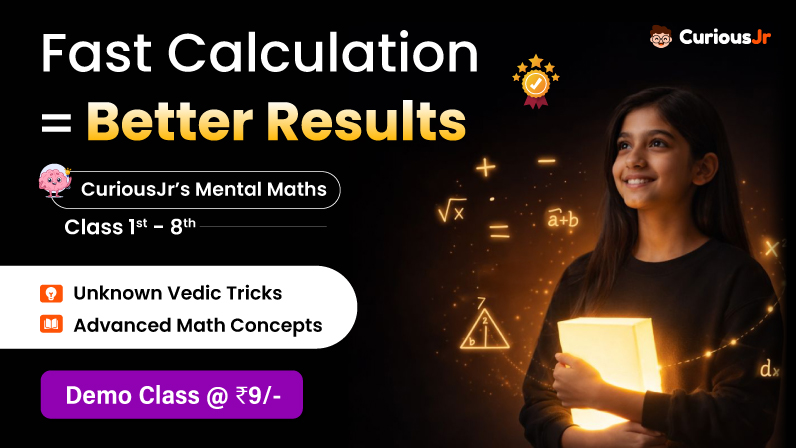
CuriousJr Mental Maths combines school Maths with fast calculation techniques. The focus is on understanding how a calculation works and learning when to use a particular method.
During live classes, students can:
-
Learn guided calculation methods from the teacher.
-
See different ways of approaching a numerical problem.
-
Apply techniques to questions during the lesson.
-
Participate in interactive activities.
-
Ask questions when a calculation is difficult.
-
Practice using shortcuts after understanding the concept.
The guided approach helps students learn how to calculate, rather than simply remembering an answer or formula.
Read More: Fun Math Activities for Kids to Develop Calculation Speed
How Does Regular Practice Help Students Become Faster and More Accurate?
Calculation speed improves when students use the techniques regularly. CuriousJr provides opportunities to practise Mental Maths through different learning resources.
Mental Maths Practice Includes:
-
Age-appropriate Mental Maths exercises
-
Practice material
-
Daily live classes
-
Recorded classes for revision
-
Calculation-based puzzles and timed quizzes
-
Regular question-solving
Regular practice helps students become more familiar with numbers and calculation methods. With continued practice, students can spend less time thinking about basic calculations and more time understanding the actual question.
What Can Students Gain from Better Calculation Skills?
Better calculation skills can make many parts of students' Maths learning easier.
|
Skill |
Benefit |
|
Calculation Speed |
Helps students solve numerical questions in less time. |
|
Accuracy |
Helps reduce basic calculation mistakes. |
|
Number Sense |
Helps students understand relationships between numbers. |
|
Problem-Solving |
Makes unfamiliar numerical questions easier to approach. |
|
Mathematical Confidence |
Helps students feel more comfortable while solving Maths problems. |
These skills can be useful when students are:
-
Solving classroom questions
-
Completing Maths homework
-
Attempting school examinations
-
Working through timed questions
-
Preparing for Olympiads
-
Solving multi-step numerical problems
Faster calculations can also give students more time to focus on questions that require deeper thinking.
Read more: Why Mental Maths is a Life Skill Every Child Should Learn?
How Can Parents Support Calculation Practice at Home?
Parents can help students develop calculation skills without turning every practice session into table memorisation.
They can encourage students to:
-
Practice Mental Maths for a few minutes every day.
-
Solve simple number puzzles.
-
Try calculations mentally before using paper.
-
Explain the method students used to reach an answer.
-
Find more than one way to solve a calculation.
-
Focus on gradual improvement instead of only speed.
-
Learn from mistakes instead of feeling discouraged by them.
Short and regular practice can make calculation activities easier to continue. Positive encouragement can also help students feel comfortable trying new methods and solving questions independently.
How Can CuriousJr Track Student Mental Maths Progress?
Practising regularly is useful, but knowing where students are improving can make student learning more focused. CuriousJr uses different methods to review student performance.
|
Progress Support |
What It Helps With |
|
Live Quizzes |
Check how well students apply concepts during learning. |
|
Performance Reviews |
Identify areas where students are improving or need more practice. |
|
Teacher Feedback |
Understand mistakes and areas for improvement. |
|
Progress Reports |
Help parents follow a student's learning journey. |
|
PTMs |
Give parents an opportunity to discuss student progress with teachers. |
This feedback can help students understand which calculation skills need more attention instead of practising every topic in the same way.
Calculation speed develops through understanding, practice, and the right techniques rather than memorisation alone. By using number patterns, mental strategies, estimation, and number relationships regularly, students can become faster and more accurate. CuriousJr online mental maths class supports this learning through interactive classes, guided practice, quizzes, and feedback, helping students build lasting confidence in Maths.






How CuriousJr Helps Improve Calculation Speed Without Memorising Tables FAQs
Can students improve calculation speed without memorising tables?
How does CuriousJr help with Mental Maths?
Can Mental Maths improve calculation accuracy?
How often should students practise Mental Maths?







Get Free Counselling Today
and Clear up all your Doubts
 Live & recorded classes available at easeDashboard for progress trackingLakhs of practice questions

