Difference Between Rational Numbers and Irrational Numbers?
 Shivam Singh15 Jan, 2026
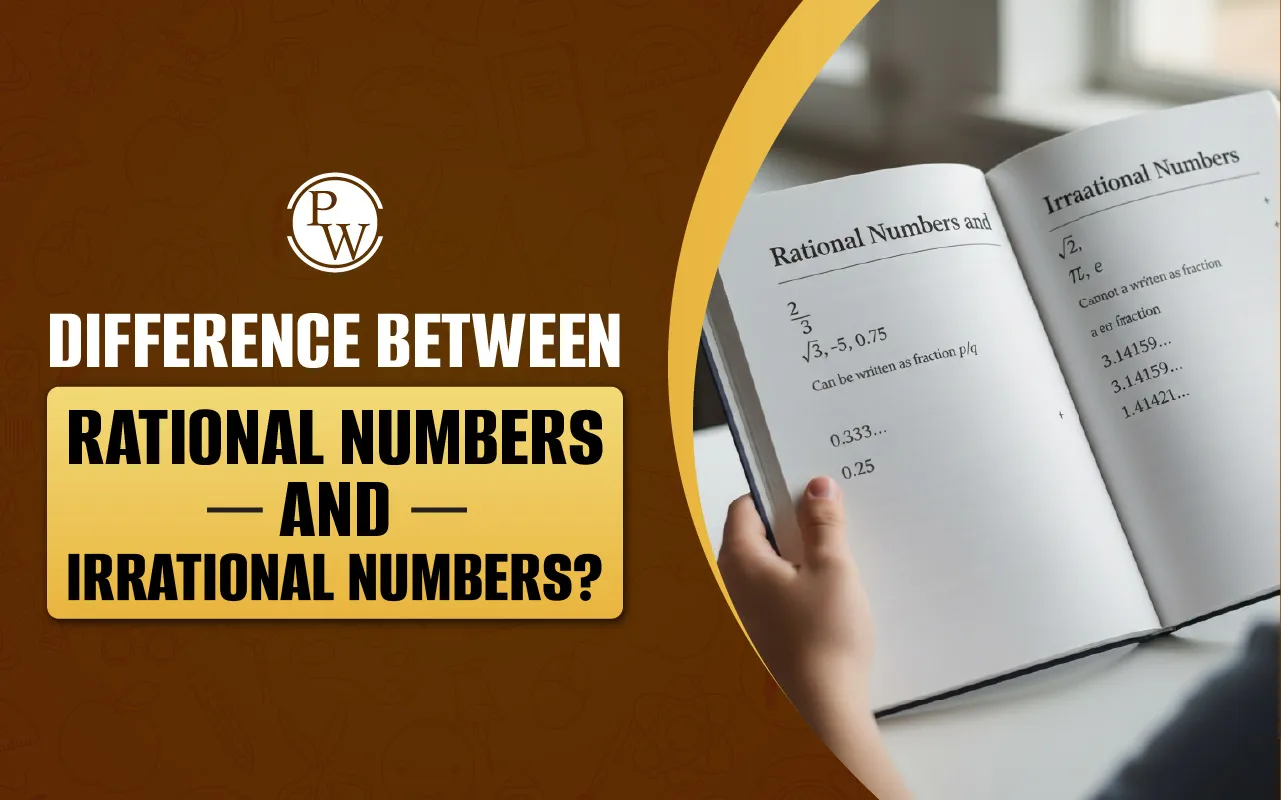
What is the Difference Between Rational Numbers and Irrational Numbers?
Numbers are an important part of mathematics and are used in daily life for counting, measuring, and calculating. In mathematics, numbers are classified into different types. Two important types of numbers are rational numbers and irrational numbers. Understanding the difference between rational and irrational numbers helps students build a strong foundation in number systems.
We will learn what rational and irrational numbers are, look at their examples, understand their properties, and clearly see the difference between rational numbers and irrational numbers.
Rational Numbers
Rational numbers are numbers that can be written in the form of a fraction, where the numerator and denominator are integers and the denominator is not zero.
In simple words, any number that can be expressed as p/q, where p and q are integers and q ≠ 0, is a rational number.
Rational numbers include:
-
Terminating decimals
-
Non-terminating repeating decimals
Properties of Rational Numbers
-
They can be written as fractions.
-
Their decimal form either terminates or repeats.
-
They can be positive, negative, or zero.
-
All integers are rational numbers.
Rational Numbers Examples
Here are some common examples of rational numbers:
-
1/2 (a fraction)
-
3/4
-
5 (can be written as 5/1)
-
0 (can be written as 0/1)
-
–7 (can be written as –7/1)
-
0.25 (terminating decimal = 1/4)
-
0.333… (repeating decimal = 1/3)
All the above numbers can be written in the form p/q, so they are rational numbers.
Irrational Numbers
Irrational numbers are numbers that cannot be written in the form of a fraction p/q, where p and q are integers.
The decimal expansion of an irrational number is non-terminating and non-repeating. This means the digits after the decimal point go on forever and do not follow any repeating pattern.
Irrational numbers are usually represented by special symbols or roots.
Read More: Adding and Subtracting of Rational Numbers
Properties of Irrational Numbers
-
They cannot be expressed as fractions.
-
Their decimal form is non-terminating and non-repeating.
-
They cannot be written exactly; only approximate values are used.
-
They are real numbers but not rational.
Irrational Numbers Examples
Some common examples of irrational numbers are:
-
√2 = 1.4142135…
-
√3 = 1.7320508…
-
π (pi) = 3.1415926…
-
e = 2.7182818…
For example, √2 cannot be written as a fraction and its decimal digits never repeat, so it is an irrational number.
Difference Between Rational Numbers and Irrational Numbers
The main difference between rational and irrational numbers is based on whether they can be written as fractions or not.
|
Basis |
Rational Numbers |
Irrational Numbers |
|
Definition |
Can be written as p/q |
Cannot be written as p/q |
|
Fraction Form |
Yes |
No |
|
Decimal Form |
Terminating or repeating |
Non-terminating and non-repeating |
|
Examples |
1/2, 3, –5, 0.25 |
√2, √5, π |
|
Exact Value |
Can be written exactly |
Cannot be written exactly |
|
Predictability |
Pattern exists in decimals |
No repeating pattern |
Simple Example to Understand the Difference
-
0.5 = 1/2 → Rational number
-
0.333… = 1/3 → Rational number
-
1.414213… (√2) → Irrational number
This clearly shows the difference between rational numbers and irrational numbers.
Also Read: Distance Formula in Maths - Derivation, Examples
Make Mental Maths Simple and Enjoyable for Your Child with CuriousJr
Every child has a unique way of learning. Some pick up numbers quickly, while others need a little more time and guidance. This does not mean they are weak in maths—it just means they learn at their own pace.
At CuriousJr, our Mental Maths classes are designed to make learning easy, fun, and stress-free. We use engaging activities, simple techniques, and visual methods to help children understand numbers better and build confidence. Our aim is to help children enjoy maths instead of feeling afraid of it.
Each class is guided by two mentors, ensuring that every child gets personal attention and clear explanations at every step. This supportive approach helps students stay focused and confident during the learning process. Parents also receive regular progress updates, so they always know how their child is performing.
With regular practice, children start solving problems faster, feel more confident with numbers, and develop a strong foundation that helps both in school and everyday life. Book a demo class with CuriousJr today and experience the positive change in your child’s learning journey.