Adverb Clauses - Definition, Uses & Examples
 Shivam Singh19 Jan, 2026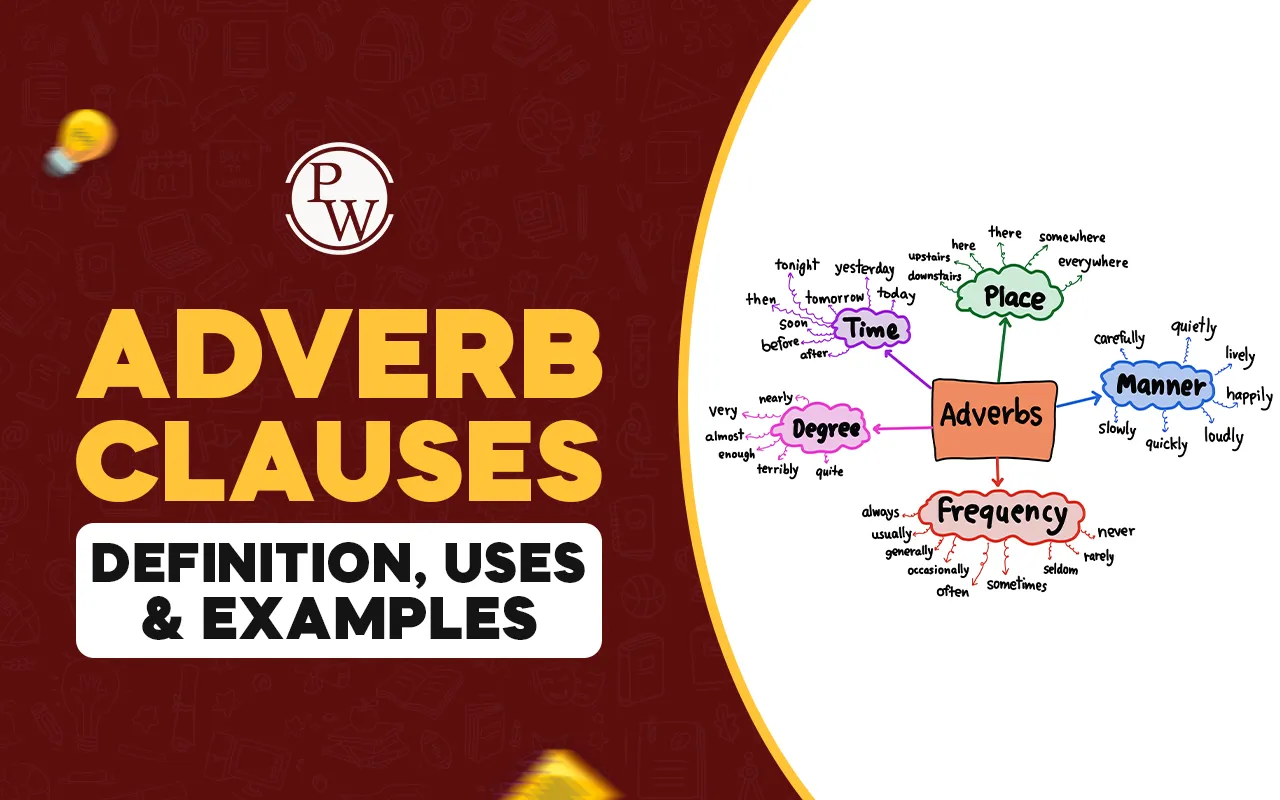
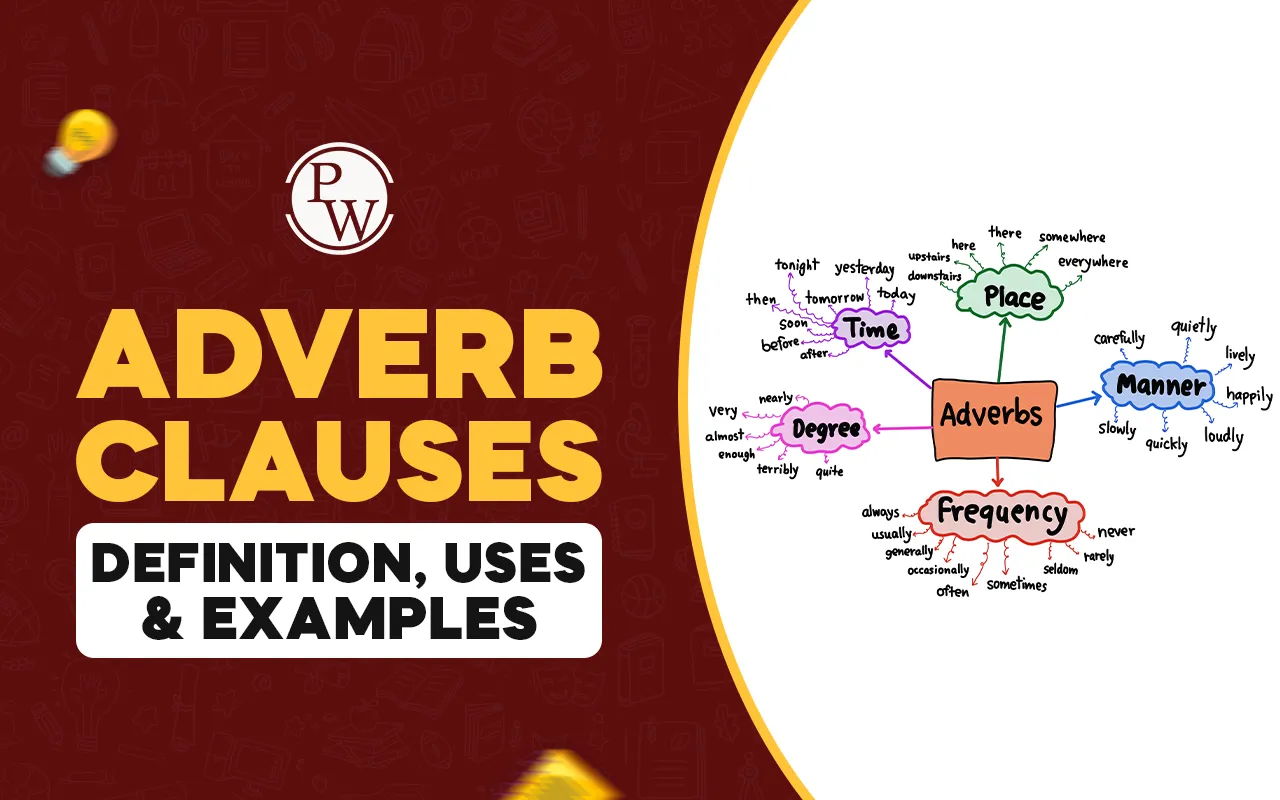
Adverb Clauses
In English grammar, clauses are essential parts of sentences. They shape meaning and help us share ideas clearly. Among them, adverb clauses play a key role because they tell us when, where, why, how, or under what conditions something happens. These clauses make writing more detailed and expressive.
Whether you’re writing essays, stories, or formal letters, understanding adverb clauses will help your sentences sound more fluent and natural. Students can learn more about what adverb clauses are, explore their types, understand how to use them correctly, and see clear examples below.
Read More: Clauses in English
What are Adverb Clauses?
An adverb clause refers to a set of words that contains a subject and a verb and functions like an adverb in a sentence. Similar to the adverbs with one word, adverb clauses provide additional information regarding a verb, an adjective, or an adverb and are used to indicate when, where, why, how, or to what degree something occurs.
An adverb clause is more elaborate than an individual adverb since it is a complete sentence with a subject and a verb.
Key Characteristics of Adverb Clauses
-
They begin with subordinating conjunctions such as because, although, if, when, since, while, unless, or as.
-
They include a subject and a verb, making them full clauses.
-
They cannot stand alone; they depend on a main (independent) clause.
-
They modify a verb, adjective, or adverb in the main clause.
Types of Adverb Clauses
Adverb clauses come in different types, each explaining something specific about the main clause such as time, place, reason, condition, contrast, manner, purpose, or result.
1. Time Clauses
A time clause tells us when something happens. These clauses often begin with words like when, before, after, until, since, while, or as soon as. For example, “When the sun rises, the birds start singing.” The clause “When the sun rises” shows the time of the action.
2. Place Clauses
A place clause explains where something happens. It usually starts with where or wherever. For instance, “You can sit wherever you like.” Here, the adverb clause “wherever you like” tells us the place related to the action.
3. Reason Clauses
A reason clause explains why something happens. It begins with conjunctions such as because, since, or as. For example, “She stayed home because she was tired.” The clause “because she was tired” gives the reason for staying home.
4. Condition Clauses
An adverb clause condition shows that one action depends on another. These clauses often begin with if, unless, provided that, or in case. For example, “If it rains, we’ll cancel the picnic.” The clause “If it rains” sets a condition for the main action.
5. Contrast Clauses
A contrast clause presents an opposite or unexpected idea. Common conjunctions include although, even though, though, whereas, or while. For example, “Although he studied hard, he didn’t pass the test.” The contrast is clear between studying hard and not passing.
6. Manner Clauses
A manner clause describes how something happens. These clauses start with as, as if, or as though. For instance, “She sings as if she were a professional.” The adverb clause “as if she were a professional” tells us the manner of singing.
7. Purpose Clauses
A purpose clause explains the aim or goal of an action. It often starts with so that or in order that. For example, “He spoke slowly so that everyone could understand him.” The clause “so that everyone could understand him” shows the purpose of speaking slowly.
8. Result Clauses
A result clause shows the outcome of an action. It usually begins with expressions like so...that or such...that. For instance, “The music was so loud that we couldn’t talk.” Here, the clause “that we couldn’t talk” expresses the result of the loud music.
By understanding these types of adverb clauses, you can describe time, place, reason, and many other details making your writing richer and more meaningful.
Read More: Phrases and Clauses
How to Use Adverb Clauses
Knowing how to use adverb clauses helps you create smoother and more natural sentences. Follow these simple guidelines:
1. Start with a Subordinating Conjunction.
All adverbial clauses have a subordinating conjunction at the beginning, which links them with the main clause. Select the one most suitable to your meaning e.g., should it be a condition, since it should be because, even though it should not be, when it should.
2. Connect It to a Main Clause
A clause adverb is not independent. It should be attached to an independent (main) clause in order to be meaningful.
3. Put It in the Right Place in a Sentence.
An adverbial clause may appear either in the beginning, middle, or the end of a sentence. The location may alter the tune, but not the text.
4. Use Commas Appropriately
When the adverb clause precedes the main clause, a comma should appear. The comma is not required when it comes after the main clause.
5. Avoid Sentence Fragments
An adverb clause is not complete. Never leave it alone but make it a main clause.
6. Subject-Verb Agreement.
Ensure that the subject and the verb of both clauses are similar in number and tense.
Read More: Figures of Speech
10 Examples of Adverb Clauses
The following are ten examples showing different types of adverb clauses in sentences:
-
When the bell rang, the students rushed out. (Time clause)
-
Because she missed the bus, she arrived late. (Reason clause)
-
If you heat ice, it melts. (Condition clause)
-
Although he tried hard, he couldn’t solve the puzzle. (Contrast clause)
-
Wherever you find water, you’ll find life. (Place clause)
-
She speaks as if she knows everything. (Manner clause)
-
He practices daily so that he can improve. (Purpose clause)
-
The movie was so boring that we left early. (Result clause)
-
Unless you hurry, you’ll miss the train. (Condition clause)
-
While I was cooking, the phone rang. (Time clause)
These examples show how adverb clauses connect ideas and make writing more interesting and meaningful.
Also Check: What Are Modal Verbs?
Help Your Child Learn English Better with CuriousJr
Every parent wants their child to be confident in English and do well in school. CuriousJr helps achieve this through online English classes that build grammar, vocabulary, reading, writing, listening, and speaking skills.
Our curriculum follows the Cambridge English Scale and CEFR standards, making learning structured and effective. Step by step, children become more fluent, lose hesitation, and learn to communicate clearly in exams, classrooms, and everyday life.
With support from experienced mentors, kids enjoy their learning journey and stay motivated. Parents can easily track progress in both academic performance and communication skills.
Join CuriousJr today to help your child grow in English fluency through fun, interactive, and child-friendly online lessons designed just for young learners.
Adverb Clauses FAQ
What are adverb clauses in grammar?
What are the types of adverb clauses?
How do you use adverb clauses in writing?
Can adverb clauses start a sentence?
Are adverb clauses always necessary?