Adjunct in English Grammar: Meaning, Uses, Examples
 Shivam Singh20 Jan, 2026
What is an Adjunct in English Grammar?
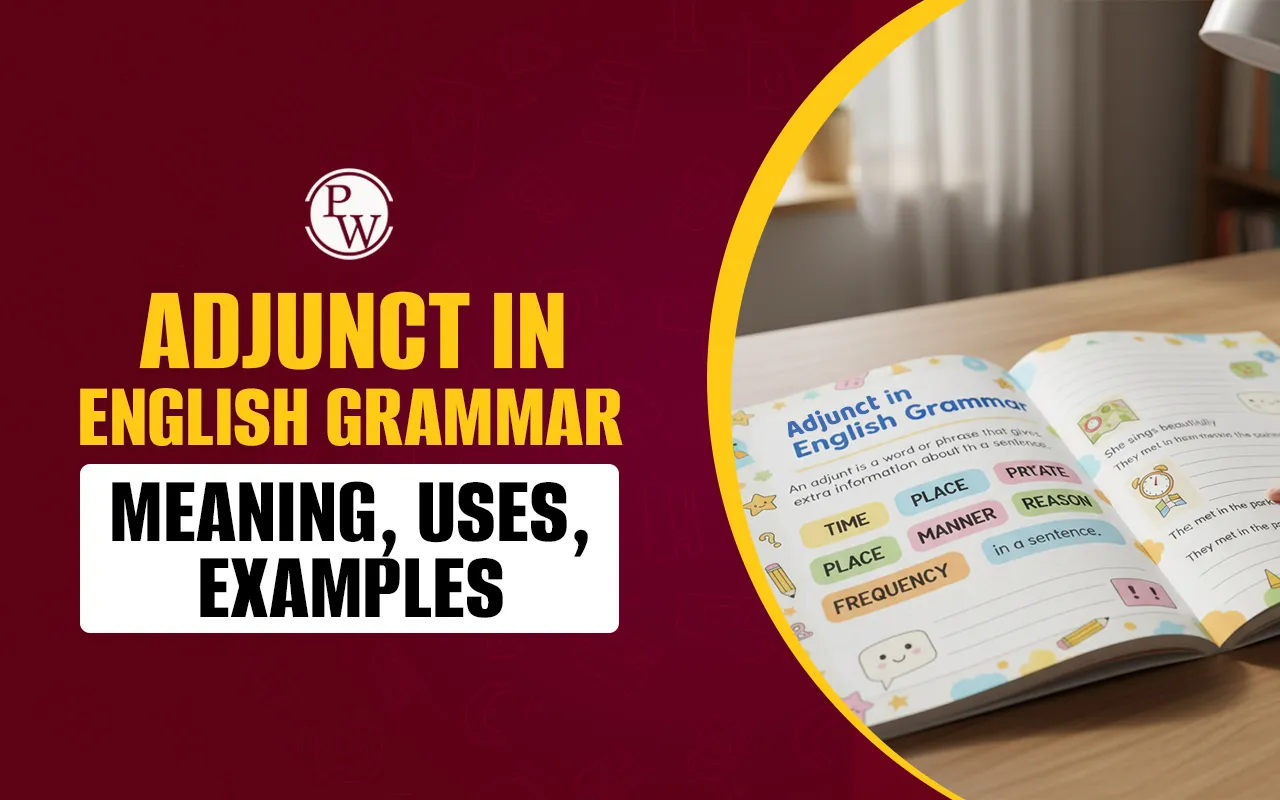
Adjunct in English grammar means a word or group of words that gives additional information in a sentence. It tells us something more about the action, like when, where, how, or why it happens. For example, in the sentence “He studies at night”, the words “at night” in this sentence are an adjunct because they tell when he studies.
Knowing what is an adjunct in English grammar helps you understand how to make sentences more clear and meaningful. While adjuncts are not needed to understand the main meaning of the sentence, they help explain it better. Even if you remove an adjunct, the sentence will still make sense, but give less detail. Let's learn more about why to use adjuncts in a sentence and understand the types of adjuncts with examples.
Read More: Difficult Words in English
Why Use Adjunct in a Sentence?
Adjuncts in a sentence are used to give extra information about the action. They tell us when, where, how, why, or how often something happens.
-
Using adjuncts makes your sentence more clear and complete.
-
An adjunct in English grammar helps the reader or listener understand the situation better.
-
Unlike the subject or verb, an adjunct in a sentence can come at the beginning, middle, or end of a sentence.
-
You can even use more than one adjunct in a sentence to add more details.
Types of Adjuncts in English Grammar
Learning about the types of adjuncts helps you understand how to use them correctly in sentences. Adjuncts can be single words, short phrases, or even full clauses. Each type of adjunct in English grammar gives extra information in a different way. Let’s understand types of adjuncts one by one:
-
Single-word adjuncts: These are generally adverbs that are used to describe the action. For example, “He ran quickly.” (Here, quickly tells how he ran.)
-
Phrase adjuncts: These are groups of words that give more detail but are not full sentences. For example, “She spoke in a soft voice.” (Here, ‘in a soft voice’, tells how she spoke.)
-
Clause adjuncts: These are full clauses that add extra meaning to the main sentence. For example, “I’ll call you when I reach home.” (Here, 'when I reach home' tells when the action will happen.)
-
Adjectival adjuncts: These describe a noun and act like adjectives. For example, “The school building is new.” (Here, 'school' works as an adjunct describing the type of building.
Adjuncts and Complements in Grammar
When learning adjuncts in English grammar, it is also important to know how they are different from complements. Both may look the same because they come after verbs or subjects, but their roles in a sentence are not the same. A complement is a word or phrase that completes the meaning of the sentence. Without it, the sentence may sound incomplete or incorrect.
On the other hand, an adjunct gives extra information, like when, where, or how something happens. Removing it will not change the basic meaning of the sentence. To understand it better, check the comparison of adjuncts and complements here:
|
Adjuncts vs Complements in Grammar |
||
|
Particular |
Adjuncts |
Complements |
|
Meaning |
Add extra or optional information |
Complete the main meaning of the sentence |
|
Need in a sentence |
Not necessary; can be removed |
Necessary to make the sentence complete |
|
Position |
Can be placed at the beginning, middle, or end |
Generally placed near the verb or subject |
|
Effect when removed |
The sentence still makes sense. |
The sentence becomes incomplete |
Read More: Root Words
Examples of Adjuncts
Understanding an adjunct in English grammar becomes easy with examples. Adjuncts can tell us when, where, why, how, or how often something happens in a sentence. Here are some simple examples of adjuncts:
1. Examples of Adjuncts Answering When
-
We will visit our grandparents next week.
-
She finished her homework yesterday.
2. Examples of Adjuncts Answering Where
-
The children are playing in the park.
-
He left his bag on the table.
3. Examples of Adjuncts Answering Why
-
She stayed home because it was raining.
-
He left early to catch the bus.
4. Examples of Adjuncts Answering How
-
He spoke softly to the teacher.
-
The dancer moved gracefully on stage.
5. Examples of Adjuncts Answering How Often
-
We go to the market every Sunday.
-
She calls her grandmother twice a week.
Read More: Compound Words
Practice Questions on Adjunct in English Grammar
Now that you've learnt 'what is an adjunct in English grammar', it's time to check your understanding. Try answering these questions on your own:
Ques. 1 Identify the adjunct in this sentence: Riya goes for a walk every evening.
Ques. 2 Rewrite this sentence by adding an adjunct that shows why: He missed the class.
Ques. 3 Find the type of adjunct in this sentence: The children played in the garden.
Ques. 4 Add two adjuncts in this sentence to make it more detailed: They met.
Answers:
-
Adjunct: every evening (shows when the action happens)
-
Example answer: He missed the class because he was sick. (The adjunct shows why.)
-
Type of adjunct: in the garden (adjunct of place)
-
Example answer: They met at the park yesterday. (at the park: adjunct of place; yesterday: adjunct of time)
Also Read: Singular and Plural Words
Help Your Child Speak & Write Better English with CuriousJr
Do you often feel your child understands English but struggles to speak or write it correctly? Many children pick up “broken English” while learning on their own, and this habit can stay with them for years. That’s why early, guided learning matters.
CuriousJr’s English Online Classes are specially made to help Indian learners build real English fluency, not just textbook knowledge. With Cambridge-certified English online live audio-video classes, your child learns to:
-
Speak clearly and confidently
-
Understand grammar in a simple, logical way
-
Write better sentences with strong vocabulary
-
Improve public speaking and real-life English skills
-
Classes are made for every age, like starters (6–8 yrs), movers (8–10 yrs), key (10–12 yrs), and preliminary (12–14 yrs).
Give your child a confident start in English that will last a lifetime. Book a demo class today and see how CuriousJr’s online English learning can make this subject your child’s favourite.
Adjunct in English Grammar FAQ
What is an adjunct in grammar, with an example?
When to use adjuncts in a sentence?
How many types of adjuncts do we have?
What is the purpose of adjuncts in English?
What is the difference between adjuncts and complements?