A^2-B^2 Formula: Proof with Examples
 Shivam Singh19 Jan, 2026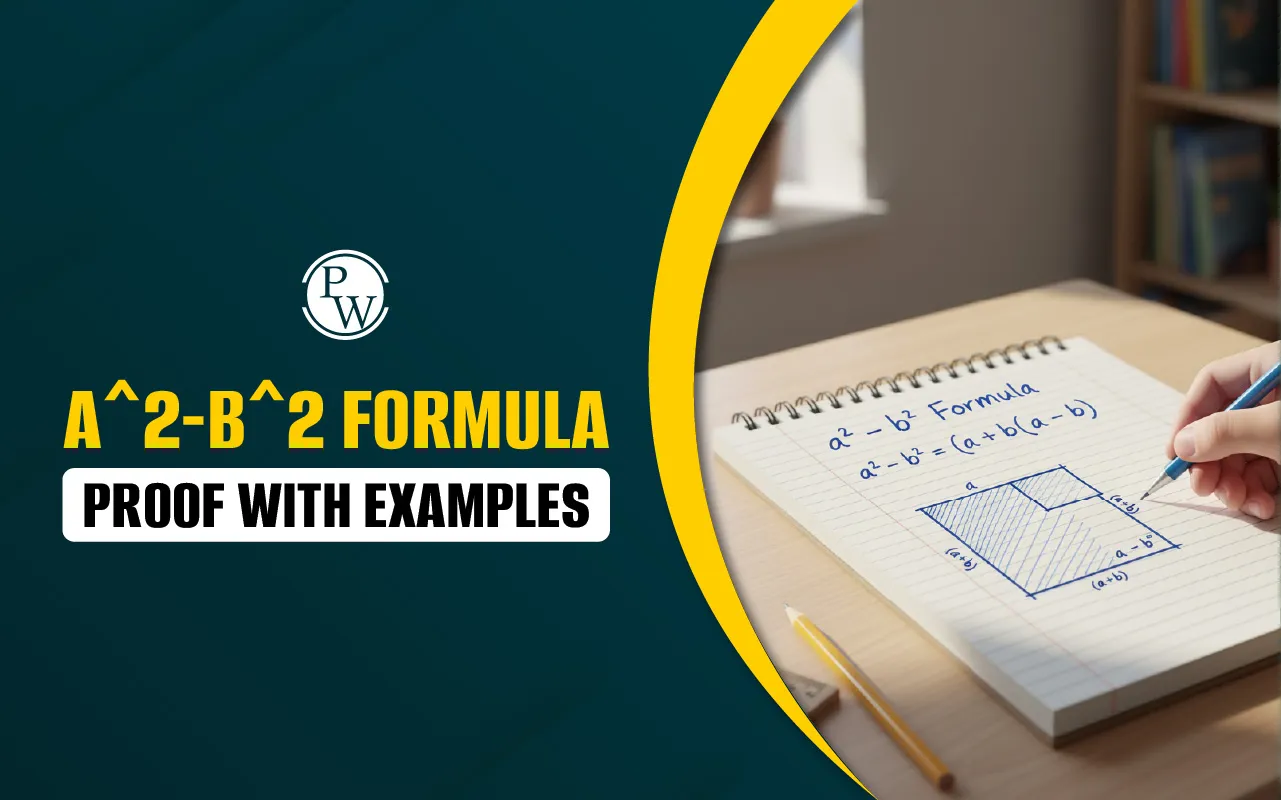
What is a^2-b^2 Formula?
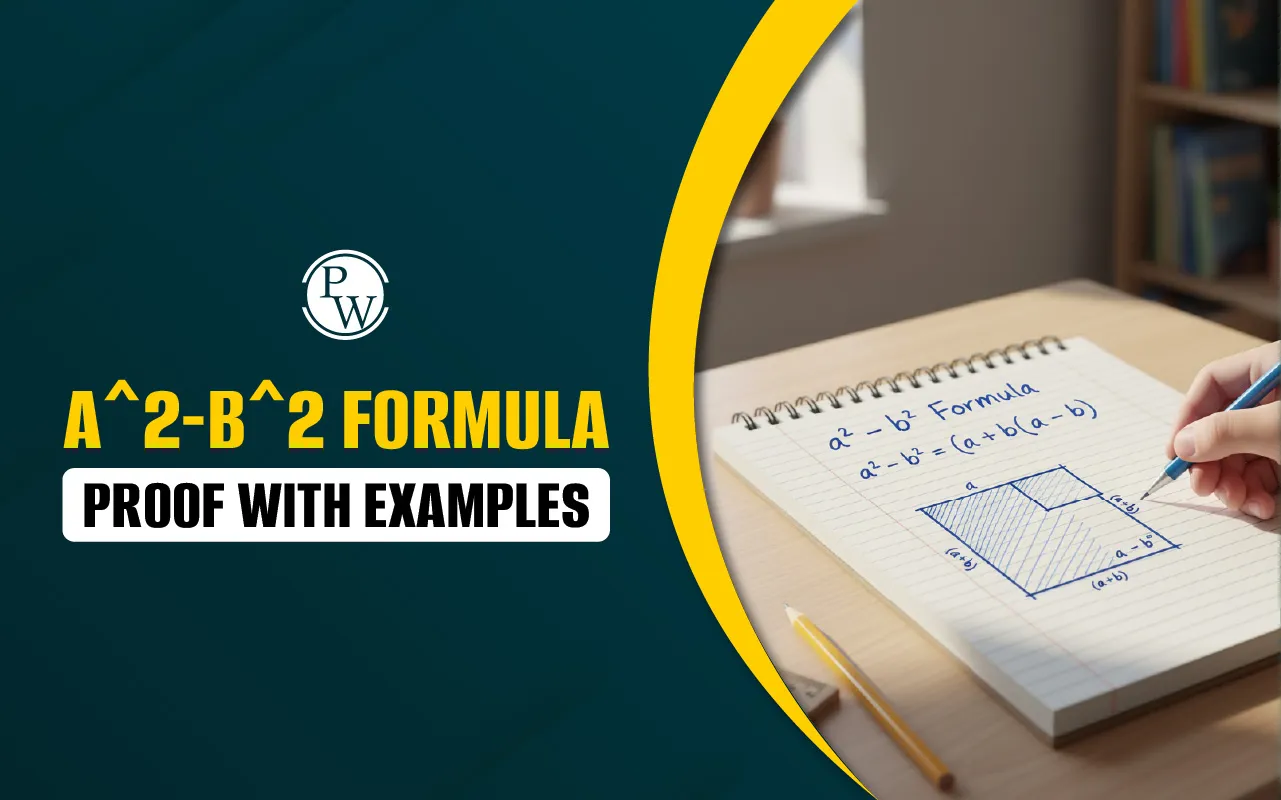
a^2-b^2 formula is also called the difference of squares formula. It is expressed as a² - b² = (a + b)(a - b). This means when we subtract one square number from another, we can write it as the product of their sum and difference. The a²-b² formula helps us find the difference between two squares without actually finding their squares.
It is one of the most common algebraic identities used to factorise binomials with squares. Learning what is a^2-b^2 formula makes it easy to solve and simplify algebra questions in maths. So keep reading to learn more about the verification of the a²-b² formula with examples.
Read More: (a + b)³ Formula
Verification of a²-b² Formula
We can do the verification of a²-b² formula by following the steps given below. As we learnt, the a^2-b^2 formula is written as:
a² - b² = (a + b)(a - b).
-
Now, to verify if this is true, we need to prove that the left-hand side (LHS) is equal to the right-hand side (RHS).
-
So, let's start with the right-hand side: (a + b)(a - b)
-
Multiply the two brackets:
= a(a - b) + b(a - b)
= a² - ab + ab - b² -
Here, -ab + ab becomes 0. So, we get= a² - b²
-
Hence, LHS = RHS
So, the verification of a2-b2 formula shows that a² - b² = (a + b)(a - b) is true, and the a square minus b square formula is a useful algebraic identity.
Proof of a²-b² Formula
You can understand the proof of a²-b² formula easily with the help of the given figure. Let’s take two squares: one with side a units and another smaller one with side b units.
Now, arrange these squares in such a way that two rectangles are formed.
-
The first rectangle has a length of a and a breadth of (a-b).
-
The second rectangle has a length of b and a breadth of (a-b).
We can now find the areas of these two rectangles:
-
Area of the first rectangle = a × (a - b) = a(a - b)
-
Area of the second rectangle = b × (a - b) = b(a - b)
-
When we add these two areas, we get: a(a - b) + b(a - b) = (a - b)(a + b)
-
If we open the brackets: (a + b)(a - b) = a² - b²
Hence, the proof of a^2-b^2 formula= (a + b)(a - b).
Read More: Brackets in Maths
Examples on a^2-b^2 Formula With Solutions
Let’s understand how to apply this formula by going through some examples on a^2-b^2 formula. This “a square minus b square formula” helps us solve questions with big numbers easily without doing long multiplication.
Example 1: Find the value of 52² - 48² using the a^2-b^2 formula.
Solution: Here, a = 52 and b = 48.
Using the a² - b² formula: a² - b² = (a - b)(a + b)
So, 52² - 48² = (52 - 48)(52 + 48)
= (4)(100)
= 400
Answer: 52² - 48² = 400
Example 2: Factorise the expression 49x² - 36 using the a²-b² formula.
Solution: We can write it as (7x)² - 6²
So, a = 7x and b = 6
Using the a² - b² formula,
a² - b² = (a - b)(a + b)
(7x)² - 6² = (7x - 6)(7x + 6)
Answer: 49x² - 36 = (7x - 6)(7x + 6)
Example 3: Simplify 82² - 78² using the a^2-b^2 formula.
Solution: Here, a = 82 and b = 78
Using the a²-b² formula,
a² - b² = (a - b)(a + b)
82² - 78² = (82 - 78)(82 + 78)
= (4)(160)
= 640
Answer: 82² - 78² = 640
Also Read: Construction in Maths
A Square Minus B Square Formula: Practice Questions
After learning what is a^2-b^2 formula, its proof, and some examples, it’s time to check how well you have understood the concept. Try solving these simple practice questions on the a square minus b square formula on your own. These will help you get better at using the a²-b² formula while solving questions in real time:
1. Find the value of 62² − 58² using the a² - b² formula.
2. Simplify 121x² − 81 using the a² - b² formula.
3. Factorise the expression 169 − 49y².
4. Using the a² - b² formula, find the value of 42² − 38².
5. Simplify 225p² − 100q² by applying the a² - b² formula.
Turn Maths Fear of Your Child into Fun Learning with CuriousJr
Many children start feeling that maths is boring or confusing when it’s taught only through formulas and lengthy calculations without enough explanations and examples. This makes them lose interest and confidence in the subject.
CuriousJr’s Online Maths Tuition Classes make learning fun, simple, and meaningful. Every topic is explained through real-life examples, step-by-step explanations, and interactive lessons, so your child understands why maths is important. Here’s what makes CuriousJr’s classes stand out:
-
Dual Teacher Mentorship: One teacher explains concepts clearly, while another helps with doubts after class.
-
Personalised Learning: Lessons are designed according to your child’s class, board, and learning pace.
-
Olympiad and Exam Support: Classes also prepare your child for school tests and Olympiads.
-
Regular PTMs: Stay updated with your child’s progress through online parent-teacher meetings.
Book a demo class today and help your child see that maths can be interesting, practical, and full of fun learning.