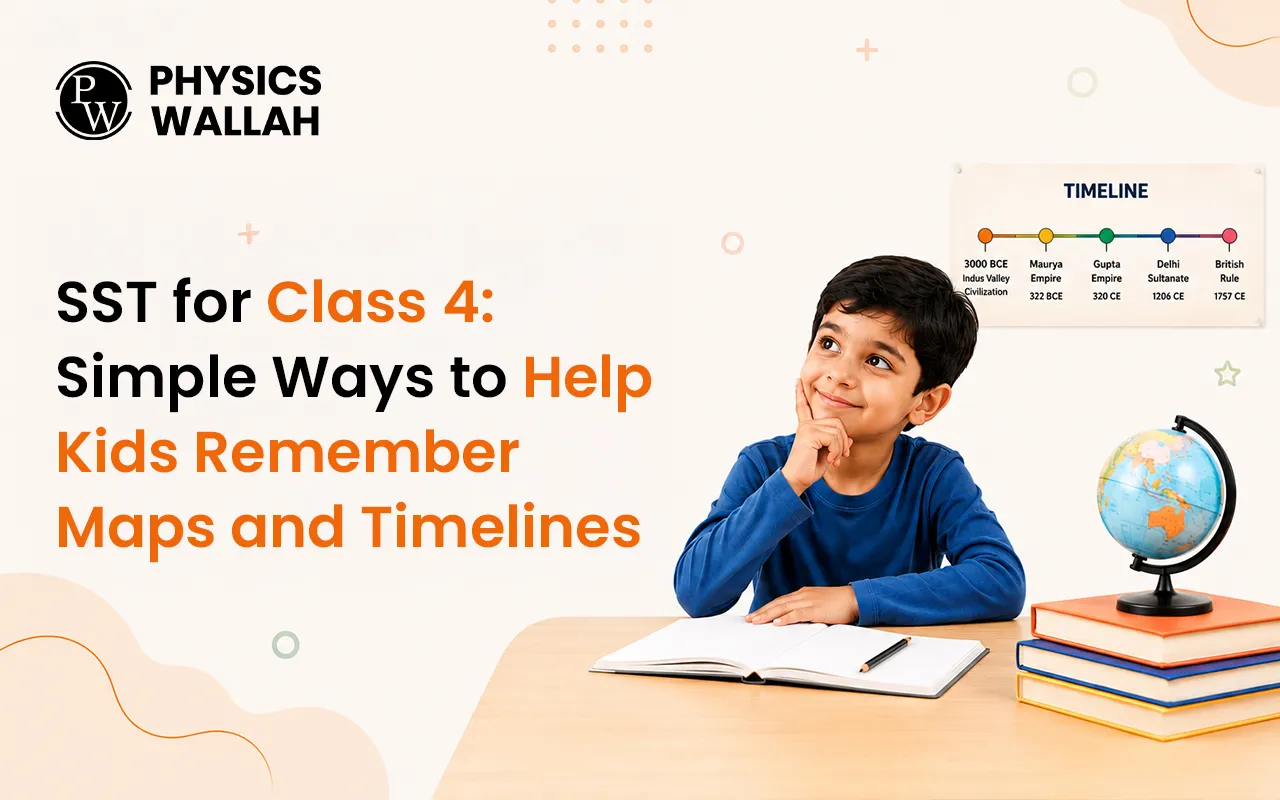
SST for Class 4: Simple Ways to Help Kids Remember Maps and Timelines
 Nikita Aggarwal10 Jun, 2026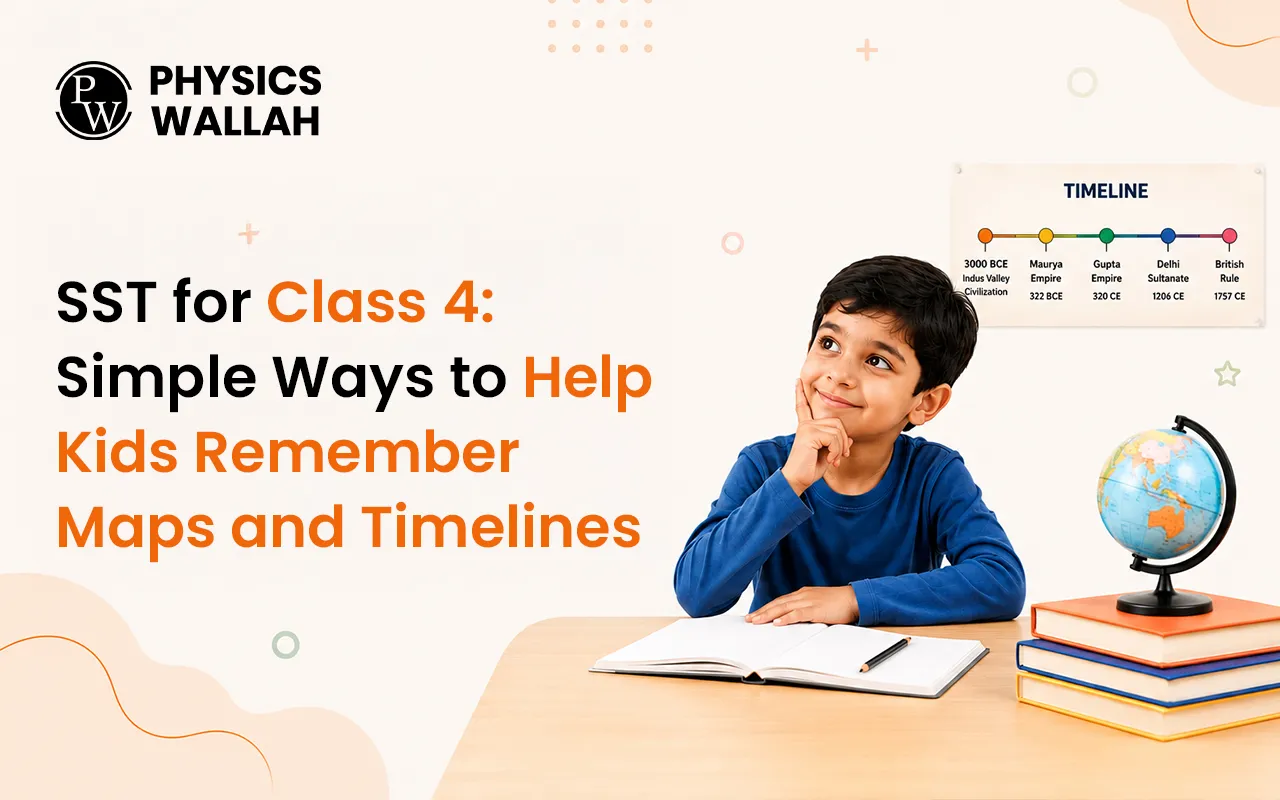
Why Students Find SST for Class 4 Maps and Timelines Difficult
The primary reason children struggle with SST is the sudden shift from concrete objects to abstract representations. In earlier grades, students focus on their immediate surroundings, but fourth-grade social studies introduces vast national boundaries and expansive historical eras.
The learning difficulties generally stem from specific core challenges:
-
Spatial Disconnection: Standard map prints lack physical context, making it hard for kids to understand how flat symbols represent major physical mountains, rivers, or state territories.
-
Abstract Time Concepts: Concepts like centuries or decades feel completely detached from a child's everyday experience of time, which is usually measured in hours or days.
-
Information Overload: Textbooks introduce multiple state capitals, official symbols, and historic dates all at once, leading to cognitive fatigue.
-
Lack of Visual Anchorage: Reading continuous text without interactive visual steps makes it highly difficult for elementary minds to store spatial layout memory.
Easy Ways to Learn Geography Maps in SST for Class 4
Transforming geographical charts into interactive visual grids helps children process spatial distribution effectively. When looking for Class 4 geography maps learning strategies, focusing on physical interactions with structural layouts gives the best academic results.
Learn North South East and West Easily
Before diving into country layouts or political maps, fourth-grade students must gain complete clarity on the cardinal direction grid. You can set up a simple directional game inside their study room to anchor this concept physically.
-
North: Always points toward the top border of the study table or map paper.
-
South: Points directly toward the bottom margin, opposite to North.
-
East: Points toward the right hand side, where the sun rises.
-
West: Points toward the left hand side, where the sun sets.
Use Colors to Remember Map Features
Blank maps look boring and confusing to young students. Assigning distinct, functional colors to different geographical features helps children categorise and remember data instantly.
|
Map Feature |
Assigned Standard Color |
Visual Function for Students |
|
Water Bodies |
Blue |
Identifies rivers, seas, oceans, and major lakes |
|
Mountains & Plateaus |
Brown |
Marks high altitude ridges and elevated landforms |
|
Plains & Agriculture |
Green |
Displays low-lying fertile land and crop valleys |
|
Deserts |
Yellow |
Represents arid, dry zones and sandy terrains |
|
State Capitals |
Red Dots |
Pins specific political centers and administrative cities |
Create Simple Map Keys and Symbols
A map key acts like a secret decoder ring for young learners. Instead of forcing children to memorise state locations blindly, encourage them to draw small, universal icons directly onto the corner legend of their study sheets.
-
Draw a tiny triangle to represent a major mountain peak.
-
Use a wavy ribbon line to indicate the natural flow path of a river.
-
Place a small star icon to highlight the national capital territory.
-
Sketch a miniature tree outline to mark dense forest reserves or national sanctuaries.
Read More - Is Your Class 5 Child Ready for the Challenges of Class 6? Here's How to Know
How to Remember History Timelines in SST for Class 4
Tracking past events in sequential order requires a solid framework. To learn how to remember history timelines Class 4, young minds need linear, segmented visual tools rather than dense paragraphs of historical text.
1. Build a Clothesline Timeline Inside the Study Room
Physical motion greatly assists memory retention. You can set up a simple horizontal string across a wall to serve as a tangible historical track.
-
Stretch a long piece of yarn or string horizontally across the room from left to right.
-
Write historical milestones or community changes on small index cards.
-
Attach the cards to the string in chronological sequence using wooden clothes pegs.
-
Have your child walk along the line from left to right, touching each card to experience the natural passage of time.
2. Use Personal Family Trees as a Prerequisite Tool
Before asking a child to understand ancient centuries, help them build a time track using events they already know. This builds immediate context for complex school topics.
-
Step 1: Mark the current year with a point showing the child's birth date.
-
Step 2: Move backward on the line to place points for parental birth years.
-
Step 3: Move further left to position points for grandparent milestones.
-
Step 4: Translate this exact left-to-right backtracking model directly into their historical textbook assignments.
3. Apply the Chunking Method to Historical Dates
Forcing a fourth-grade student to memorise random four-digit years causes immediate confusion. Break those numbers down into smaller, digestible bits.
-
Instead of saying "fourteen ninety-eight," break it down into two separate number blocks: 14 and 98.
-
Connect the date numbers directly to a funny, memorable rhyming sentence or a distinct visual action.
-
Limit history review sessions to a maximum of three core milestones per day to prevent memory fatigue.
Read More - How to Help Your Child Score Better in Class 5 Unit Tests and Exams
Important Topics in SST for Class 4
The standard primary curriculum covers specific structural themes that form the foundation for higher-grade studies. Learning these core Class 4 SST topics early gives children a distinct academic advantage.
1. The Physical Layout of the Land
Students learn to identify the natural divisions that make up their country. This includes studying major mountain wall protections, fertile river plains, deep plateau sections, and coastal edges. Learning this topic relies heavily on the five-color mapping system described earlier.
2. Local Administration and Civic Governance
This topic introduces kids to how communities organise themselves. It covers the roles of local village panchayats, city municipal bodies, and basic civic duties like waste management and public safety.
3. Evolution of Transport and Human Housing
Students track how human lifestyle choices shifted from early cave shelters to modern urban concrete housing. It also covers the historical progression of transport, moving from simple animal-driven carts to high-speed railway layouts.
How Online Tuition Can Improve SST for Class 4 Learning
When home practice sessions are not enough to bridge the learning gap, setting up formal digital guidance can provide excellent support. Enrolling a child in targeted EVS Class 4 online tuition ensures they receive systematic, expert help tailored to their learning pace.
Professional digital tutoring platforms help students handle complex curriculum topics through:
-
Live Visual Interaction: Tutors use animated map pointers and digital sliding timelines to make abstract topics clear.
-
Daily Guided Checkpoints: Regular short reviews prevent students from falling behind on complex textbook sections.
-
Personalised Explanations: Dedicated educators break down complicated vocabulary into simpler language that aligns with your child's thinking speed.
-
Targeted Study Worksheets: Curated mapping exercises help children practice drawing legends and locating borders accurately before school exams.
How to Choose the Best Online Support for SST for Class 4
Finding the right digital resources is key to helping your child succeed in school. When searching for reliable Class 4 Social Studies online materials, always look for platforms that value visual structure over dense blocks of text.
Keep these essential quality markers in mind when choosing a learning platform:
-
Ensure the platform offers a rich library of printable blank maps and interactive timeline templates.
-
Look for short, engaging video lessons that explain historical events like an exciting story rather than a list of facts.
-
Check that the practice quizzes offer immediate feedback so your child can learn from mistakes right away.
-
Make sure the curriculum structure aligns with your child's school board requirements to keep their studies on track.
How CuriousJr Helps Students Learn SST for Class 4
Using a well-planned academic framework is essential for building long-term academic confidence. For parents looking for reliable social science Class 4 help, the CuriousJr school curriculum offers a structured approach designed specifically to match the development and learning needs of fourth-grade students.
Interactive Live Lessons for Young Learners
The system focuses on active participation rather than passive listening. During live sessions, students engage with interactive mapping tools, drag-and-drop timeline puzzles, and real-time conceptual quizzes. This regular interaction keeps children focused and helps them retain details much better than standard textbook reading.
Comprehensive Subject Coverage on CuriousJr
The platform delivers balanced academic support across all primary subject areas, ensuring no topic is left unchecked:
-
Mathematics: Simple breakdowns of multi-digit division, fractions, geometry layouts, and everyday measurement calculations.
-
English Language Skills: Structured practice for noun classifications, verb tenses, reading comprehension passages, and short paragraph composition.
-
Science Explorations: Easy to follow modules covering plant life cycles, human body systems, solar system tracks, and environmental conservation.
-
Social Studies Modules: Step-by-step guidance for map reading, tracking community governance, understanding cultural festivals, and organizing historical event timelines.
Structured Homework Support and Conceptual Clarity
CuriousJr class 4 kids online tuition provides clear homework assistance to eliminate evening study stress. Expert educators explain difficult textbook questions using relatable everyday examples. This targeted reinforcement helps children understand basic principles, turning frustrating study hours into productive, confidence-building experiences.





SST for Class 4: Simple Ways to Help Kids Remember Maps and Timelines FAQs
1. What is the easiest way to teach map directions in SST?
2. How can I help my child remember historical dates for Class 4 Social Studies online?
3. Which core Class 4 SST topics require the most map practice?
4. Can EVS Class 4 online tuition improve my child's map reading scores?

Get Free Counselling Today
and Clear up all your Doubts
 Live & recorded classes available at easeDashboard for progress trackingLakhs of practice questions