Prepositions Worksheet for Class 4 Students
 Nivedita Dar30 May, 2026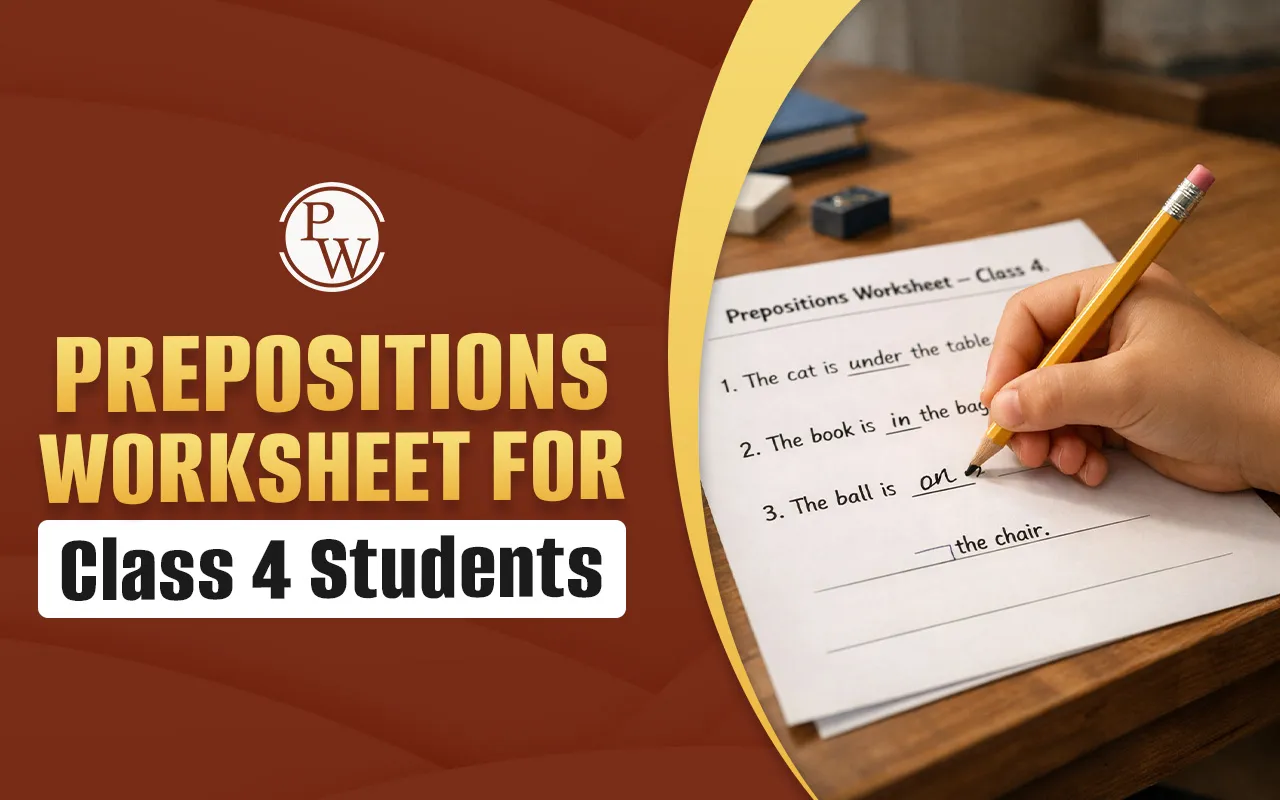
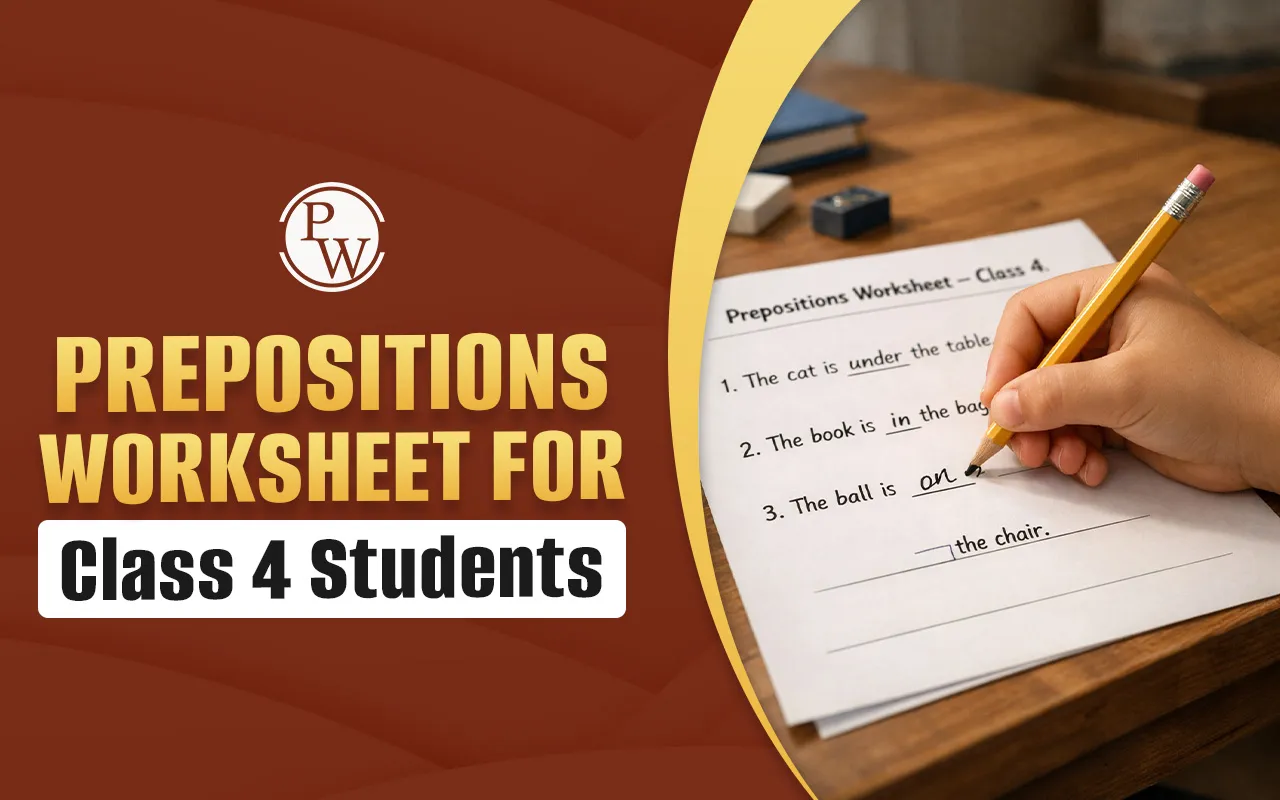
A preposition worksheet for class 4 helps kids learn words that show how things are related. These small words tell us where something is, when things happen, or where someone is going.By using a preposition worksheet for class 4 with answers, you can learn to write clear and correct English sentences easily. It is a vital part of grammar.
Using a preposition worksheet for class 4 is the best way to see how words like "in," "on," and "at" change what a sentence means. These words might look small, but they are like glue. They hold the different parts of a sentence together. These words always need a partner, like a noun or a pronoun. If you say "The book is," nobody knows where it is. But if you say "The book is on the table," the sentence is complete.
Grammar rules say you should use words like "me," "him," or "them" after these prepositions. This is because they act as objects. For example, you should say "He is sitting with me" instead of "He is sitting with I." This is a common mistake that students make. By practicing with a worksheet, you can avoid these errors and speak better English. We use these words to link people and things so our stories are easy for everyone to understand.
Read More - Class 1 English Worksheet Prepositions
Prepositions Worksheet for Class 4 Uses
A preposition worksheet for class 4 is great because you can use it even without the internet. You can print it out and carry it in your bag. It is a big part of your studies because it gives you a lot of benefits:
-
Easy Examples: You see the difference between "the cat is under the table" and "the cat is on the table."
-
Quick Check: A preposition worksheet for class 4 with answers lets you fix your mistakes right away. You don't have to wait for a teacher to tell you if you are right.
-
Fun Pictures: A preposition worksheet for class 4 with pictures helps you see the spot where things are. Seeing a
-
picture of a dog behind a fence helps you remember the word better than just reading it.
-
School Help: Practice common pairs like "proud of" or "interested in" to get better marks in class. These help you prepare for exams like the Olympiads.
Practice makes you perfect
When you use a preposition worksheet for class 4, try to make your own sentences too. Don't just fill in the blanks. If the worksheet says "The pen is in the box," try to look around your room. Can you find something else that is "in" a box? Maybe your toys are in a bin. This kind of practice helps the brain remember the rules for a long time. It makes learning feel less like a chore and more like a fun activity.
Three Main Types of Prepositions
When you do a preposition worksheet for class 4 icse, you will see three main groups. Each group answers a simple question: Where? When? or Which way? Understanding these groups helps you choose the right word every time.
Words for Places
These words tell us where a person or thing is. They show the position of one object compared to another.
-
At: Used for one exact spot. If you are standing right by the door, you are "at the door." If you are waiting for a bus, you are "at the bus stop."
-
In: Used for inside a space. This could be a small thing like a "box" or a big place like "London" or "Delhi."
-
On: Used for top of a surface. Think of things that touch a flat area. A picture is "on the wall." A laptop is "on the desk."
-
Under and Above: These show if something is below or higher than something else. A fan is "above" your head, and your shoes are "under" the bed.
-
Beside vs. Besides: "Beside" means "next to." "Besides" means "as well as" or "in addition to." Try not to mix them up! For example: "Sit beside me" means sit next to me. "I have no friends besides you" means you are my only friend.
Read More - Prepositions of Manner - Definition, Rules, Examples in English
Words for Time
These words tell us when something happens. They are very important for telling stories or making plans with friends.
| Word | When to Use | Example |
| :--- | :--- | :--- |
| At | Clock times | At 5 o'clock, At noon |
| On | Days and dates | On Monday, On June 10 |
| In | Months or years | In 2026, In the morning |
| For | How long it lasts | For one hour, For a week |
| Since | When it started | Since yesterday, Since 2010 |
Words for Direction
These words show movement. They tell us where something is going.
-
To: Shows where you are going. "I am going to school."
-
Into: Shows movement from outside to inside. "The frog jumped into the pond."
-
Towards: Shows the way you are moving. "We walked towards the park."
-
Across: Shows moving from one side to the other. "He ran across the road."
Read More - Prepositions of Time: Definition, Rules, Uses, Examples
Simple Rules for Using Prepositions
Before you start your preposition worksheet for class 4, remember these easy rules. They will help you avoid small slips that many people make. Even smart students can get confused, so these rules are a vital part of your learning journey.
The Partner Rule
A preposition cannot be alone. It must have a "partner" word (an object). This partner is usually a naming word (noun) or a pronoun. For example, in the phrase "in the room," the word "in" is the preposition and "room" is its partner. Without the partner, the word "in" doesn't tell us enough. Always use "me" or "her" after them. Say "Give it to him," not "Give it to he." This is because "him" is an object pronoun. Using the right pronoun makes you sound like a pro!
Multi-word Prepositions
Sometimes, a preposition is made of two or three words. These act like one single word. Don't try to break them apart.
-
Examples: "In front of," "next to," "according to," and "instead of."
-
Usage: You can say, "The car is parked in front of the house." Even though it is three words, it works just like the word "near."
Important Tips to Remember
-
The "To" Rule: Sometimes "to" is a preposition (to the park), but sometimes it sits with an action word (to play). Look closely at how it is used! If "to" is followed by a place, it is a preposition. If it is followed by an action, it is part of a verb.
-
Naming Words: Always put a naming word (noun) after a preposition, not a doing word (verb). Say "good at drawing," not "good at draw." If you must use an action word, add "-ing" to the end of it to make it act like a noun.
-
No Verbs Alone: A preposition is never followed by a verb in its basic form. You won't say "She is fond of dance." You would say "She is fond of dancing."
Class 4 Preposition Practice Questions
Let's see what you know! Use these questions as a small preposition worksheet for class 4 with answers to check your learning. Cover the answers with your hand first and try to solve them on your own.
Fill in the Blanks
Pick the right word from the brackets.
-
The apple is _______ the plate. (in/on)
-
We go to school _______ 8:00 AM. (at/on)
-
The frog jumped _______ the pond. (in/into)
-
My bag is _______ the chair. (under/between)
-
I am not afraid _______ dogs. (from/of)
-
Please be kind _______ animals. (to/with)
-
The train is passing _______ the tunnel. (across/through)
-
I am interested _______ learning music. (at/in)
-
He is sitting _______ his father and mother. (among/between)
-
We have been waiting _______ two hours. (since/for)
The Correct Answers
-
On (it sits on top of the flat surface)
-
At (used for an exact clock time)
-
Into (shows movement from the air into the water)
-
Under (it is on the floor below the chair)
-
Of (this word always goes with 'afraid')
-
To (this is the standard way to show kindness)
-
Through (moving from one end of a tube to the other)
-
In (always used with 'interested')
-
Between (used when there are only two people)
-
For (used to show a length of time)
Preposition Worksheet for Class 4 Tips
-
Say it Out Loud: Read your sentence. If it sounds funny, it might be wrong! Our ears are often better at grammar than our eyes.
-
Draw a Map: If you are using a preposition worksheet for class 4 pdf, draw a quick sketch of the sentence. Drawing "the ball is in the box" helps you understand it better.
-
Try New Words: Don't just use "on." Use words like "across" or "among" to make your stories better. Using different words makes your writing more interesting to read.
-
Learn Word Pairs: Some words always go together, like "agree with" and "different from." If you learn them as pairs, you will never make a mistake.
-
Keep a Notebook: Every time you see a new preposition in a book, write it down. See how the author used it. This is a great way to learn without even trying!
Read More - Difference Between For and Since: Meanings and Examples
Help Your Child Gain Confidence in English with CuriousJr
Is your child nervous about speaking English or unable to express thoughts clearly? This usually happens when children do not get enough speaking practice or personal guidance.
CuriousJr Online English Classes make learning enjoyable through live lessons, fun activities, and interactive speaking exercises. By actively participating, children improve grammar, pronunciation, and vocabulary in a natural way.
The program builds all essential language skills—listening, speaking, reading, and writing—helping children communicate better in every situation.
CuriousJr provides four age-based levels: Starters (6–8 years), Movers (8–10 years), Key (10–12 years), and Preliminary (12–14 years), ensuring learning at a comfortable pace for every child.
Parents also receive regular progress reports. Enroll your child today and help them become confident, fluent English speakers with CuriousJr Online Classes.




Prepositions Worksheet for Class 4 Students FAQs
What is a preposition?
When do I use 'at' for a place?
What is the difference between 'in' and 'into'?
Can a preposition have three words?
Why should I learn these words?
How do I use 'between' and 'among'?

Get Free Counselling Today
and Clear up all your Doubts
 Live & recorded classes available at easeDashboard for progress trackingLakhs of practice questions