Ordinal Numbers Worksheet for Student to Practice
 Nikita Aggarwal14 Apr, 2026
What is Ordinal Numbers Worksheet?
When parents or teachers ask, 'What is ordinal numbers worksheet?'They want to know about a tool that teaches kids about position. This concept is different from quantity. These worksheets are all about where something's in a line. They do not just focus on how many things are in a group.
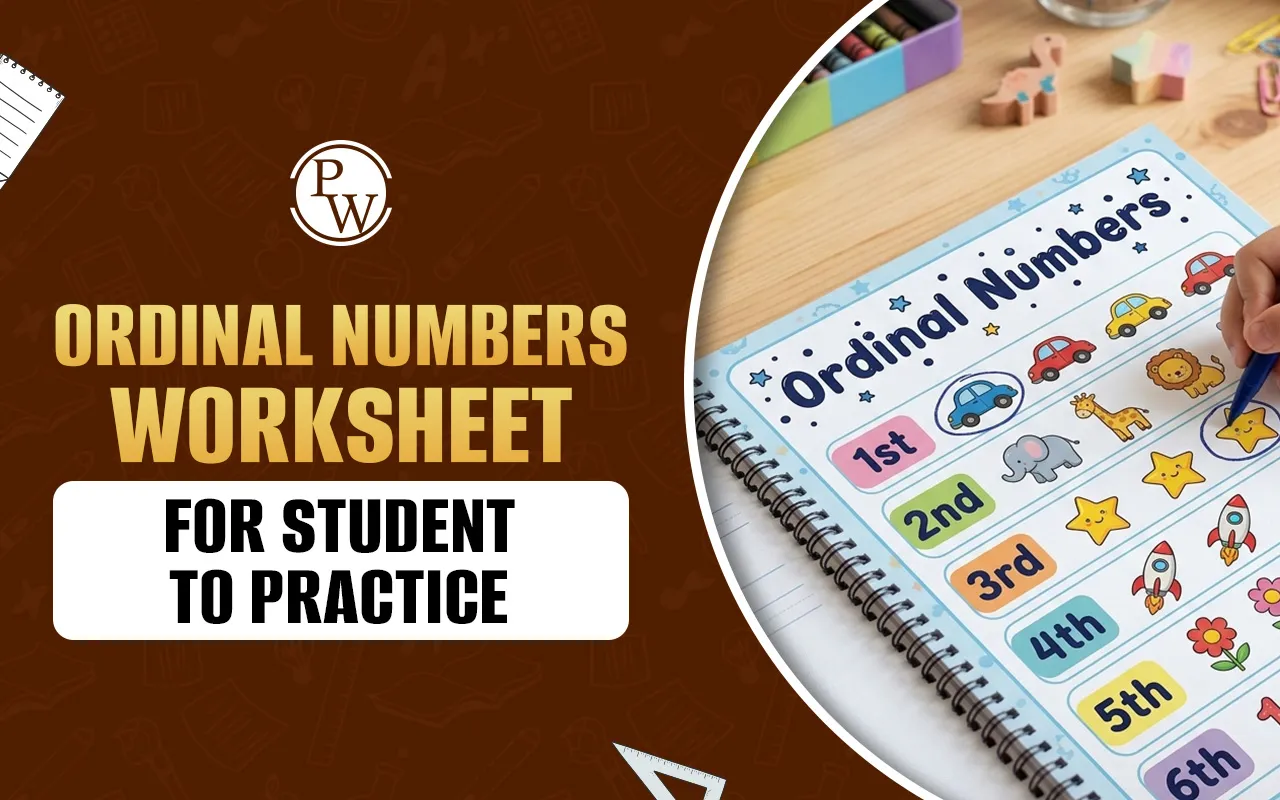
An ordinal number worksheet in maths has exercises where kids have to do things like circle the apple or colour the fifth car. This helps kids learn how to use "st", "nd", "rd", and "th" after a number. For example, the ordinal numbers worksheet is important because it teaches kids how to put things in order and follow steps one after the other. Such practice is a help when it comes to solving harder problems later on. The ordinal numbers worksheet is a way to start teaching kids these skills.
Topics of Ordinal Numbers Worksheet in Maths
A well-rounded ordinal numbers worksheet in maths covers several key areas to ensure a student is fully competent. Typically, these worksheets divide into different difficulty levels:
1. Identifying Positions 1 to 10
When we start with the basics, we look at a row of things that are all alike. Students must identify the row's start, usually on the left, and count to locate something specific. This helps students learn directional counting, which is vital for their education.
2. Matching Numbers to Words
It is not enough to know that "3rd" is third. Students must learn to link the numeral (3rd) with the written word (third). Worksheets often use matching columns to reinforce this connection, helping with both maths and literacy.
3. Suffix Application
One of the things for people who are learning is figuring out which suffix to use with ordinal numbers. Ordinal numbers end with 'th', but there are some ordinal numbers that do not obey this rule, like 1st, 2nd and 3rd ordinal numbers. A good worksheet for numbers will highlight these exceptional ordinals so that people learning about them can practice them.
Exercises of Ordinal Numbers Worksheet
To get the most out of your study session, try these common types of ordinal numbers worksheet questions:
-
The Animal Race: Look at a line of five animals. If the lion is at the front, which position is the zebra in?
-
Colour by Position: You are given a row of ten circles. Colour the 2nd circle green, the 7th circle yellow, and the 10th circle black.
-
Missing Sequences: Fill in the blanks: 1st, ____, 3rd, 4th, ____, 6th.
-
Calendar Fun: Look at the month of May. What is the ordinal position of the 12th day?
Read More - Decimal Worksheet for Students to Practice
Ordinal Numbers Worksheet Questions with Answers
Here are some sample questions you might find in an ordinal numbers worksheet with answers to help you check your progress.
Question 1: In the word "mathematics", what is the fourth letter?
Answer: The 4th letter is 'H'.
Question 2: If there are seven days in a week and Sunday is the 1st day, what is the 5th day?
Answer: The 5th day is Thursday.
Question 3: Which ordinal number comes immediately after 9th?
Answer: 10th (Tenth).
Question 4: In a line of 10 people, if you are the "penultimate" person, what is your ordinal position?
Answer: 9th (Ninth).
Question 5: Write the word form for the ordinal number 22nd.
Answer: Twenty-second.
Read More - Number Line Worksheet for Students
Ordinal numbers worksheet chart
|
Number |
Ordinal Word |
Suffix |
|
1 |
First |
st |
|
2 |
Second |
nd |
|
3 |
Third |
rd |
|
4-10 |
Fourth to Tenth |
th |
By consistently using an ordinal numbers worksheet, students turn a confusing abstract concept into a practical skill they can use every day.
Benefits of Ordinal Numbers Worksheet for Students
Using a dedicated ordinal numbers worksheet for students offers several developmental advantages:
-
Spatial Awareness: It helps children understand the relationship between objects in a physical or theoretical line.
-
Vocabulary building: students learn words like "penultimate", "between", "before" and "after". These words, like "penultimate", "before", and "after", are important for students to know.
-
Following Directions: A lot of the tasks on worksheets need you to do things in an order. For example, the instructions might say, "Colour the bird blue and the fourth bird red." You have to follow the instructions for the worksheet tasks carefully. The worksheet tasks are similar to these exercises because they include steps, such as the example of the birds that says, "Colour the second bird blue and the fourth bird red."
-
Real-world Application: This program helps kids become ready for things they do every day. For example, it teaches them how to read dates on a calendar. It also helps them understand competition rankings. The program is really effective at teaching kids about things like reading dates on a calendar and understanding competition rankings.
Make Maths Simple and Fun with CuriousJr
CuriousJr helps children develop a strong maths foundation by reducing fear and building confidence. Our Mental Maths online classes for students in Classes 1 to 8 focus on improving speed, accuracy, and logical thinking using easy techniques and interactive learning methods.
With our dual-mentor approach, students attend engaging live classes and receive dedicated support to clear their doubts after every session. Animated lessons, fun activities, and exciting challenges make maths enjoyable and easy to understand.
Parents receive regular progress updates along with review sessions, ensuring complete transparency in their child’s learning journey.
Book a demo class today and see how CuriousJr makes maths simple, engaging, and confidence-building for your child.