NCERT Solutions for Class 7 Science Chapter 2 Nutrition in Animals
 Nivedita Dar29 May, 2026
NCERT Solutions for Class 7 Science Chapter 2 Nutrition in Animals
Nutrition in animals class 7 questions and answers explain how various organisms consume and utilize food for growth and health. This chapter covers the complex process of digestion, starting from ingestion in the mouth to egestion. Students learn about the human digestive system, ruminants, and Amoeba through detailed diagrams and step-by-step biological explanations found in NCERT.
NCERT Solutions for Class 7 Science Chapter 2
NCERT Solutions for Class 7 Science Chapter 2 Nutrition in Animals help students understand how animals take in food and use it for growth and energy. The solutions explain key topics such as different modes of feeding, digestion in humans, ruminants, and amoeba in clear and simple language. Prepared according to the latest NCERT syllabus, these answers make learning easier and more effective. They are helpful for homework, revision, and exam preparation. By using these solutions, Class 7 students can strengthen their concepts, improve answer writing, and feel more confident in science.
Nutrition in Animals Class 7 Questions and Answers
Question 1: Fill in the blanks.
(a) The main steps of nutrition in humans are __________, __________, ___________, __________ and __________ (b) The largest gland in the human body is __________. (c) The stomach releases hydrochloric acid and ________ juices which act on food. (d) The inner wall of the small intestine has many finger-like outgrowths called __________. (e) Amoeba digests its food in the __________.
Answer:
(a) The main steps of nutrition in humans are __ingestion__, __digestion__, __absorption__, __assimilation__ and __egestion__. (b) The largest gland in the human body is __liver__. (c) The stomach releases hydrochloric acid and __digestive__ juices which act on food. (d) The inner wall of the small intestine has many finger-like outgrowths called __villi__. (e) Amoeba digests its food in the _food vacuole_.
Question 2: Mark ‘T’ if the statement is true and ‘F’ if it is false:
(a) Digestion of starch starts in the stomach. (T/F) (b) The tongue helps in mixing food with saliva. (T/F) (c) The gall bladder temporarily stores bile. (T/F) (d) The ruminants bring back swallowed grass into their mouth and chew it for some time. (T/F)
Answer:
(a) Digestion of starch starts in the stomach. (F) (b) The tongue helps in mixing food with saliva. (T) (c) The gall bladder temporarily stores bile. (T) (d) The ruminants bring back swallowed grass into their mouth and chew it for some time. (T)
Question 3: Tick ( ) mark the correct answer in each of the following:
(a) Fat is completely digested in the (i) stomach (ii) mouth (iii) small intestine (iv) large intestine (b) Water from the undigested food is absorbed mainly in the (i) stomach (ii) food pipe (iii) small intestine (iv) large intestine
Answer: (a) Fat is completely digested in the
(i) stomach (ii) mouth (iii) small intestine √ (iv) large intestine (b) Water from the undigested food is absorbed mainly in the (i) stomach (ii) food pipe (iii) small intestine (iv) large intestine √
Question 4: Match the items of Column I with those given in Column II:
| Column I | Column II |
| Food components | Product(s) of digestion |
| Carbohydrates | Fatty acids and glycerol |
| Proteins | Sugar |
| Fats | Amino acids |
Answer:
| Column I | Column II |
| Food components | Product(s) of digestion |
| Carbohydrates | Sugar |
| Proteins | Amino acids |
| Fats | Fatty acids and glycerol |
Question 5: What are villi? What is their location and function?
Answer: Villi are tiny finger-like projections originating from the walls of the small intestine. They increase the surface area for absorption of the digested food. The blood vessels present inside the villi can absorb the nutrients from the digested food.
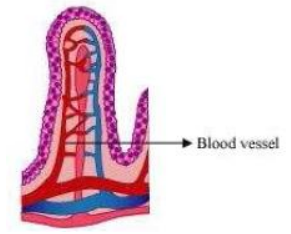 Structure of a villus
Question 6: Where is the bile produced? Which component of the food does it help to digest?
Answer: Liver secretes the bile juice which is stored in the gall bladder. Bile plays an important role in the digestion of fats.
Question 7: Name the type of carbohydrate that can be digested by ruminants but not by humans. Give the reason also.
Answer: Cellulose is a type of carbohydrate that can be digested by ruminants and not by humans. Ruminants have a large sac-like structure between small and large intestine where the food containing cellulose is digested by the action of certain bacteria. On the other hand, humans cannot digest cellulose, as the cellulose digesting enzymes are absent in them.
Question 8: Why do we get instant energy from glucose?
Answer: Glucose is a simple sugar. Carbohydrates, when consumed, have to be digested into glucose. As glucose can be easily absorbed in blood, it provides energy to the body. Hence, when glucose is directly taken, it does not have to be digested and thus acts as an instant source of energy.
Question 9: Which part of the digestive canal is involved in:
(i) absorption of food ____. (ii) chewing of food ____. (iii) killing of bacteria ____. (iv) complete digestion of food ____. (v) formation of faeces ____.
Answer: (i) absorption of food small intestine
(ii) chewing of food buccal cavity (iii) killing of bacteria stomach (iv) complete digestion of food small intestine (v) formation of faeces large intestine
Question 10: Write one similarity and one difference between the nutrition in Amoeba and human beings.
Answer: Similarity between nutrition in Amoeba and human beings:
Both Amoeba and humans require energy for the growth and maintenance of their bodies. This energy is derived from the food that they eat. The food that they consume is always in a complex form and is therefore broken down into simpler forms by the process of digestion. Hence, both these organisms are heterotrophs.
Differences between nutrition in Amoeba and human beings:
| Digestion in Humans | Digestion in Amoeba | ||
| (i) | Humans have a mouth and a complex digestive system. | (i) | Mouth and digestive system are absent in Amoeba. |
| (ii) | Digestive juices are secreted in the buccal cavity, stomach, and small intestine. | (ii) | Digestive juices are secreted in the food vacuole. |
| (iii) | Digestion of carbohydrates, proteins, and fats starts in separate regions. | (iii) | All the food components are digested in the food vacuole. |
Question 11: Match the items of Column I with suitable items in Column II
| – | Column I | – | Column II |
| (a) | Salivary gland | (i) | Bile juice secretion |
| (b) | Stomach | (ii) | Storage of undigested food |
| (c) | Liver | (iii) | Saliva secretion |
| (d) | Rectum | (iv) | Acid release |
| (e) | Small intestine | (v) | Digestion is completed |
| (f) | Large intestine | (vi) | Absorption of water |
| – | – | (vii) | Release of faeces |
Answer:
| – | Column I | – | Column II |
| (a) | Salivary gland | (iii) | Saliva secretion |
| (b) | Stomach | (iv) | Acid release |
| (c) | Liver | (i) | Bile juice secretion |
| (d) | Rectum | (ii) | Storage of undigested food |
| (e) | Small intestine | (v) | Digestion is completed |
| (f) | Large intestine | (vi) | Absorption of water |
Question 12: Label the following figure of the digestive system.
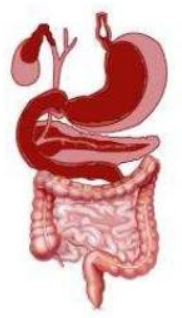 A part of human digestive system
Answer:
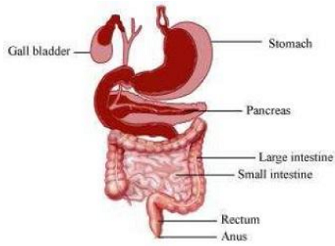
Question 13: Can we survive only on raw, leafy vegetables/grass? Discuss.
Answer:
No. Humans cannot survive only on raw, leafy vegetables, or grass. It is because the grass is rich in cellulose, which is a type of carbohydrate that humans are not able to digest due to the absence of cellulose-digesting enzymes.
Mastering Nutrition in Animals Class 7 Questions and Answers
How we feed our bodies is the first step to understanding the biological mechanisms of life. It's not enough to only memorise names like "oesophagus" and "small intestine" in this chapter. You also need to understand how nutrients are absorbed. A lot of students look for the nutrition in animals class 7 questions and answers to assist them picture the digestive system and the jobs of different glands. We've taken the most important ideas from the best educational sources and put them together so that you may answer any class 7 science ch 2 question with perfect confidence.
The Five Stages of Animal Nutrition
There are many steps involved in nutrition. It doesn't happen all at once. Ingestion is the first step, and it just means eating food. Then follows digestion, when complicated food breaks down into simpler, more soluble forms. Absorption lets these nutrients get into the blood vessels once they have been broken down. Assimilation is the moment where the body actively employs the things it has absorbed to grow. Lastly, egestion gets rid of the waste that your body couldn't digest.
Human Digestive System: A Detailed Breakdown
The alimentary canal is a lengthy, continuous tube that the body uses. It starts at the mouth and ends at the anus. The liver is the biggest gland in the body. It makes bile juice, which is stored in the gallbladder. Bile is very important for breaking down lipids. At the same time, the stomach, which is a thick-walled bag shaped like a flattened "U," gets food and employs hydrochloric acid to destroy microorganisms.
The actual magic of absorption comes in the small intestine, which is around 7.5 meters long. Villi are finger-like growths on the inside walls. These villi make the surface area bigger so that your body can absorb as much energy as possible. When you check for class 7 science chapter 2 nutrition in animals question answer sets, you'll commonly see questions about how the tiny and large intestines work differently. The small intestine takes in nutrients, but the big intestine mostly takes in water and salts from food that hasn't been digested yet.
Detailed NCERT Class 7 Science Chapter 2 Question Answer
When you sit down to solve the class 7 science chapter 2 questions and answers, you should focus on the specific functions of different teeth and organs.
-
Milk Teeth vs. Permanent Teeth: Humans grow two sets of teeth. The first set, milk teeth, falls off between ages six and eight. These are replaced by permanent teeth which usually last throughout life.
-
Types of Teeth: We use incisors for biting, canines for piercing, and premolars/molars for chewing and grinding.
-
The Role of Saliva: Saliva isn't just water. It breaks down starch into sugars, making it easier for the stomach to process food.
Digestion in Grass-Eating Animals
Have you ever noticed cows chewing even when they aren't eating? They're ruminants. These animals quickly swallow grass and store it in a part of the stomach called the Rumen. Here, the food gets partially digested and is called cud. Later, the cud returns to the mouth in small lumps for the animal to chew again. This unique process allows them to digest cellulose, a type of carbohydrate that humans can't process easily.
Feeding and Digestion in Amoeba
Amoeba is a microscopic, single-celled organism found in pond water. It doesn't have a mouth or a complex digestive system. Instead, it uses pseudopodia (false feet) to engulf food particles. The food becomes trapped in a food vacuole where digestive juices break it down. It’s a simple yet fascinating version of the same five stages of nutrition we see in humans.
How CuriousJr Online Tuition Classes Make Learning More Effective for Your Child
CuriousJr’s online tuition classes are thoughtfully designed for students from Class 3 to Class 8 to support better learning outcomes. These classes focus on building clear concepts, improving academic performance, and boosting students’ confidence in school subjects.
What makes CuriousJr stand out:
-
Interactive daily classes that encourage questions, discussions, and active participation, helping students understand topics deeply.
-
Concept-based teaching that goes beyond rote learning and helps students apply what they learn in exams and real life.
-
Full syllabus coverage of Maths, Science, English, and Social Studies, aligned with the latest school curriculum.
-
Regular tests and practice sessions to check understanding, strengthen weak areas, and improve exam readiness.
-
Detailed feedback and progress tracking to help parents and students clearly see improvement over time.
-
Dedicated mentor support that provides personalised guidance based on each child’s learning pace and needs.





NCERT Solutions for Class 7 Science Chapter 2 FAQs
What are the primary elements of the digestive system?
What do the villi do in the small intestine?
Why can't cows digest cellulose as people can?
What does the gallbladder do?
What does Amoeba do to get its food?

Get Free Counselling Today
and Clear up all your Doubts
 Live & recorded classes available at easeDashboard for progress trackingLakhs of practice questions