NCERT Solutions for Class 6 Social Science Chapter 2 Oceans and Continents
 Shivam Singh16 Sept, 2026
Class 6 Social Science Chapter 2 plays an important role in helping students understand the Earth as a planet. This chapter mainly focuses on the shape of the Earth, its movements, and how these movements affect day, night, seasons, and climate. Students often search for class 6 chapter 2 question answer to prepare well for school exams and improve their understanding of geography concepts.
The NCERT Solutions for class 6 geography chapter 2 explains topics like the Earth’s rotation and revolution in an easy and clear manner. Rotation of the Earth causes day and night, while revolution around the Sun leads to the change of seasons. These concepts are very important and form the base for higher classes. Using class 6 geography chapter 2 questions and answers, students can revise these topics quickly and effectively.
Many learners rely on class 6 social science chapter 2 question answer because NCERT-based solutions follow the latest syllabus and exam pattern. Oceans and Continents answers are written in simple language, making it easy for students to understand and remember key points. Diagrams and examples further help in better learning.
Class 6 social science chapter 2 also explains why different parts of the Earth experience different seasons at the same time. This helps students connect textbook knowledge with real-life situations. Regular practice of class 6 geography chapter 2 question answer improves writing skills and boosts confidence during exams.
Overall, class 6 chapter 2 question answer is very useful for students who want to score well and build a strong foundation in geography. Reading and revising class 6 geography chapter 2 questions and answers regularly helps students understand the Earth and its movements clearly and makes learning social science more interesting and enjoyable.
NCERT Solutions for Class 6 Social Science Chapter 2 Question Answers
Looking for NCERT Solutions for Class 6 Social Science Chapter 2 Oceans and Continents? These solutions cover all important questions, activities, and map work as per the latest syllabus and exam pattern.
Practicing these will help you prepare better for exams. Check the complete solutions below and strengthen your understanding of continents, oceans, and their importance.
1. What are oceans and continents? What are their names and their distribution?
Oceans are the large water bodies covering nearly three-fourths of the Earth's surface. The five major oceans are the Pacific, Atlantic, Indian, Southern (or Antarctic), and Arctic Oceans.
Continents are large continuous masses of land covering a little over one-fourth of Earth. The seven continents are Asia, Africa, North America, South America, Antarctica, Europe, and Australia. Oceans and continents are not evenly spread across the Northern and Southern Hemispheres — the Northern Hemisphere has more land, while the Southern Hemisphere has more water.
2. In what ways do oceans and continents impact life on Earth, including human life?
Oceans and continents shape the Earth's climate, produce rainfall, and support plant and animal life. Oceans provide oxygen and regulate climate, acting as the planet’s lungs.
They support marine life and influence human activities like trade, fishing, and migration. Continents provide habitat and resources for humans, plants, and animals.
LET’S EXPLORE
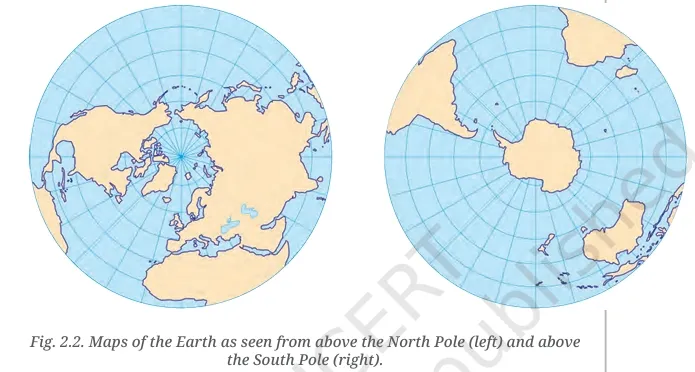
What are the circular lines in each map called? And do you know what the lines radiating out of the two poles are called?
The circular lines are lines of latitude (parallels). The lines radiating from the poles are lines of longitude (meridians).
Which hemisphere holds more water?
The Southern Hemisphere holds more water.
What do you think could be the approximate proportion of water to land in the Northern Hemisphere? And in the Southern Hemisphere?
In the Northern Hemisphere: about 60% water, 40% land.
In the Southern Hemisphere: about 80% water, 20% land.
Are all the oceans connected with one another, or are there separations between them?
Yes, all the oceans are connected, and seawater flows between them freely.
LET’S EXPLORE (p.32)
Locate the five oceans and, in the table below, mark the hemisphere or hemispheres they belong to.
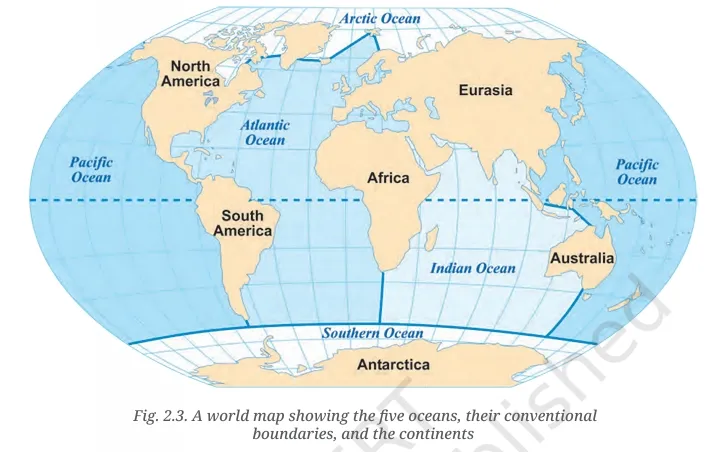
| Ocean | Northern Hemisphere | Southern Hemisphere |
|---|---|---|
| Pacific Ocean | Yes | Yes |
| Atlantic Ocean | Yes | Yes |
| Indian Ocean | Yes | Yes |
| Southern Ocean | No | Yes |
| Arctic Ocean | Yes | No |
LET’S EXPLORE (p.36)
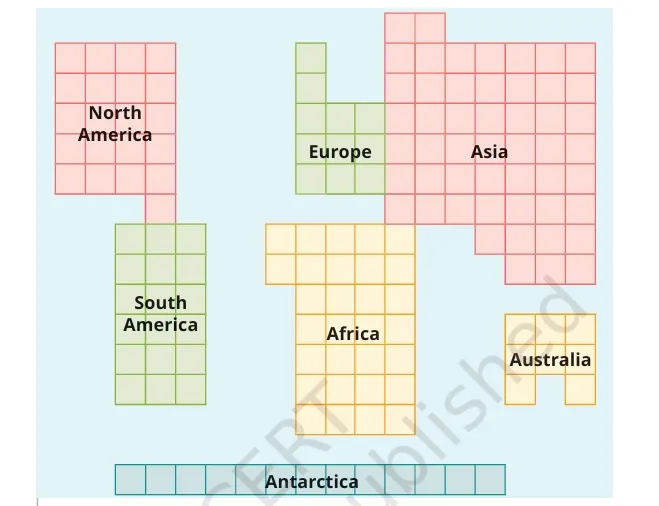
Counting the numbers of squares, name the largest continent and the smallest.
The largest continent is Asia. The smallest is Australia.
Which one is larger — North America or South America? Africa or North America? Antarctica or Australia?
North America is larger than South America.
Africa is larger than North America.
Antarctica is larger than Australia.
Re-colour the diagram by having a single colour for Europe and Asia and rename the result as ‘Eurasia’. Compare its size with South America’s.
Eurasia is much larger than South America.
Write down the list of continents from the smallest to the largest.
Australia, Europe, Antarctica, South America, North America, Africa, Asia.
THINK ABOUT IT
If there is such abundance of water on the planet, why is there so much talk of ‘water scarcity’ or a ‘water crisis’?
Most of the Earth’s water is salty and not fit for drinking or farming. Freshwater is very limited and unevenly distributed, leading to water scarcity in many areas.
What ways of saving water are you aware of? Which ones have you seen practised at home, at your school, and in your village, town or city?
Ways to save water: fixing leaks, using buckets instead of showers, rainwater harvesting, reusing water for gardening, turning off taps when not needed. At home and school, I have seen people use water carefully and install rainwater harvesting systems.
1. Explain the following terms:
(a) Continent
A large continuous landmass on Earth.
(b) Ocean
A large body of saltwater that covers much of Earth’s surface.
(c) Island
A piece of land surrounded by water on all sides.
2. Let us draw
(Students should try drawing the continents freehand and colour them. Then compare with the map in the chapter.)
3. Let us do
(Students should label the continents and oceans on the provided outline map.)
4. Solve this crossword
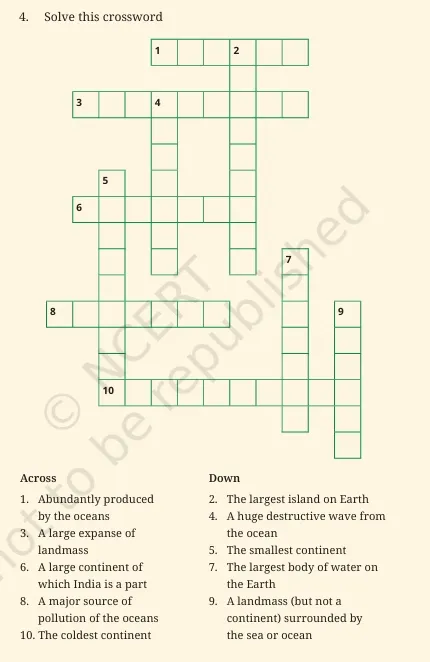
Across
-
Oxygen
-
Continent
-
Asia
-
Plastic
-
Antarctica
Down
2. Greenland
4. Tsunami
5. Australia
7. Pacific
9. Island
Read More: Facts About the Earth Everyone Should Know
Detailed Exploration of Oceans and Continents
The Earth is a unique planet, often referred to as the "Blue Planet" because about 71% of its surface is covered with water, while only 29% consists of land. This chapter explores these two major components: the continents (large landmasses) and the oceans (huge water bodies).
Understanding the Seven Continents
There are seven main continents on Earth, and they are all separated by big bodies of water. They are:
-
Asia: This is the biggest continent; it makes up nearly a third of the Earth's land area. It is in the eastern half of the world. The Tropic of Cancer runs through this continent, while the Ural Mountains separate it from Europe to the west.
-
Africa: The Equator, the Tropic of Cancer, and the Tropic of Capricorn all go through it, which makes it special. A lot of Africa is in the Northern Hemisphere. The Nile is the longest river in the world, and the Sahara is the hottest desert.
-
North America: The Isthmus of Panama, a very narrow strip of land, connects it to South America. The whole continent is in the Northern and Western Hemispheres.
-
South America: It is mostly in the Southern Hemisphere. It has the Andes, which is the longest mountain range in the world, and the Amazon, which is the biggest river in the world.
-
Antarctica: It is a big continent that is located near the South Pole. There are no permanent human settlements there, and it is always covered in massive ice sheets. Maitri and Dakshin Gangotri are research sites in India.
-
Europe: It is to the west of Asia and is much smaller than Asia. It is surrounded by sea on three sides and the Arctic Circle runs across it.
-
Australia: It is the smallest continent that is completely in the Southern Hemisphere. People sometimes call it an "Island Continent" because it is surrounded by oceans and seas on all sides.
The Five Major Oceans
The waters in the oceans are continually moving, and they are all connected. Waves, tides, and ocean currents are the three basic ways that ocean water moves. The five biggest oceans, in order of size, are:
-
The Pacific Ocean: It is the biggest ocean and covers more than a third of the Earth. It looks like a circle. This is where the Mariana Trench, the deepest portion of the Earth, is.
-
The Atlantic Ocean: It is the second largest ocean and is formed like a "S." On the west side, it is next to North and South America, while on the east side, it is next to Europe and Africa. Its very jagged shoreline makes it a great place for natural harbours.
-
The Indian Ocean: It is the only ocean that is named after a country (India). The ocean is almost in the shape of a triangle.
-
The Southern Ocean: It goes around Antarctica and north to 60 degrees south latitude.
-
The Arctic Ocean: It is in the Arctic Circle and surrounds the North Pole. There is a thin, shallow stretch of water called the Berring Strait that connects it to the Pacific Ocean.
The Major Domains of Earth
To understand class 6 social science chapter 2 question answer, one must understand the four domains:
-
Lithosphere: The Earth's solid part, which is land.
-
Atmosphere: The layers of gas that surround the Earth.
-
Hydrosphere: The hydrosphere is made up of all the different forms of water, such as ice, water, and water vapour.
-
Biosphere: The biosphere is the small area where land, water, and air all come together. It is home to all living things.
Also read: NCERT Solutions for Class 6 Social Science Chapter 1
How CuriousJr Online Tuition Classes Enhance Student Learning
CuriousJr’s online tuition classes are carefully planned for students from Class 3 to Class 8. These classes focus on building clear subject understanding and boosting students’ confidence in managing their regular school studies.
Key highlights of CuriousJr classes include:
-
Daily interactive sessions that keep learners actively involved and make concepts simple, clear, and easy to remember.
-
Comprehensive subject coverage of Maths, Science, English, and Social Studies, fully aligned with the latest school syllabus.
-
Regular assessments and detailed feedback to monitor progress and support steady academic improvement.
-
Personalised mentor support, where teachers guide students based on their individual strengths and help overcome learning gaps effectively.
|
Related Articles |





Class 6 Social Science Chapter 2 FAQs
What is the lowest point in the Pacific Ocean?
Which continent is sometimes called the "Island Continent"?
Is it possible for me to sign up for Physics Wallah classes for 6th grade geography?
What ocean has a "S" shape?
What is the name of the longest mountain range in the world and where is it?

Get Free Counselling Today
and Clear up all your Doubts
 Live & recorded classes available at easeDashboard for progress trackingLakhs of practice questions