What Is Word Order?
 Amit Lingwal20 Jan, 2026
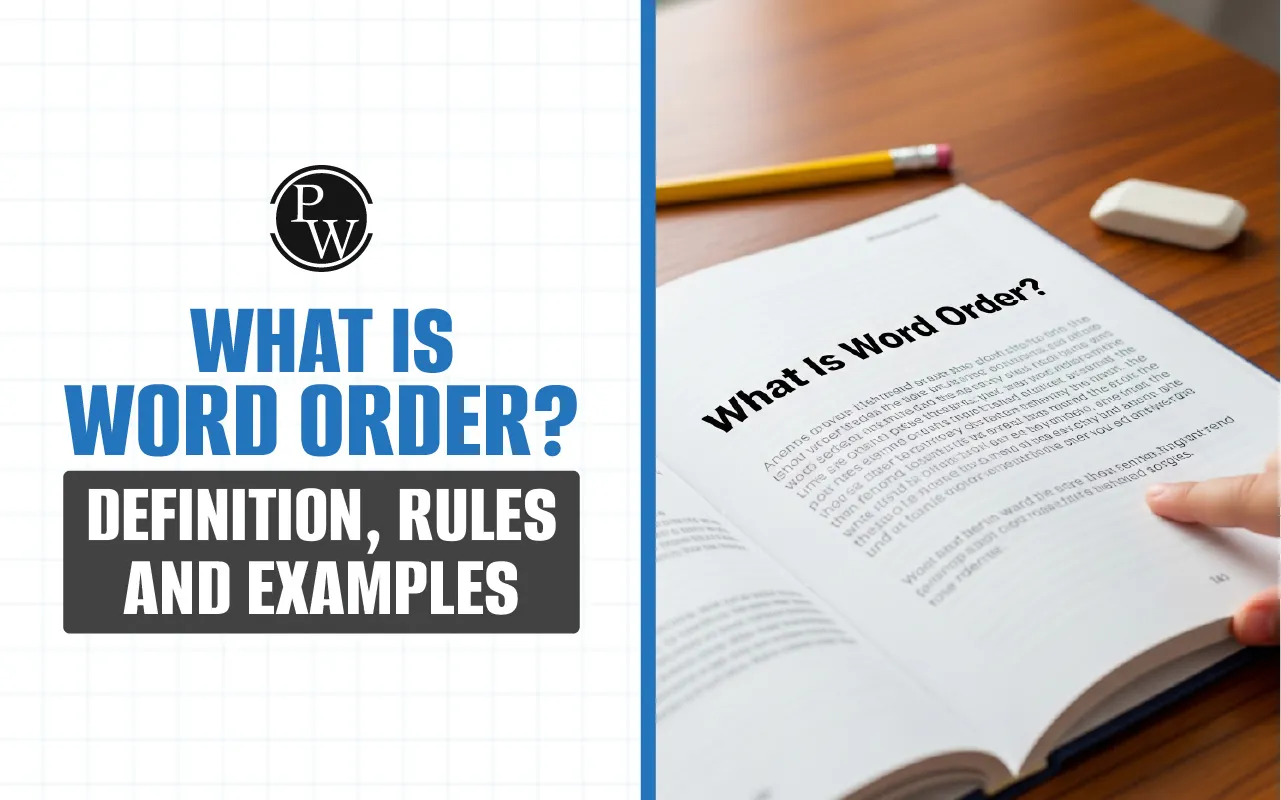
Word Order is the way of arranging words in a sentence so that it gives a meaning. In English, the order of words is very important. If the words are not in the right order, the sentence can sound confusing or even wrong. For example, saying “Dog runs fast” is not correct, but “The dog runs fast” is correct because the word order is right.
Learning word order in English helps us speak and write clearly. It also improves reading because the right word order in sentences makes them easy to understand. After learning the rules of word order in sentences, children can make their own sentences in a correct way. So, to learn what word order is and the basic rules with examples, keep reading.
What is Word Order?
One common question among the children is, "What is word order?" Word Order means the way words are arranged in a sentence so that it gives the correct meaning. While writing in English, it becomes very important to place words in a proper sequence to make sense.
So, word order is the order in which you see the words arranged in a sentence. This order helps understand who is doing the action, what the action is, and what the action is being done to. That is why learning the right word order in English is very important for speaking and writing clearly and correctly.
Read More: Reported Speech
Rules for Applying Word Order in Sentences
Word order in sentences follows some basic rules. If we use these rules, our sentences will be easy to read and correct. Let's learn about the rules for applying word order in sentences with simple word order examples.
Rule 1: Subject + Predicate
In most sentences, the subject, which is the doer, comes first, and the predicate, which is the action or what is said about the subject, comes after. For example:
-
Riya / plays football.
-
The dog / is barking.
Rule 2: Negative Sentences Word Order
When we write negative sentences in the right word order, the word “not” generally comes after the helping verb. For example:
-
She is not going to school today.
-
They do not like ice cream.
Rule 3: Interrogative Sentences Word Order
In questions, the verb generally comes before the subject. This is a common word order in sentences that ask something. For example:
-
Are you ready for the test?
-
Do they know the answer?
Rule 4: Sentences with Complement Word Order
Some sentences need extra words to complete their meaning. These are called complements. For example:
-
The cake is tasty. (subject complement)
-
They made me happy. (object complement)
Rule 5: Adjunct Sentences Word Order
Adjuncts are extra words like adverbs or phrases that tell us more about when, where, or how something happens. For example:
-
We will meet tomorrow.
-
He sang loudly in the hall.
Rule 6: Indirect Object Sentences Word Order
If a sentence has two objects (direct and indirect), the indirect object generally comes first in the word order. For example:
-
The teacher gave us homework.
-
My father bought me a new pen.
Rule 7: Adjectives Order in Sentences
When we use many adjectives together, they should follow a fixed order. Here is the adjectives order: opinion - size - age - color - material.
-
I saw a beautiful small red bag.
-
She has a big old wooden chair.
Rule 8: Word Order With Multiple Adverbs
When a sentence has many adverbs, their word order depends on what they describe: manner → place → time. For example:
-
He ran quickly to the park yesterday.
-
They always eat breakfast at 8 a.m.
Read more: How to Improve English Speaking Skills at Home
Word Order Examples
In English, the place of each word in a sentence plays an important role. By changing the word order, the meaning of the sentence can also change. Here are some word order examples that explain how words should be arranged in a sentence to convey proper meaning.
-
Anita reads a storybook.
Anita is the subject, reads is the verb, and a storybook is the object. -
The stars shine at night.
The stars are the subject, shine is the verb, and at night shows the time. -
He is not sleeping.
Here, "not" comes after the helping verb to make it negative. -
Are they coming to the party?
In this question, the verb "are" comes before the subject "they." -
The box is heavy.
This has a subject (the box) and a complement (heavy). -
My grandfather told me a story.
This sentence has an indirect object (me) and a direct object (a story). -
She wore a lovely long blue dress.
The adjectives lovely, long, and blue are in the correct order before the noun dress. -
We are going to the park today.
Here today shows the time, added at the end. -
The child sang sweetly on the stage yesterday.
The adverbs express manner (sweetly), place (on the stage), and time (yesterday) in the right order.
Read More: List of Tricky Words in english
Solved Word Order Practice Questions
Test your understanding of word order by arranging the jumbled words into correct sentences. Remember to follow the word order rules we have learned before.
-
park/the/dog/playing/is/in
-
read/loves/bedtime/books/she/at
-
fast/very/train/the/moving/is
-
birthday/gift/a/me/my/friend/gave
-
cricket/every/Sunday/boys/the/play
-
question/answer/you/can/the
-
yesterday/movie/went/we/to/a/see
Answers:
-
The dog is playing in the park.
-
She loves to read books at bedtime.
-
The train is moving very fast.
-
My friend gave me a birthday gift.
-
The boys play cricket every Sunday.
-
Can you answer the question?
-
We went to see a movie yesterday.
Why Learning Word Order in English Is Important for Kids?
Word order helps in writing or speaking clear and meaningful sentences. Here's why learning word order in English is important:
-
Helps With Communication: Learning word order helps you share your thoughts in the right way and also understand what others say without any confusion.
-
Builds Strong Reading and Writing: When you know how to place words correctly, your reading becomes clear and your writing gets better.
-
Helps With Speaking Fluently: Using the right word order makes your English sound smooth and natural, just like the way native speakers talk.
-
Good Exam Results: English tests generally check grammar and sentence order. Knowing word order well can help you score better marks.
-
Important for Competitive Exams: Many competitive exams check grammar and sentence order. If you know word order well, you can answer questions quickly and correctly.
Also Read: Phrasal Verbs
Tips to Teach Word Order in English To Your Child
Teaching word order to your child can be fun and easy if you use simple activities and daily conversations that make learning simple and enjoyable. With daily practice, your child will start using the correct word order in sentences. Here are some tips for you:
1. Start with Easy Sentences
Start with introducing your child to the basic sentence pattern, S-V-O (Subject + Verb + Object). Teach them using examples, such as “The boy kicks the ball.” Here, the boy is the subject, the kick is the action, and the ball is the object.
2. Use Cards or Toys
Children learn best in a playful way. You can write words on cards or use your child’s toys to make sentences. For example, take a toy cat, a word card that says “runs,” and a toy ball together to form “The cat runs to the ball.” This makes learning playful and practical.
3. Play Sentence Games
Children love games. So you can use games and write down jumbled words on small pieces of paper and ask your child to arrange them into a correct sentence. Start with simple two- or three-word sentences. This improves their sentence-building skills.
4. Make Simple, Funny Sentences
Encourage your child to create funny sentences while keeping the word order correct. For example, “The frog eats the cake.” Even though the sentence sounds silly, it gives children confidence in arranging words properly.
5. Practice in Daily Talk
The best way to teach word order is to practice it in everyday conversations with children. If your child makes a mistake, don’t scold them. Instead, repeat the same sentence back in the correct way.
Boost Your Child's Foundational English with CuriousJr
Many children understand English well but face problems when it comes to speaking or writing it correctly. Weak grammar, limited vocabulary, and hesitation while speaking can affect their confidence and school performance.
CuriousJr’s Online English Learning Classes are made to make foundational English simple and fun for kids. The classes slowly build skills in grammar, reading, writing, and speaking so that your child feels confident. Here’s what CuriousJr's online English classes offer:
-
Live interactive sessions with teachers for regular practice.
-
Interesting grammar lessons that make sentence-building easy.
-
Vocabulary and pronunciation practice to speak clearly.
-
Fun games, creative writing, and speaking activities to enjoy learning.
-
Regular updates for parents to track progress.
Book a demo class today and see how CuriousJr can support your child in becoming more fluent and confident in English.