Position Words - Definition, Importance, Examples
 Nikita Aggarwal14 Apr, 2026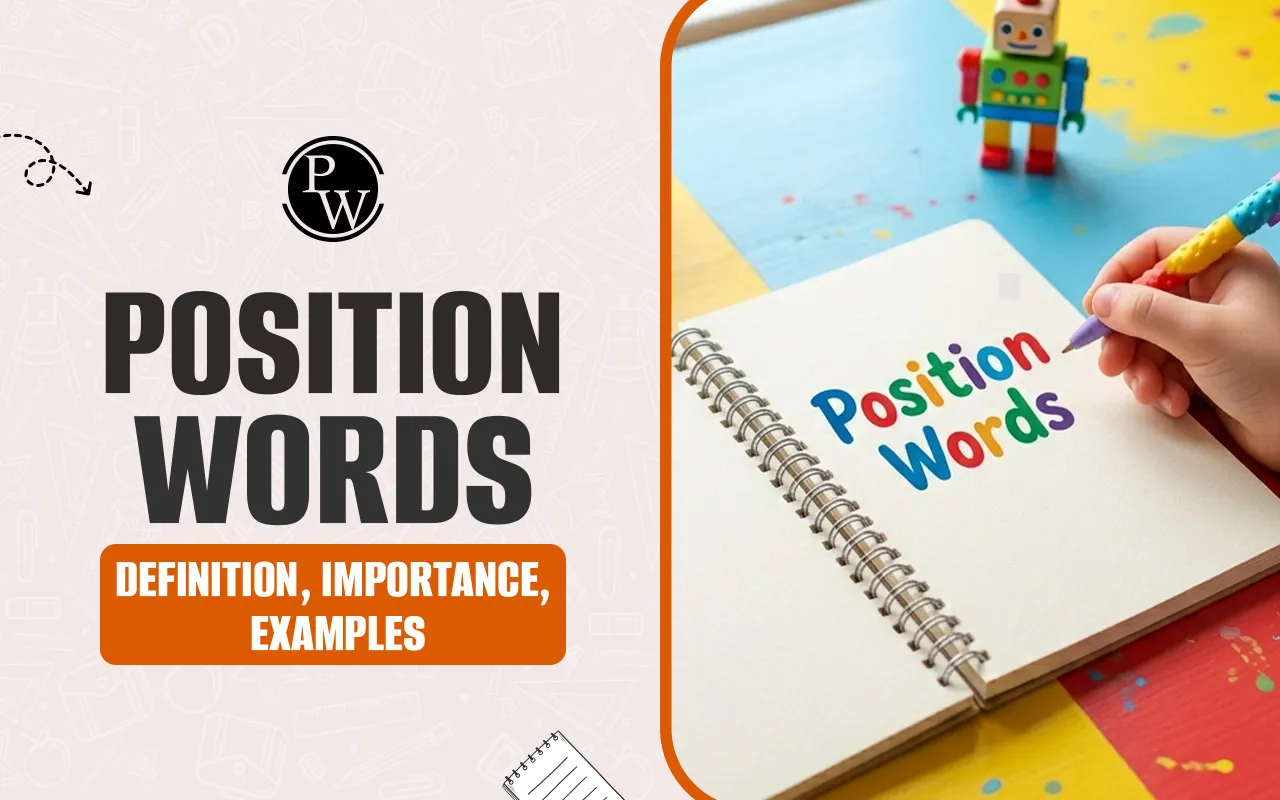
What are Position Words?
Position Words Definition is simple - Position words are used to describe where something is. They help us understand the location of a person, place, or thing in relation to something else. These words connect nouns to the rest of the sentence and make descriptions clearer.
While they are often short—like "in", "at", or "by"—their impact on the meaning of a sentence is massive. Changing a single position word can completely change the situation. For instance, "the bird is in the box" is very different from "the bird is on the box". One bird is trapped, while the other is just resting!
When we use a position word, we are usually comparing two things. For example, in the phrase "The book is at the table." The word "at" tells us about the relationship between the book and the table. Without these markers, sentences would feel incomplete and lose their physical context.
Key characteristics include the following:
-
They usually appear before a noun.
-
They answer the question, "Where?"
-
They create a mental picture of a physical space.
Importance of Position Words
Position words are important because they help us understand where people, places, and things are. They make communication clearer and help us describe locations correctly.
Here are a few reasons why they are important:
-
They help in following instructions: Position words make it easier to understand where something should go while building, arranging, or finding things.
-
They improve communication: They help us describe exact locations more clearly instead of using vague words.
-
They support safety: Words like near, far, above, and below help us notice where things are around us.
-
They are useful in school: Subjects like geography and maths often use location-based terms, so position words are helpful in learning too.
Position Words List
To become comfortable with these terms, it helps to see them grouped by how they describe space. Here is a list of common position words in English that people use daily.
|
Type of Position |
Examples |
|
Vertical |
Above, Below, Over, Under, On top of |
|
Horizontal |
Beside, Next to, Between, Among, Aside |
|
Directional |
Inside, Outside, Into, Out of, Through |
|
Proximity |
Near, Far, Close to, Against |
|
Ordering |
In front of, Behind, Opposite |
Position Words in Daily Life
We use position words in many everyday situations. They help us explain where something is in a simple and clear way.
-
At home: We may say the keys are on the table, the shoes are under the bed, or the bottle is inside the fridge.
-
At school: Students may stand in front of the line, sit behind a friend, or keep their books inside the bag.
-
While giving directions: People often say the shop is next to the bank or the park is behind the building.
-
In daily conversations: These words make it easier to describe the place of a person, object, or animal clearly.
-
For better understanding: Real-life examples help children connect position words with things they see around them every day.
This is why position words are useful not just in grammar, but also in daily life.
Read More - Daily Use English Words with Meaning and Example
Position Words Examples
Here are some position words examples:
Behind and In Front Of
These terms describe where something is on a straight line relative to the observer.
-
The sun disappeared behind the clouds.
-
The garden is in front of the house.
Above and Below
These are used when something is at a higher or lower level than something else.
-
The shelf is above the desk.
-
The recycling bin is below the sink.
On and Under
These usually involve physical contact or being directly beneath a surface.
-
The laptop is on the rug.
-
The shoes are tucked under the bed.
Between and Beside
These describe items that are next to each other or in the middle of two points.
-
The park is between the library and the shop.
-
Sit beside me during the film.
Read More - 7 Letter Words in English - Usage with Examples
How to Use Position Words in English?
Using position words correctly is about understanding where something is in relation to other things. To choose the word, follow this simple guide:
-
Identify the Target: What object are you trying to locate? (e.g., a ball)
-
Identify the Landmark: What is the ball near? (e.g., a box)
-
Determine the Relationship: Is it touching the top? Is it inside? Is it hidden?
-
Pick the word: if it is inside, use "in". If it is to the side, use "next to".
-
Be Specific: Instead of saying "it is near the house", say "it is behind the garage" to be more helpful.
-
Check for Clarity: Read your sentence back. Does it create a clear picture?
-
Watch the Pairings: Some words like "in front" always need the word "of" to make sense.
Practice with Position Words for Kids
Fill in the blanks with the correct position word:
-
The pencil is ___ the notebook.
-
The ball rolled ___ the chair.
-
The cat is sitting ___ the sofa.
-
The shoes are ___ the bed.
-
The clock hangs ___ the door.
Answers:
-
on
-
under / behind
-
on
-
under
-
above
Build Your Child’s Confidence in Speaking English with CuriousJr
Does your child hesitate to speak in English or struggle to form correct sentences? This can impact their confidence, participation in class, and overall communication skills. CuriousJr’s online English classes are designed to make learning simple, engaging, and effective.
The program focuses on essential grammar, correct pronunciation, vocabulary building, and basic writing skills. Through live interactive sessions, children get regular speaking practice with experienced mentors. Fun activities like games, storytelling, and writing exercises make learning enjoyable and interesting. Parents also receive regular updates to monitor their child’s progress.
With structured levels suited to different learning speeds, CuriousJr helps children improve steadily while building a strong foundation in English. Book a demo class today.