
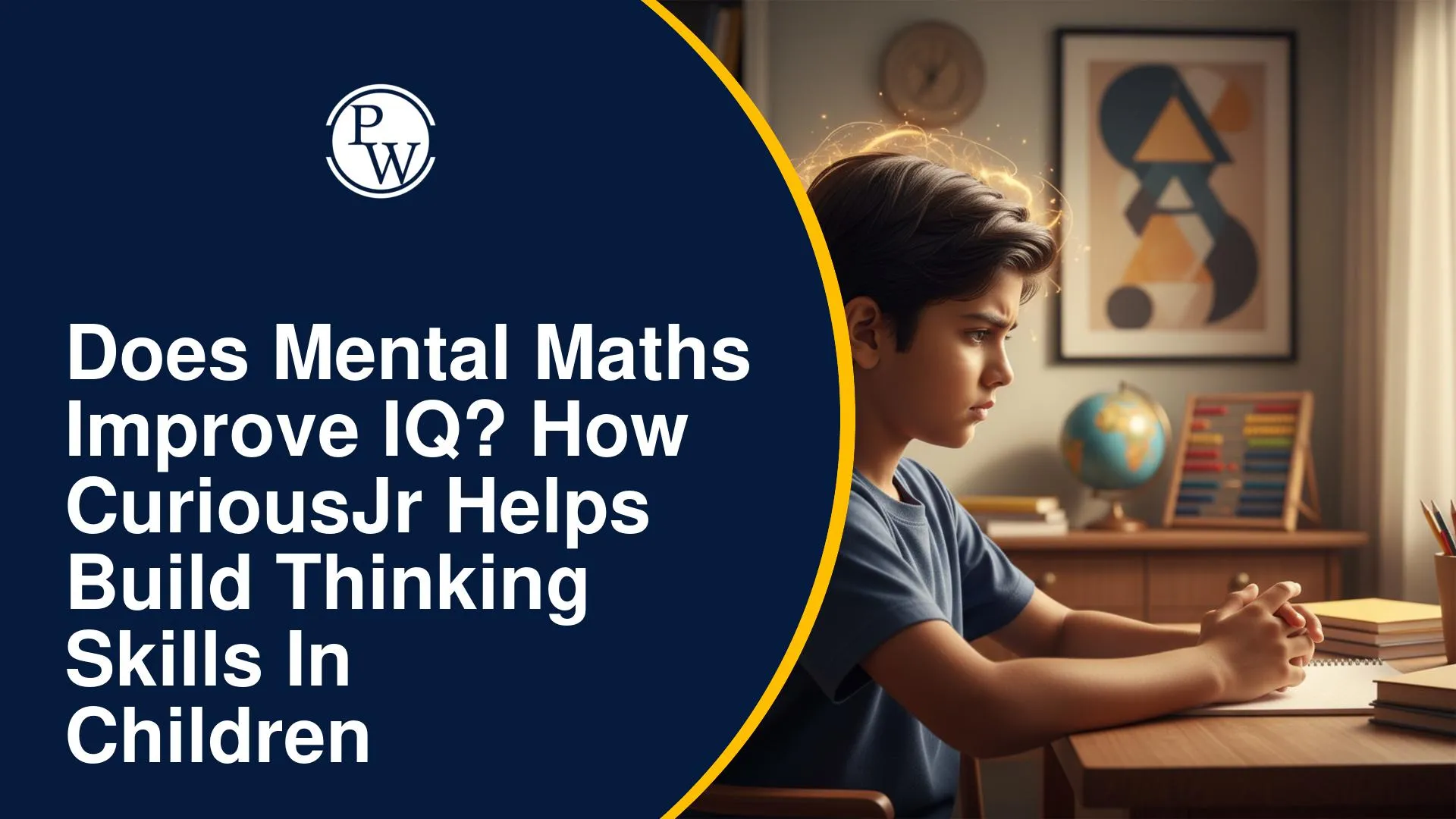
Does Mental Maths Improve IQ? How CuriousJr Helps Build Thinking Skills in Children
 Mishika Gupta10 Aug, 2026
Many parents wonder whether learning Mental Maths can directly increase their child's IQ. While Mental Maths alone does not determine or guarantee a higher IQ score, it can support the development of important cognitive abilities that contribute to better learning. Skills such as logical reasoning, concentration, memory, problem-solving, and numerical confidence improve when children regularly practise mental calculations.
The CuriousJr Mental Maths programme focuses on building these essential skills through interactive classes, engaging activities, guided practice, and continuous support. By strengthening mathematical thinking and learning habits, children can become more confident in solving problems and applying concepts in school and competitive exams.
How Does Mental Maths Support Brain Development?
Mental Maths involves more than calculating numbers quickly. Children need to process information, choose appropriate methods, and arrive at answers without always relying on written calculations.
Regular practice can help develop:
|
Skill |
How Mental Maths Helps |
|
Logical Reasoning |
Helps children identify patterns and relationships between numbers. |
|
Memory |
Encourages recall of numbers, methods, and mathematical concepts. |
|
Concentration |
Requires children to stay focused while processing calculations. |
|
Problem-Solving |
Encourages children to find efficient ways to solve questions. |
|
Numerical Confidence |
Reduces hesitation and builds comfort with numbers. |
These skills can support learning across Maths and other subjects that require attention, reasoning, and decision-making.
How Does Mental Maths Improve Thinking and Decision-Making?
When children regularly perform calculations mentally, they learn to process numbers and information more efficiently. They begin recognising familiar patterns, making connections between concepts, and selecting suitable methods more quickly.
Mental Maths practice can help children:
-
Recognise number patterns faster.
-
Make connections between numbers and concepts.
-
Choose efficient calculation methods.
-
Make quicker decisions while solving problems.
-
Approach unfamiliar questions with greater confidence.
The goal is not simply to make children calculate faster, but to help them become more flexible and confident thinkers.
Why Is Regular Practice Important?
Cognitive skills develop through consistent use. Short, regular Mental Maths sessions give children repeated opportunities to recall concepts, solve calculations, recognise patterns, and correct mistakes.
Practice can gradually help children improve:
-
Calculation speed and accuracy
-
Concentration
-
Analytical thinking
-
Pattern recognition
-
Problem-solving
-
Decision-making
Consistent practice is generally more useful than occasional long sessions because children get the opportunity to build these skills gradually.
Read More: Fun Math Activities for Kids to Develop Calculation Speed
How Does Mental Maths Support School Mathematics?
Mental Maths complements classroom learning by helping children become more comfortable with basic calculations. When calculations become easier, children can focus more attention on understanding the question and applying the right mathematical concept.
It can help children:
-
Complete calculations more efficiently.
-
Reduce avoidable calculation errors.
-
Manage time better during tests.
-
Respond more quickly to numerical questions.
-
Feel less hesitant when working with Maths.
This can be particularly useful in competitive exams, where both speed and accuracy are often important.
Read more: Why Mental Maths is a Life Skill Every Child Should Learn?
What Makes CuriousJr Mental Maths Learning Effective?
Learning becomes more effective when children receive the right guidance along with regular practice. CuriousJr combines interactive teaching methods with activities that make Mental Maths engaging and easier to understand.
|
Learning Approach |
Benefit for Children |
|
Interactive Classes |
Helps children understand concepts through active participation. |
|
Guided Practice |
Allows children to learn the right methods. |
|
Engaging Activities |
Makes learning enjoyable and encourages regular involvement. |
|
Teacher Support |
Helps children overcome difficulties and improve gradually. |
This approach helps children build strong foundations while developing positive learning habits.
Mental Maths does not directly decide a child's IQ, but it can support the development of important skills such as reasoning, concentration, memory, and problem-solving. With consistent practice, interactive learning, and proper guidance, children can improve their mathematical confidence and develop stronger thinking abilities. CuriousJr Mental Maths classes help children build these skills in an engaging way, supporting their overall academic growth and future learning.







Does Mental Maths Improve IQ? FAQs
Does Mental Maths increase a child's IQ?
How does Mental Maths help in brain development?
What skills can children improve through Mental Maths?
How does CuriousJr Mental Maths support children's learning?






Get Free Counselling Today
and Clear up all your Doubts
 Live & recorded classes available at easeDashboard for progress trackingLakhs of practice questions

