Mental Math Strategies - Tips and Tricks For Students
 Shivam Singh7 Nov, 2025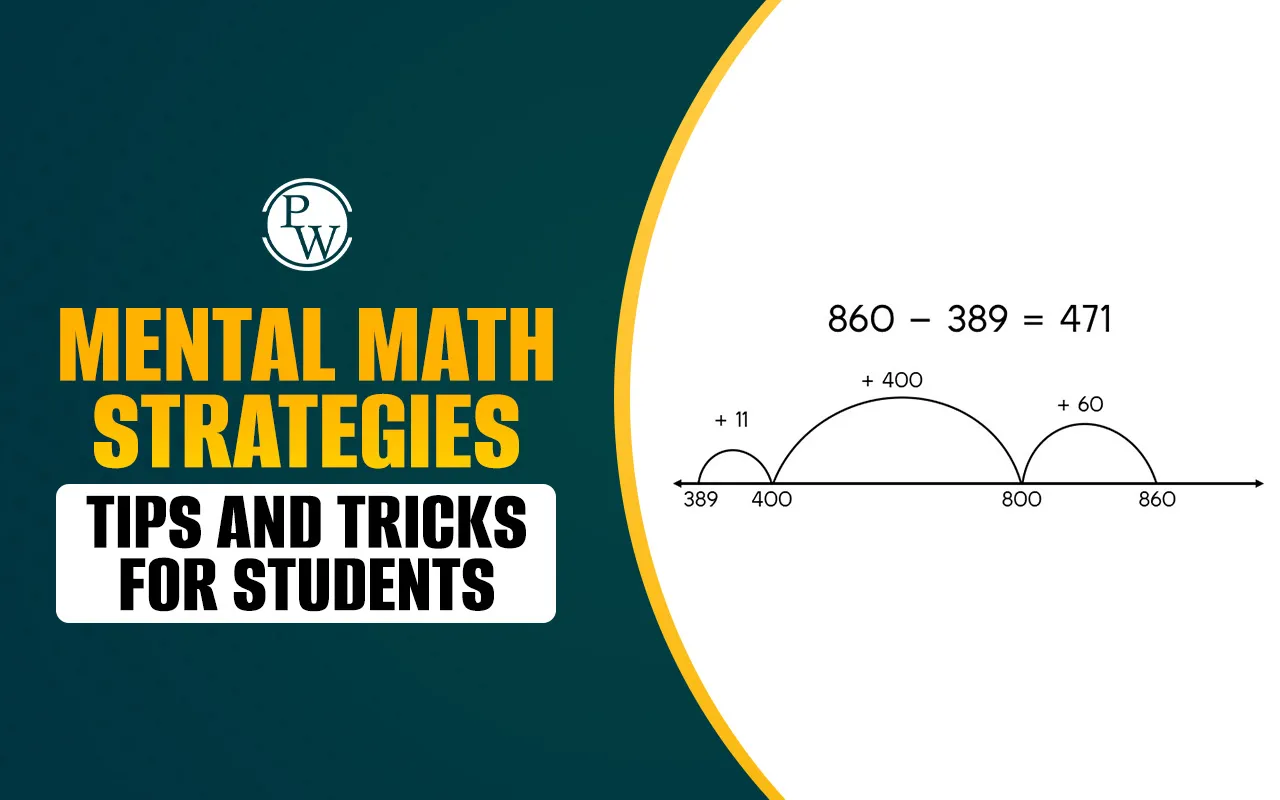
Mental Math Strategies
Mental math is about performing math calculations in the mind, without using physical aids like pen and paper or a calculator. Mental math strategies include some smart techniques based on logic and visualization that approach math problems in a non-conventional way and deduce the solutions immediately. Learning mental math strategies is not just an academic skill; it helps improve focus, build confidence, and enhance thinking and reasoning abilities in young learners.
How Mental Math Strategies Benefit Students?
Mental math strategies enhance skills and confidence in your child to handle math questions and improve their academic performance. Here are some of the significant benefits of mental math:
-
Learning mental math from an early age fosters brain development by approaching problems through smart techniques.
-
Practicing mental math develops a clear understanding of number concepts and relationships.
-
Step-wise techniques help increase the processing speed and improve thinking abilities.
-
Learning interesting calculation tricks makes math more fun and reduces anxiety and fear of math.
-
Applying mental math methods makes students feel independent without depending on external tools.
Read More: Fun Math Activities for Kids to Develop Calculation Speed
Addition Mental Math Strategies
Adding numbers mentally becomes easier and faster when students follow the simple addition mental math strategies as mentioned below:
-
Rounding and Adjusting
Example: 38 + 23 = ?
Rounding off 38 to the nearest ten gives 40.
Add 40 + 23 = 63.
Since you have taken 2 more in 40, deduct it from 63, which gives 63 - 2 = 61.
Therefore, 38 + 23 = 61.
-
Breaking Down Numbers
Example: 75 + 43 = ?
Think of 75 as 70 + 5 and 43 as 40 + 3.
Then add 40 and 70 to get 70 + 40 = 110.
Again, add 5 and 3 to get 5 + 3 = 8
Now, add 110 and 8 to get 110 + 8 = 118
Therefore, 75 + 43 = 118
Mental Math Strategies for Subtraction
Subtraction sums become easier to solve with correct mental math strategies for subtraction, as students can avoid lengthy calculations and quickly get the correct answer. Here are some easy tips for subtraction:
-
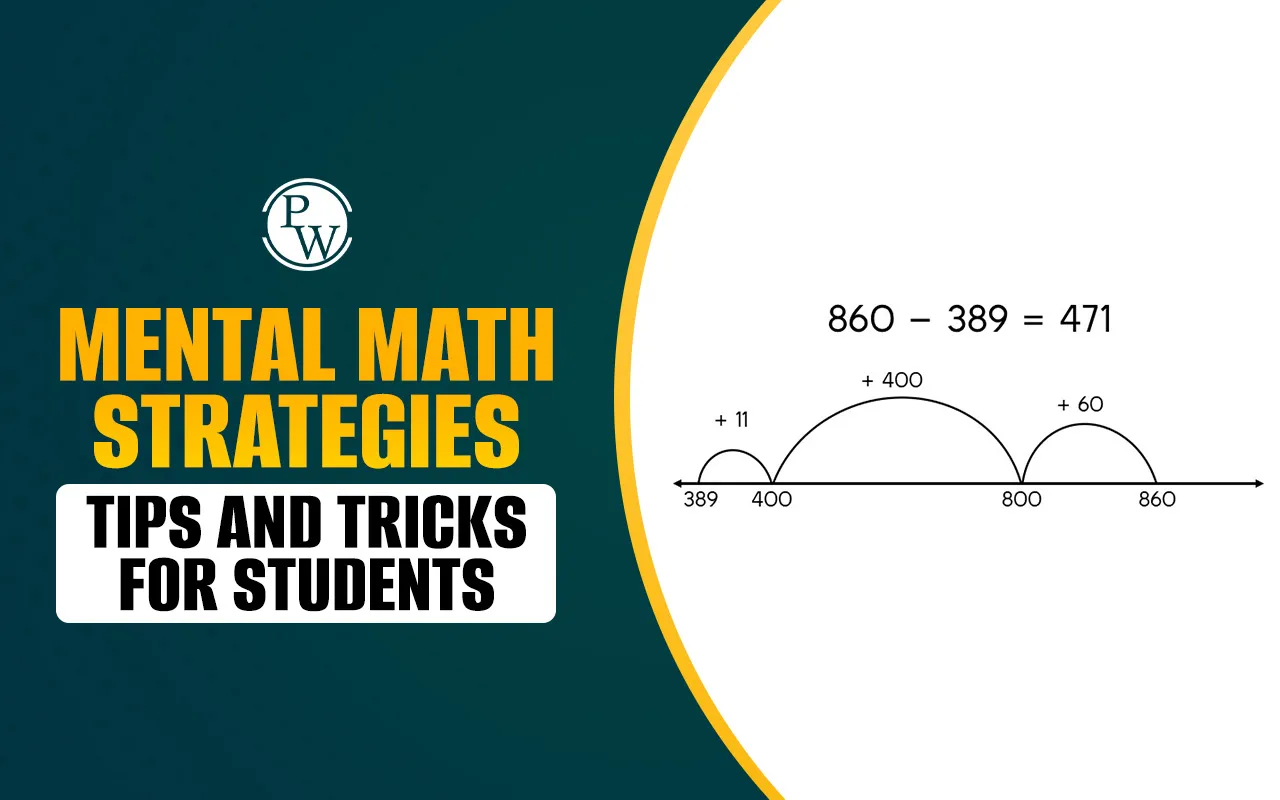
Count Up Instead of Subtracting
Instead of subtracting directly, count up the numbers that are added to the smaller number to get the larger number.
Example: 500 – 378 = ?
Let’s take 378 + 2 = 380, 380 + 20 = 400, 400 + 100 = 500.
By adding these numbers, we get 2 + 20 + 100 = 122.
So, the answer is 122.
-
Round and Adjust
Round numbers to the nearest ten or hundred, then adjust.
Example: 805 – 396 =?
Think: 805 – 400 = 405
Then add 4 which was subtracted extra. So, we get 405 + 4 = 409
So, the answer is 409.
-
Subtract in Parts
Break numbers into parts to make the subtraction easier and faster.
Example: 84 – 37 =?
Let’s consider the above as: (84 – 30) – 7 = 54 – 7 = 47
So, the answer is 47.
Read more: Why Mental Maths is a Life Skill Every Child Should Learn?
Mental Math Multiplication Strategies
Multiplication often takes more time during exams, but the right mental math multiplication strategies can simplify the process, as mentioned below:
-
Break Numbers using Distributive Property
Example: 23 × 8 =?
Consider the given sum as: (20 × 8) + (3 × 8) = 160 + 24 = 184
Multiply by 5, 25, 50, or 100 Using Easy Patterns
Multiply by 5 is equivalent to division by 2, and then multiply by 10.
Example: 42 × 5
= (42/2) × 10 = 21 × 10 = 210
Multiply by 25 means multiplication by 100, and then division by 4.
Example: 56 × 25
= (56 × 100)/4 = 5600/4 = 1400.
-
Use Doubling and Halving
If at least one number is even, halve it and double the other for easier multiplication.
Example: 16 x 15 =?
The half of 16 is 8 and 8 x 15 = 120
Now, you have to double the value, which means 120 x 2 = 240.
Therefore, 16 x 15 = 240.
Using multiples of 10 as base number
Example: 26 x 8 =?
Multiply 8 by 20 to get: 8 x 20 = 160
Then multiply 8 by 6 to get: 8 x 6 = 48
Now, 160 + 48 = 208
Therefore, 26 x 8 = 208.
Read more: What Is the Best Age to Start Teaching Kids Mental Maths?
Mental Math Division Strategies
Division becomes simpler with the mental math division strategies as mentioned below:
-
Break into Smaller Parts
Example: 195 ÷ 13 =?
Think: 13 × 10 = 130 and remainder is: 195 – 130 = 65
Again, 65 ÷ 13 = 5 and the remainder is zero.
So, the answer is: 10 + 5 = 15
-
Divide by 5, 25, 50 Using Patterns
Divide by 5 means multiplying by 2 and then dividing by 10.
Example: 170 ÷ 5 = (170 × 2) ÷ 10 = 340 ÷ 10 = 34
Divide by 25 means multiplying by 4 and then divide by 100.
Example: 450 ÷ 25 = (450 × 4) ÷ 100 = 1800 ÷ 100 = 18.
Mental Math Examples
Application of mental math strategies becomes easier by getting a clear understanding through the mental math examples, as given below:
-
Addition: 332 + 457 =?
Round and adjust:
(330 + 460) + (2 – 3) = 790 – 1 = 789
-
Subtraction: 1000 – 674 =?
Count up and add:
674 + 26 = 700, 700 + 300 = 1000
So, the answer is: 26 + 300 = 326.
-
Multiplication: 36 × 25 =?
Multiplication by 100:
(36 × 100) ÷ 4 = 3600 ÷ 4 = 900
-
Division: 528 ÷ 16 =?
Break into smaller parts:
Here, 16 x 30 = 480 and remainder is 528 – 480 = 48
Again, 48 ÷ 16 = 3 and the remainder is zero.
So, the answer is 30 + 3 = 33
Read More: How to Prepare for Math Olympiads with Mental Maths
Tips to Master Mental Math Strategies
Students can learn mental mathematics strategies through some easy and exciting ways. Here are some practical tips and tricks that can help your child apply smart calculation techniques to excel in school exams and beyond.
-
Practice Daily: Learning mental math requires consistent practice. Practice solving a few mental math exercises daily.
-
Memorize Basic Facts: Learn multiplication tables up to 20 and memorize common squares, fractions, and percentages to make calculations quicker.
-
Visualize Numbers: Visualize numbers on a number line to make calculations quicker.
-
Use Learning Apps: There are many apps designed for mental math practices that use puzzles, sequencing, data handling, memory games, etc.
-
Start Simple: It’s always better to start with simple exercises and gradually move to complex calculations.
Mental math is not just about exams; it strengthens focus, improves logical reasoning, and boosts brainpower. Learning mental mathematics strategies allows students to handle tricky math problems quickly and confidently, giving them an edge. It’s a unique approach to problem-solving that helps effectively in academics and everyday life.
Also Read: 10-Minute Daily Exercises to Improve Mental Maths Skills
Help Your Child Enjoy and Excel in Mental Maths with CuriousJr
Is your child finding maths challenging at school or taking too long to solve problems at home? Many students need extra guidance to understand key concepts, improve speed, and build confidence. CuriousJr’s Mental Maths Classes for students in Classes 3 to 9 make learning maths simple, engaging, and effective.
Why Choose CuriousJr?
-
Live Interactive Classes: Students participate actively, ask questions, and solve problems in real time.
-
Easy-to-Understand Explanations: Lessons follow the school syllabus and are designed to make concepts clear and memorable.
-
Two-Teacher Model: One teacher explains concepts while the other provides individual support, ensuring every child stays on track.
-
Homework Support: Immediate help with homework during class makes study time stress-free and productive.
-
Progress Tracking for Parents: Regular updates keep you informed about your child’s improvements and achievements.
Book a demo class today and discover how CuriousJr can help your child become faster, more accurate, and confident in mental maths!