Contractions in Grammar: Meaning, Rules and Examples
 Shivam Singh16 Oct, 2025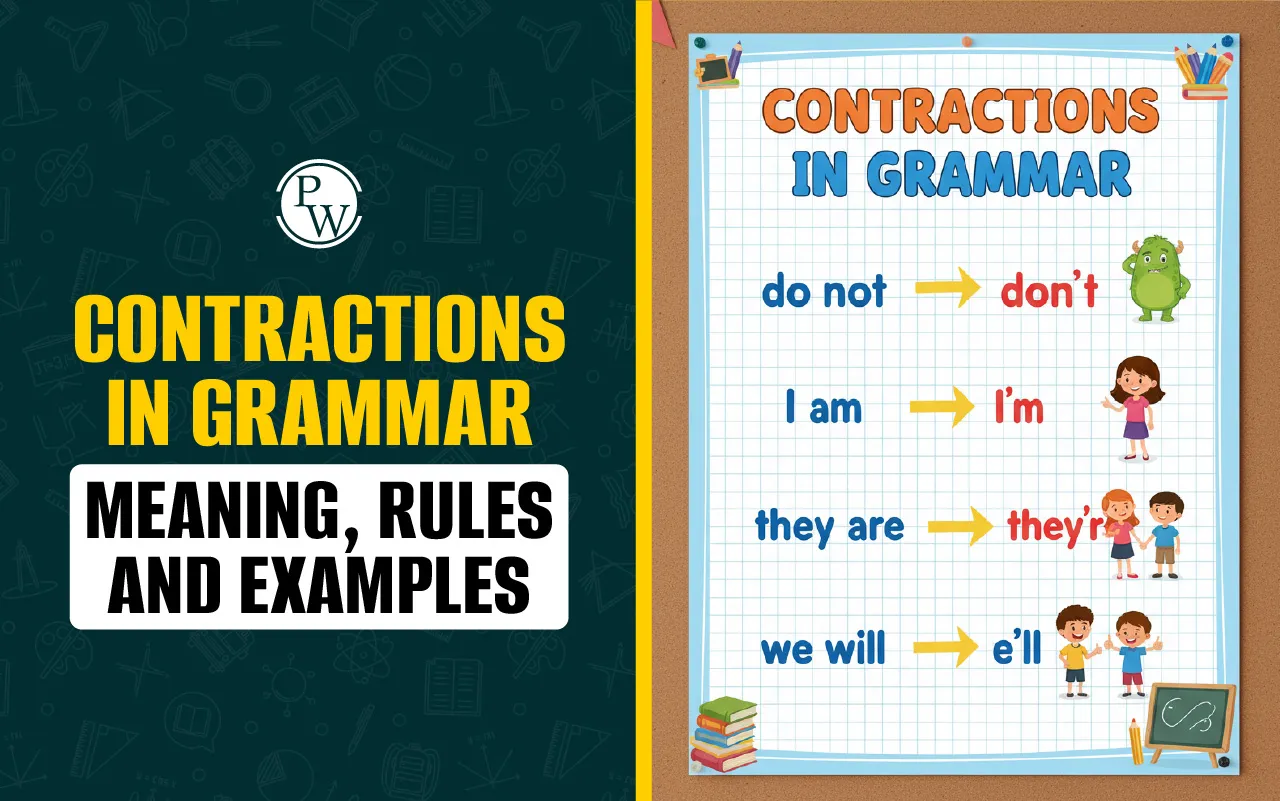
Contractions in English Grammar
Contraction in grammar refers to a shortened version of a word or two, in which some letters have been omitted and an apostrophe inserted in their place. They help to make the sounding of the language more natural and conversational.
Contracts are used in speech and informal writing, and they aid in the smooth flow of sentences. They serve a very useful purpose in enabling the young learners to learn spoken English better and be able to express themselves. Nonetheless, formal writing does not normally involve the use of contractions.
Students can learn more about contractions in English grammar, including types, examples, and more below.
Read More: Mood in English Grammar
What are Contractions in English Grammar?
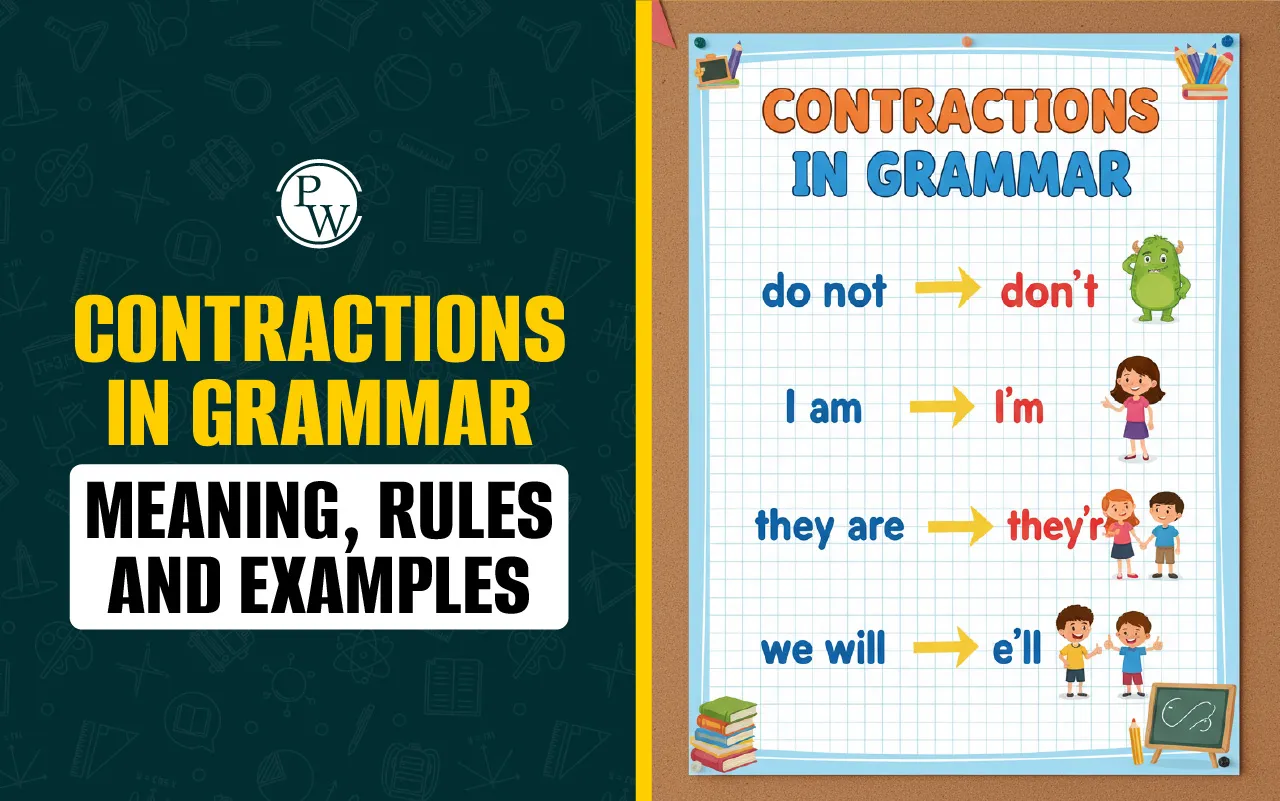
Contractions in English grammar are shortened forms of two words, created by leaving out one or more letters and replacing them with an apostrophe (’). They are applied in verbal English and less formal writing to make the sentences sound more natural and less difficult to pronounce. As an example, do not is replaced by don’t, and I is by I am.
Contractions often combine:
-
Auxiliary verbs (e.g., is → he’s, have → I’ve)
-
Modals (e.g., will → we’ll, would → she’d)
-
Negatives (e.g., cannot → can’t, should not → shouldn’t)
These shortened forms help make language more fluent and conversational. Nevertheless, in formal writing (e.g., an essay or a report), one is not generally allowed to use contractions, unless one is literally quoting a person or writing dialogue.
Types of Contractions in English
In English grammar, contractions are formed by joining two words together and removing some letters, which are replaced by an apostrophe (’). These shortened forms are commonly used in everyday conversation and informal writing to make sentences sound natural and easy to understand. Different types of contractions are based on the kinds of words they combine. Here are the main types:
1. Negative Contractions (Verb + Not)
These combine auxiliary or modal verbs with "not" to show negation.
Examples:
-
do not → don’t
-
is not → isn’t
-
should not → shouldn’t
2. Be Verb Contractions
These use forms of the verb "to be" with pronouns or nouns.
Examples:
-
I am → I’m
-
They are → They’re
3. Have / Has Contractions
These combine have or has with pronouns or question words.
Examples:
-
I have → I’ve
-
She has → She’s
4. Will / Would Contractions
These shorten will or would with pronouns.
Examples:
-
I will → I’ll
-
He would → He’d
5. Informal or Spoken Contractions
Used in casual speech, not usually in formal writing.
Examples:
-
Let us → Let’s
-
Madam → Ma’am
Understanding these types helps learners use contractions correctly in different contexts.
Read More: Gender in Grammar
Contractions in English Grammar With Examples
Contractions in English grammar are especially helpful in everyday English, helping speakers sound more fluent and making sentences feel less formal. You’ll often hear or see them in dialogues, texts, or casual conversations. However, they are usually avoided in formal or academic writing unless quoting someone directly.
Examples of Contractions in Sentences:
-
I’m tired after the game. (I am)
-
She’ll call you soon. (She will)
-
They’ve seen the movie already. (They have)
-
We’re ready to start. (We are)
-
He’d love a sandwich. (He would)
-
It’s getting late. (It is)
-
Don’t be late. (Do not)
-
Can’t we go now? (Cannot)
-
Didn’t she say something? (Did not)
These examples show how contractions shorten common phrases while keeping the meaning clear.
Read More: Common Grammar Mistakes and How to Avoid Them
Contractions vs Possessives
In English grammar, both contractions and possessives use an apostrophe (’), but they serve different purposes. Contractions are used to shorten two words, while possessives show ownership or belonging. Mixing them up is a common mistake, but knowing the difference can help you write more clearly and correctly.
|
Key Differences Between Contractions and Possessives |
||
|
Feature |
Contractions |
Possessives |
|
Purpose |
Join and shorten two words |
Show ownership or possession |
|
Structure |
Pronoun/verb + apostrophe |
Noun + apostrophe |
|
Examples |
She’s, don’t, we’ll |
John’s, teacher’s, cats’ |
|
Common Mistakes |
It’s (it is) vs. Its (belonging to it) |
You’re (you are) vs. Your (belonging to you) |
Also Read: English Grammar Notice Writing Class 7th
Help Your Child Improve English Skills with PW CuriousJr Online Classes
PW CuriousJr offers online English classes designed specifically for junior students to help them improve their reading, writing, speaking, and listening skills. The classes are held in small groups so that each child receives personal attention and support. Lessons are interesting and suited to the child’s current level, making learning easier and more enjoyable.
The courses follow recognized international standards like the Cambridge English Scale and CEFR, ensuring that the skills taught meet global learning levels. Each course is designed to be completed in one day, making it manageable for young learners.
In addition to live classes, PW CuriousJr provides video lessons that review and practice the material covered. These videos help children learn at their own pace and reinforce what they have learned in class, supporting steady progress in English language skills.